

Glory to Devi the Divine Feminine Energy
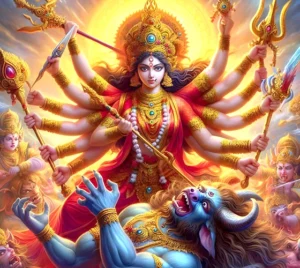
Shrimad Devi Bhagavat Mahapuran and Shree Durga Saptashati are two major scriptures which lay emphasis on the importance of the Devi, the Divine Feminine Energy. The followers of Shakta tradition in Hinduism derive their spiritual inspirations from these books. The Devi Bhagavat presents the goddess in the form of Shakti or energy that creates, sustains and dissolves the universe. Similar thoughts are expressed in the Durga Saptashati. The Durga Saptasati is also known as Devi Mahatmya and Chandi. Being a shorter text than Devi Bhagavat, the Durga Saptasati has wider practical utility for the general Hindu believers. It is an extracted section of Markandeya Puran with additional pieces of praise which help to make it an independent book. Chapters 78 to 90 of the Markandeya Puran which amount to 590 shloks is entitled the Greatness of Devi. Supplementary shloks have been added to bring it to a total of 700 shloks.
The book starts with the Saptashloki Durga. This auspicious text glorifies the Devi who is kind, powerful and generous, and offers refuge to all her devotees. She destroys fears, grants knowledge, health and prosperity, cures diseases, protects from enemies and controls the minds of all creatures.
The Saptashloki is followed by Durga Ashtotarshatam Stotram. It is a collection of 108 names of Durga in verses. These names highlight specific characteristics of the Devi and refer to specific legends. These legends have motivational power and are recounted in various other ancient scriptures.
Subsequently the correct procedure of reciting the Durga Saptashati text is described in the book. To allow the recital of the book to be fully effective and fruitful, certain rituals are to be followed.
Next comes Devyah Kavacham, which eulogises Durga in her numerous forms with varying features. Navadurgas that include Shailputri, Brahmacharini, Chnadraghanta, Kushmanda, Skandmata, Katyayani, Kalratri, Mahagauri and Siddhidatri along with many of her other incarnations are extolled in this section. It is believed that chanting the Kavacham provides divine protection and grants safety from enemies and dangers, whether they are in the form of humans, animals, birds, disease or natural disasters. Hence, devotees who seek protection and safety recite the kavacham text. Navadurgas forms of Durga are the main goddesses worshipped during the Navaratras.
Before the main text starts, other sets of prayers included are Argala Stotram, Kilakam, Vedic Ratrisuktam, Tantrik Ratrisuktam, and Devyatharva Shirsham. Vedic Ratrisuktam is a hymn from the Rigved whereas the Tantrik Ratrisuktam is a prayer sung by Brahma to Bhagavati Nidradevi, the feminine deity of sleep. Devyatharva Shirsham is taken from the Athrvaved and is a prayer offered by gods to Devi.
All of the above-mentioned prayers, mantras and hymns are normally recited before starting the reading of the main text.
The main section of the Durga Saptashati comprises thirteen chapters. Three major legends that demonstrate the greatness of the Devi are narrated in the text. They relate to the destruction of 1) asuras Madhu and Kaitabh, 2) demon Mahishasur, and 3) Shumbh and Nishumbh along with their associates. A summary of the story from the Durga Saptashati is presented below.
Devi Mahamaya – Chapter one relates to the destruction of Madhu and Kaitabh. During the age of an earlier Manu named Svarochish, lived a king named Surath. He was a just king and protected his subjects properly, treating them like his own children. However, he was attacked by powerful enemies and his advisers conspired against him.
The king lost his kingdom and went to a desolate forest. There he saw a hermitage of sage Medha. The sage welcomed him and the king found shelter in his hermitage. The king spent his time roaming around and reminiscing about his previous status of opulence. He often mulled over the potentially appalling condition of his subjects, royal elephants and horses, advisers and family members.
One day the king observed a new exile near the hermitage. He learnt that the new person known as Samadhi was previously a wealthy businessman. His wife, children and relatives had colluded against him, extracted all his riches and banished him from the house. Being rejected by his close family members and relatives, he had retreated to the forest.
He regularly ruminated over his past and worried about the well-being of his family members and relatives, who had expelled him. His mind was deeply engrossed in attachment to them, despite being deprived of wealth and status due to their actions.
Both the king and the businessman were mistreated by their own people, nevertheless they felt affection towards them. They wished to explore the reason that causes one to love those who harmed them. Together, they approached the sage in the hermitage, and the king presented their query to him.
In response to king’s query, the sage Medha stated that all creatures associated with material objects in different ways. In human, this develops into greed with the sense of “mine” that leads to the whirlpool of delusion. The sage further explained that the power of Mahamaya, the goddess of illusion, was the reason for this type of behaviour. Mahamaya, originated from Hari, the lord, when he was immersed in yog and asleep. She confounded the entire universe. Mahamaya forcibly seizes the minds of even those who are learned to thrust them into delusion.
The king further queried about the goddess Mahamaya, including her origin, nature of her work, her power, her temperament and other relevant and related characteristics. In response, the sage stated that she was eternally embodied in everything, however she originated in many different ways. She appears to accomplish the tasks of gods.
Through the legend of Madhu and Kaitabh, the sage illustrates the power of Mahamaya. At the end of a Kalpa, a cosmic aeon, Lord Vishnu was lying asleep on the Sheshnag in the cosmic ocean. Two asuras, known as Madhu and Kaitabh manifested from the wax in Vishu’s ears and prepared to destroy Brahma who was seated on the lotus flower rooted in Vishnu’s navel.
Brahma saw the terrible asuras and noticed that Vishnu was asleep. He sought to awake Yognidra, the sleep deity who resided in Vishnu’s eyes. He praised her with single-minded devotion and chanted a eulogy with intent to awaken Vishnu. Brahma’s prayer to Devi Yoganidra is known as Tantrik Ratrisukta. Following Brahma’s prayer, Yoganidra emerged as Mahamaya from Vishnu’s eyes, nose, arms, heart and chest, and stood aside.
Vishnu awoke and saw the evil-minded Madhu and Kaitabh ready to kill Brahma. Using his arms as weapons, Visnu wrestled with them for an extended period. The asuras were strong and intoxicated but were confounded by Mahamaya. In their confusion, they told Vishnu, “We are pleased with your bravery, seek a boon from us”. Vishnu replied, “If you are satisfied then let you be destroyed by me”.
The asuras looked around and saw water everywhere. They consented to Vishnu’s suggestion with a condition that they should be killed on a dry place. Vishnu agreed to their proposal and placed them on his thighs and sliced their heads off with his Chakra. Thus, the goddess had arisen after being invoked by Brahma to help protect him.
Devi Durga – Chapters 2 to 4 relate to the emergence of a divine female from the union of masses of energy from gods. Sage Medha continues telling the glory of the goddess through the legend of her victory over the demon Mahishasur and his fighters.
In an earlier age, there was an ongoing war between gods and asuras that lasted for hundreds of years. Mahishasur was the leader of asuras and Indra led the deities. Asuras were strong and defeated Indra in the battle. Mahishasur usurped the heavenly kingdom and became ruler of the universe. All the deities headed by Brahma went to the place where Shiv and Vishnu were reposed, and told them about Mahishasur’s misdeeds including how he had seized the positions of deities. The deities requested Shiv and Vishnu find a way to eliminate Mahishasur.
After listening to their stories, both Shiv and Vishnu became filled with anger. At that moment, a great mass of energy arose from the bodies of Vishnu, Shiv, Brahma and other deities, and merged together, forming a blazing mountain. It pervaded the universe and transformed into the body of a woman. The energy of each god formed a specific body part.
The deities rejoiced upon witnessing the goddess formed from their energy. Each of them bestowed a powerful weapon to her. They also gave her decorative jewels, protective body armours, and a lion as her mount. Infused with divine powers, wearing jewels, holding armours and mounted on a lion, she manifested as a powerful goddess and became famed as Durga.
Honoured by all the gods, the goddess Durga roared and challenged the asuras, causing turmoil among them. Their king Mahishasur sent his commanders to overcome her and also joined the battle himself. They attacked the goddess but she overwhelmed them and initially destroyed a large number of asura soldiers in the battle.
The combat with the Mahishasur’s army continued. In the field, the goddess killed all his commanders, along with their armies and in the end, she conquered Mahishasur. His death delighted all the deities. Gandharvas sang and apsaras danced in honour of the goddess’s victory.
Following Mahishasur’s demise, Indra with all the deities visited the goddess and praised her with a powerful hymn. Pleased with their prayer, the goddess offered them a blessing. The deities asked the goddess to fulfill the wishes of all those who praise her with their hymn and be available to manifest and help them when they need her help. The goddess consented to their request and vanished from the scene.
Devi Kali and Others – Chapters 5 to 10 relate to the stories of asuras, Shumbh and Nishumbh. Intoxicated by their strength, they had appropriated the kingdom of heaven. When all the gods were routed and deprived of their rights, they remembered Jagadamba, the mother of the world, who had promised to help when needed. They went to the Himalayas and praised goddess Vishnumaya with a hymn known as Tantrik Devisuktam.
While the deities were chanting the hymn, goddess Parvati arrived there to bathe in the River Jahnavi. She enquired about the reason for their praying. She realised that they had been defeated by the demons Shumbh and Nishumbh and were seeking her support.
Goddesses Shiva, Ambika, Kaushiki and Kalika emerged from Parvati’s embodied form.
Ambika assumed a supremely radiant and extremely beautiful form. When Shumbh heard about Ambika’s beauty, he became infatuated. Initially, he tried to convince her to become his queen. When she declined, he sent his commanders to bring her forcefully to him.
A fight broke out between demonic forces and the divine Devi. She transformed herself in many female forms and eventually killed demon fighters, including Dhumralochan, Chand, Mund, Raktabeej, Shumbh and Nishumbh.
In the battle, the Devi fought in the form of Ambika, Chandika, Kali, and consecutively emerged in various other images known as Ishana, Katyayani, Maheshwari, Brahmani, Vaishnavi, Aindri, Narshimhi, Shivduti and many others.
In chapter 11, the deities collectively recited hymns in praise of the goddess. She became pleased and agreed to their request to remove any obstacle that they encountered and to destroy their enemies. The effects of reciting the Durga Saptashati are extolled in Chapter12.
In the concluding chapter 13, sage Markandeya narrates that after hearing this story, king Surath and businessman Samadhi bowed down to sage Medha, and went to perform austerities dedicated the Devi. Being pleased with their prayers, Goddess Chandika manifested before them. She granted the king a boon to become a Manu by the name of Savarni in the future epoch. Samadhi’s mind had become detached from worldly affairs and he asked for knowledge so that he might get rid of the notion of me and mine. The goddess granted him his wish.
Following the main text, Vedic and Tantrik Devisuktam, Pradhanic Rahasyam, Vaikritik Rahasyam Murti Rahasyam, Durga Manaspuja and other relevant sections are included in the book. The concept of Mahalakshmi, Mahagauri and Mahasaraswati is also presented.
Durga Sapsahti is especially recited during the Sharad and Chaitra Navaratras. During this period, devout families organise recitals of the text in their homes.
During the Sharad Navaratra, images of Goddess Durga subduing demons are publicly displayed at temples, shops and various public institutions, and public gatherings are organised. A number of hymns from Durga Saptashati are used in regular worship during this time and also throughout the rest of the year.
—Awadhesh Sharma
www.hinduguru.com.au.
