

Where Nations Choose to Meet
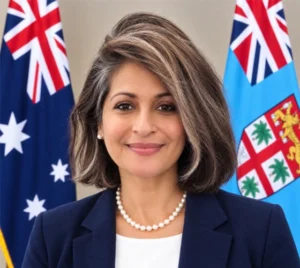 The Human Thread with Sabrina Iqbal Khan
Exploring humanity, storytelling, and the social issues impacting our communities. Nations say a great deal by where they choose to meet. This October, Pre-COP31, a preparatory gathering where ministers and delegates build understanding before a major United Nations conference opens, was held in the Pacific for the first time. Nadi hosted it, with a leaders’ segment in Tuvalu and I was grateful to be there.
International relations scholars increasingly study emotion in diplomacy: how states use presence, hospitality and symbol to signal what they value. To me, meeting here in the islands rather than a distant capital said that those living closest to the questions deserve a place nearest the table.
Beyond the formal sessions, I spent time with community groups, the Fiji Red Cross Society and the Fiji National University team at the Pacific Voices and Leadership exhibition, wearing a dress of my own design patterned with tapa inspired motifs, a small piece of home carried into a global conversation.
There I met again a woman I once supported through my women’s empowerment work. No agenda, no speeches, just a warm greeting between two people. Moments like that are diplomacy at its very smallest scale and, I think, its most honest.
My faith offers a compass here. Scripture urges us to be quick to listen (James 1:19), to love our neighbour as ourselves (Mark 12:31) and never to forget hospitality to strangers (Hebrews 13:2). Many readers of Indian heritage, in Australia, Fiji or elsewhere, know what
it is to be both guest and host across more than one home.
When delegates gather in Antalya in November, may they carry that spirit of welcome into every room. Every agreement rests on an unspoken question: will you stay and hear me?
Hospitality, offered freely, answers yes.
The strongest communities are not those without problems, but those willing to face them together.
ABOUT THE WRITER:
Sabrina Iqbal Khan is an international award-winning filmmaker, producer and actress, a barrister to the High Court of Fiji and admitted to the Supreme Court of Victoria, 2007. She is a recipient of a Fijian Medal of Honour for community service, domestic violence awareness and poverty alleviation, and the winner of the 2025 New South Wales Human Rights Medal. Her first film, Seema, received recognition in the United States of America, where a national day was declared in honour of the film.
Sabrina has also been published in the field of cross-cultural dialogue, including developing a dialogue theory recognised by the American Center for Dialogue. With heritage connected to North West India, Bengal, Afghanistan and the wider Girmit diaspora experience, she writes on humanity, storytelling, rights, and the social justice issues impacting our communities.
