

A Journey to the Nordic Nations
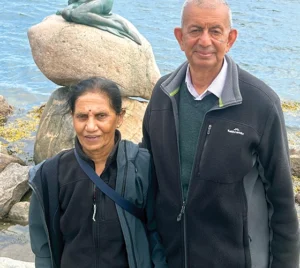
In June 2026, my wife Sudha and I visited the Nordic Nations including Finland, Sweden, Norway and Denmark. The later three are also known as Scandinavia. Previously, Finland was a part of Sweden. It became a part of the Russian Empire in 1809 and then an independent nation in 1917.
Scandinavia was home to the Vikings, who were fierce seafarers, traders and explorers that influenced vast territories starting around the eighth century.
The Arctic Circle, an imaginary line of earth latitude, passes through northern Finland, Sweden and Norway. North of this line, one can experience the Midnight Sun in the summer and the Polar Night in the winter.
Finland
We travelled from Brisbane via Singapore to Helsinki, the capital of Finland. Finland is bordered by Sweden, Norway, and Russia. It has a population of approximately 5.7 million people. Finland is a member country of the European Union and uses Euro as its official currency.
Swedish and Finnish are the official languages of Finland. Finland’s constitution guarantees both languages equal status in government, public services and education.
Helsinki was founded in 1550 by the Swedish king Gustav Vasa. It occupies a peninsula and surrounding islands in the Baltic Sea. It has a population of about 685,000 residents. It was made Finland’s capital in 1812 by the Russian Emperor Alexander I. Under the Russian empire, Finland was allowed extensive autonomy and was able to retain its Lutheran religion and Swedish as the official language.
During the reign of Alexander II, the population began agitating for the Finnish language to be recognised as a joint official language with Swedish, which was achieved in 1866. On 6 December 1917, Finland declared its independence from Russia and adopted a republican constitution in 1919.
A number of tourist attractions are located in Helsinki. They include the Helsinki Cathedral, Suomenlinna fortress, Upenski Cathedral, Kampin Kappeli, Oodi library, Market Square and numerous museums and public buildings.
Helsinki Cathedral is the Finnish Evangelical Lutheran church located in the centre of Helsinki at the senate square. It was built from 1830 to 1852 as a tribute to Emperor Nicholas I of Russia. It is a distinctive landmark in the Helsinki cityscape, with its tall green dome surrounded by four smaller domes.
Suomenlinna is a sea fortress, which was built on a group of islands belonging to the district of Helsinki. Covering an area of 210 hectares and consisting of 200 buildings and 6 km of defensive walls, the fortress stretches over six separate islands. The purpose of the fortress was originally to defend the Kingdom of Sweden against the Russian Empire and to serve as a fortified army base, complete with a dry dock. Sandbanks, barracks and various other buildings were added during the 19th-century Russian period. The defensive system was adapted to match the requirements of a modern fortress and developed in the 19th century using contemporary fortification equipment.
Now, the buildings have been renovated to serve as apartments as well as workspaces, to house private and public services, and for cultural purposes. It is included in the UNESCO list of World Heritage Sites as a unique example of the military architecture of its era. Regular ferry service runs between the market squares on the mainland to the fortress.
Upenski Cathedral is the main monument of the Orthodox Church of Finland. It is located on a hill overlooking the city. It was built in 1868 and is the largest Eastern Orthodox church in Western Europe.
Kampin Kappeli is a small chapel within a shopping complex. Everyone is welcome to enter it and sit in silence. Oodi library is well-known for its special design. It provides dedicated spaces for reading, research and other activities. It overlooks the Parliament house, a glassy concert house and other imposing buildings in the area. Market square is located on the sea shore with numerous shops for souvenirs and food. In a nearby park, free musical and dance entertainment programs are held.
Sweden
From Helsinki we flew to Stockholm in Sweden. Sweden is bordered by Norway to the west and north, and Finland to the northeast. The country is separated from Denmark in the southwest by the Skagerrak, Kattegat, and Öresund straits. The Oresund bridge, a combined railway and motorway bridge, connects Malmo in Sweden with Copenhagen in Denmark. Sweden comprises thousands of coastal islands and inland lakes, along with vast boreal forests and glaciated mountains.
The current population of Sweden is estimated to be 10.7 million. Ethnic Swedes make up around 80% of the population. The indigenous Sami people who mostly live in the northern parts of the country account for about 20,000. Approximately 20% of the population is foreign born representing diverse racial and ethnic groups.
A unified Swedish state was established during the late 10th century. From 1397 to1523 it was a part of the Kalmar Union that included Sweden, Denmark and Norway. Sweden under King Gustavus Adolphus joined the Thirty Years’ War in 1630 to protect its Baltic territories from the advancing Catholic Holy Roman Empire. The king also desired to establish Sweden as a dominant northern European superpower. Sweden remained a formidable European power until its defeat in the war with Russia in 1809.
Modern Sweden is a highly developed nation. It is renowned for its social welfare model that provides universal healthcare and tertiary education. It routinely ranks among the top countries globally in quality of life, gender equality, and innovation metrics. Its currency is the Swedish krona (SEK).
Stockholm is the capital of Sweden. The population of Stockholm is approximately 2.49 million people in the greater metropolitan area, with nearly 1 million residents living directly within the city limits. As Sweden’s economic and cultural hub, it is the largest urban area amongst the Nordic countries.
It encompasses 14 islands connected by more than 50 bridges on an extensive Baltic Sea archipelago. It seamlessly blends a well-preserved medieval history, most notably evident by the cobblestone streets of the Old Town Gamlastan, with cutting edge fashion, design and modern high-rise buildings and shopping complexes.
Gamlastan is home to the Royal Palace, Storkyrkan cathedral and the Noble Museum. Parliament House and other public buildings are either located within it or its vicinity. Ferries and sightseeing boats shuttle passengers between the islands.
The Royal Palace is the official residence of the King. Most of the monarchy’s official receptions are held at this site. It is a combination of royal residence, workplace and cultural-historical monument, and is open all year round to visitors. The palace has more than 600 rooms divided between eleven floors with a state apartment facing the city and smaller living rooms facing the inner courtyard.
In addition to the Royal Apartments, there are three museums steeped in regal history and the Treasury with the regalia. The palace also houses the Royal Chapel. The Changing of the Guard Ceremony and the Royal Gift Shop are particularly popular with visitors. Djurgarden’s Funfare, which is accessible by ferry from near the palace and the Naval Museum Vasamuseet are other major attractions.
In Stockholm we met my class mate from university days in Moscow. He along with his family members welcomed us with open hearts, organised a home gathering in our honour and accompanied us to many sites of interest in Stockholm. Meeting him and his loving family was a highlight of the Stockholm trip.
Norway
From Stockholm, we flew to Oslo in Norway. Norway is a narrow country in northern Europe. It shares the Scandinavian Peninsula with Sweden and Finland. Norway’s coastline is renowned for its fiords, which are sea inlets between steep cliffs. Norway is also home to many mountains. Some of the peaks are so steep that no human has ever tried to climb them.
Mainland Norway shares land boundaries to the east with three countries: Sweden, Finland and Russia. The rest of the country is flanked by extensive coastlines facing the North Sea, the Norwegian Sea, the Barents Sea, and the Skagerrak strait. In addition to the mainland on the Scandinavian Peninsula, Norway also owns the Svalbard island chain and three islands in the Antarctic.
In 872, Harald Fairhair was the first ruler to unite most of Norway. Denmark and Sweden invaded Norway during the rule of Harald Fairhair’s descendant. Denmark ruled Norway for the next century. In 1319, control of Norway was passed to Sweden. In 1397 Denmark, Norway, and Sweden were united as the Union of Kalmar by Queen Margrethe. Sweden broke away from the Union in 1523, and Denmark ruled Norway until 1814. During part of the 19th century, Norway returned to Swedish control. Norway became an independent country in 1905. The current population of Norway is 5.67 million. Its national currency is the Norwegian krone (NOK).
Oslo is its capital and sits on the country’s southern coast at the head of the Oslofiord. The population of Oslo municipality is approximately 724,000 people. When factoring in the contiguous urban area and surrounding suburbs, the greater Oslo region’s population exceeds 1.5 million residents.
Oslo is known for its green spaces, notable building and museums that include Vigeland Park, Royal Palace, Akershus Fortress, Parliament, City Hall, Opera House, Munch Museum, Maritime Museum and the Viking Ship Museum containing Viking ships from the 9th century.
Vigeland Park is the largest sculpture park by a single artist in the world, with more than 200 carvings in bronze, granite and cast iron produced by the Norwegian sculptor Gustav Vigeland. His realistic work represents the cycle of human life and all its emotions.
It is located within Frogner Park, the largest public park in Oslo. Frogner Park also has an open-air pool, a cafe and restaurant, plus the largest playground in Norway and the biggest collection of roses in the country, with 14,000 plants of 150 species. Vigeland was involved in the design and planning of the park, although unfortunately he died six years before its completion in 1949.
The Royal Palace in Oslo was built in the first half of the 19th century as the Norwegian residence of the French-born Charles XIV, who reigned as king of Norway and Sweden. The palace is the official residence of the current Norwegian monarch. It is surrounded by a large well-maintained park.
The new Opera House has a grand design with large walking and viewing spaces on its roof, which offer a complete view of the city. Akershus Fortress is the historical fort covering a sizeable area along the seashore.
Denmark
We flew from Norway to Copenhagen in Denmark. Denmark comprises the Jutland Peninsula and an archipelago of over 400 islands. It shares its mainland land border with Germany to the south, and in the Arctic, it shares a land border with Canada on Hans Island. It is surrounded by the Baltic and North seas, with maritime borders touching Sweden, Norway, Poland and the United Kingdom. It has a population of 5.8 million and its currency is the Danish krone (DKK).
Copenhagen is its capital with a population of approximately 672,000 people. The broader metropolitan area is home to about 1.4 million residents.
Major tourist attractions such as royal palaces, Nyhvan harbour, Tivoli amusement park and the Little Mermaid statue are located in Copenhagen. The Little Mermaid is based on the fairy tale of the same name written by Danish author Hans Christian Andersen. In addition, the library building known as black diamond, Opera House, Freetown Christiana, churches and museums attract numerous tourists.
In all these countries’ capitals, the major tourist attractions are close to the city centre. Among many options, many people prefer “Hop-on, Hop-off” buses that allow stops at and pick-ups from any site along the route.
These countries are among the wealthiest in the world measured by per capita GDP, with Norway sitting at the top of the Nordic ranking. Knowledge of local languages is always desirable but one can manage with English in all these countries. Our conversations with many locals at the places we visited suggested that the populations are stable and feel cared for by their governments. We returned home via Dubai to Brisbane.
—Awadhesh Sharma
www.hinduguru.com.au
