Brisbane Comes Alive with Colours and Culture at Basava Jayanthi 2025
Brisbane, Australia – 23 May 2025: The vibrant multicultural city of Brisbane witnessed a heartwarming celebration of Basava Jayanthi 2025, hosted by Basava Samiti of Asia Pacific (BSAPAC). The annual event commemorates the birth anniversary of Guru Basava, the 12th-century social reformer and spiritual visionary who pioneered inclusive social practices and ethical living, centuries ahead of his time.
Held at a packed venue in Coopers Plains, the celebration showcased a spectacular blend of devotion, knowledge, and community spirit. It was a multicultural confluence of the community dressed in traditional attire, children and adults alike participated in a lively procession of Vachana recitations, songs, and interactive discussions—highlighting the adoption of Guru Basava’s values that centre on equality, compassion, and rational thought.
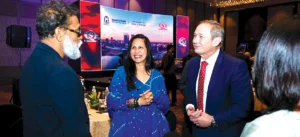
The program opened by lighting the lamp followed by the key note address was delivered by Mrs Karen Lay-Brew, the Board Member of Energy Queensland, Strategic Advisor to Australian Government. Karen migrated with family at the age of 11 from Mynamar provided an inspiring speech of the hardships of migrants and their journey to success, happiness and peace while navigating through the value system of life. Her speech was inspirational and touched the hearts of young and old.
Mrs. Margie Nightingale, Member of Inala, graced the audience and was impressed to see the community unity threaded with the values. Her encouraging best wishes meant to a lot to the growing community and the charity.
The key highlight of the discussion was the interactive introspection from the audience representing different ethnicities in the community namely, Sri Lanka, multi cultural diaspora of India, Pakistan, Iran, Burma, local Australians sharing their journey of life and the adoption of values. The Distinguished speakers, including local leaders and community scholars, praised BSAPAC’s commitment to Engage, Educate, Empower, and Enlighten across the Asia Pacific. / Guru Basava vegetarian, non-alcoholic community meal (Anna Dasoha), symbolising Basava’s vision of social equality through shared values.
The event also honored young children for their beautiful singing from the Sargam Academy of Music. We thank Mr. Mithun Chakraborthy and Mrs. Bonita Chakraborthy for presenting the wonderful music to the audience. Mr. Linden May, Ex-Board Director of the Charity awarded all the children with the medals for their fantastic participation.
Other notable programs included the Australian national anthem via the violin, presentation of the Guru Basava Dashboard Idol – a spiritually uplifting artefact designed for the car, symbolising values of truth, work, and devotion, ideal for daily travel inspiration by the 12 year old Master Hanish Banavar. BSAPAC will promote these dashboard idols that can be used in the cars via their shopping carts.
Mrs. Soniya Sharma, from the ANZ Bank Mt Ommaney also spoke to the team regarding the offering of the Home Loan Introductory Program.
Other notable organisers were Mrs. Girija Karekal, Executive Director; Mr. Stephen Hodgson, CEO, Mrs. Nivedita H E lead coordinator of Brisbane Chapter. BSAPAC offers gratitude for all the volunteers and children who made this an intimate evening and strengthened the values through multicultural confluence. “Guru Basava’s message is more relevant today than ever. His vision of a just society is what drives our charity’s work in over eight locations across Australia and New Zealand.”
Basava Jayanthi 2025 in Brisbane stood not only as a celebration of history but also a call to action for unity, service, and purposeful living in our contemporary world.
Learn more at https://basavasamitiapac.org
Follow us: #BasavaJayanthi #BSAPAC #GuruBasava #STEMWithValues #EngageEducate
EmpowerEnlighten
In Uttar Pradesh (UP), the heartland of northern India—Diwali holds profound spiritual and cultural significance. As the legendary setting of the Ramayana, UP is home to Ayodhya, the birth city of Lord Rama, making the state’s festivities among the grandest and most authentic in the world. From sacred riverbanks to domestic doorsteps, the celebrations blend deep scriptural devotion with rich folk traditions.
1. Deepotsav in Ayodhya: A World-Record Spectacle
The crown jewel of Diwali celebrations in Uttar Pradesh is Deepotsav, held in the holy city of Ayodhya along the banks of the Saryu River.
• The Reenactment: The grand event begins with a ceremonial procession featuring elaborate tableaux depicting episodes from the Ramayana. Helicopters drop flower petals as actors portraying Lord Rama, Goddess Sita, and Lakshmana arrive, symbolically reenacting their return from 14 years of exile.
• Guinness World Records: Millions of hand-crafted earthen lamps (diyas) are arranged across the Ram Ki Paidi ghats. Volunteers and devotees light these lamps simultaneously, creating a mesmerizing sea of golden light that consistently sets world records for the largest display of oil lamps.
• Laser and Drone Shows: Modern technology merges with tradition as grand 3D laser light shows, sound performances, and eco-friendly fireworks illuminate the night sky, depicting the epic narrative of good triumphing over evil.
2. Dev Deepawali in Varanasi: The Diwali of the Gods
While the main Diwali is celebrated on the dark night (Amavasya), Varanasi (Kashi) celebrates Dev Deepawali (“Diwali of the Gods”) fifteen days later, on the full moon night of Kartik Purnima.
According to regional belief, the gods descend to Earth to bathe in the holy Ganges River on this night. All 84 historic riverfront ghats from Assi to Rajghat are illuminated with over a million diyas. Thousands of pilgrims gather to witness the breathtaking Ganga Aarti at Dashashwamedh Ghat, accompanied by chanting, brass bells, and floating floral lamps (deepdan) drifting down the river.
3. Traditional Domestic Customs Across UP
Inside households across Uttar Pradesh, the festival unfolds over five days with distinct regional customs:
• Traditional Wall Art (Aipan and Chowk): Women decorate doorways and prayer spaces with elaborate rangoli and traditional geometric patterns called Chowk Purna, drawn using rice flour and vermilion to welcome Goddess Lakshmi.
• Clay Idols & Kulhad Diyas: Families purchase freshly baked clay idols of Lakshmi and Ganesh along with handmade earthen pots (kulhads) from local artisans, reinforcing community bonds.
• Khel-Batasha Offering: During the evening Lakshmi-Ganesh Puja, a special offering of puffed rice (Khel) and sugar candies (Batasha) is presented to the deities as a symbol of agricultural prosperity and sweetness in life.
4. Festive Culinary Delights of Uttar Pradesh
Food is central to UP’s Diwali celebrations, featuring traditional slow-cooked vegetarian dishes and rich sweets unique to northern India:
Dish / Sweet Description & Significance
Suran (Elephant Foot Yam) Sabzi Consumed on Diwali night across UP households; traditionally believed to bring good fortune and steady wealth.
Poori & Aloo Rasdar Deep-fried puffed bread served with a rich, spiced potato gravy, cooked as the primary festive lunch.
Gujiya & Mathri Crispy pastries filled with sweetened khoya (condensed milk) and nuts, served alongside savory spiced crackers.
Moti Choor Ladoo Soft, melt-in-the-mouth gram flour sweets offered to Lord Ganesh during evening prayers.
5. Community Joy and Brotherly Bond
The festivities conclude with Bhai Dooj, where sisters apply a sacred vermilion tilak on their brothers’ foreheads, praying for their long life and prosperity. Across towns and villages in Uttar Pradesh, markets stay vibrant late into the night, filled with fairy lights, festive sweet shops, and joyful gatherings, encapsulating the deep warmth and hospitality of Uttar Pradesh’s cultural heritage.
From Diwali to Community: Embracing Kindness and Connection
By Xavier Hernandez
Happy Diwali to all our readers who have started planning how they will celebrate this local, national and international celebration, which falls on November 8. From the Australian Indian Times family and me, I wish you all a safe and joyful five-day festival, both in the lead-up and throughout the celebrations. Diwali symbolises the spiritual victory of light over darkness, good over evil, and knowledge over ignorance.
This month, I would like to begin by thanking JD and the Deo family, my friends and the Australian Indian Times community for their ongoing support. I am honoured to announce that I have been appointed as a Chapel Prefect as part of the St John’s Anglican College 2027 Leadership Team. This is a journey I look forward to continuing to share with you. Thank you to the Deo family and my village for your love and ongoing support.
I am grateful to be growing up in such a vibrant and supportive community. Recently, I caught up with a friend and the owner of A–Z Gallery at Sunnybank Shopping Centre. I still remember how he would give me a gift and say hello every time I walked into his store. He has shown me small but impactful acts of kindness since I was three years old. Sitting down with him, seeing his wife and talking with his staff, particularly during the Moon Festival, was an incredible experience. Enjoying a cuppa of organic tea and finding some awesome bargains made it even more memorable. I would like to challenge our readers to perform an act of kindness this month and every month.
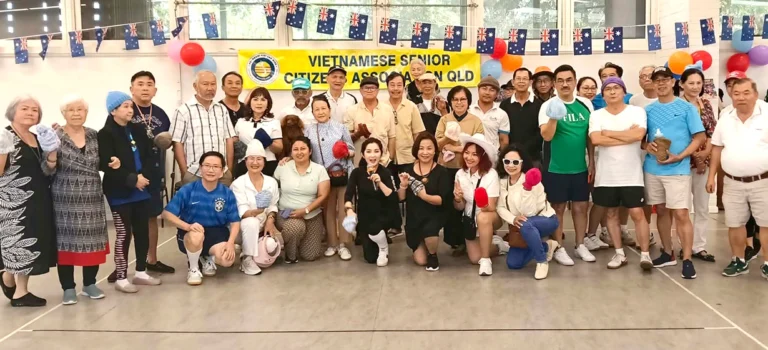
I also had a wonderful time with the Vietnamese senior citizens, President Khue Oanh Do and members. I took part in their Father’s Day badminton challenge and helped hand out knitted beanies and items donated by Mission Possible and Gail Harrow. Gail and I have known each other since we were very young, and seeing her and all her volunteers was another incredible moment. If you would like to volunteer or donate to Gail and her team, reach out to Mission Possible in Logan Central.
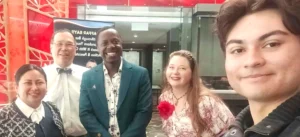
I also attended the Zaffarology Transformation Workshop, a powerful one-day workshop themed MASTER YOUR MIND – BUILD YOUR LEGACY. As a young person whose journey is still being laid out, it was an eye-opener and a wonderful opportunity to work alongside some of Queensland’s brightest minds. One topic that particularly interested me was Artificial Intelligence.
Artificial Intelligence (AI) continues to be discussed by our Australian Indian Times readers, particularly the opportunities and threats it may bring to our day-to-day lives.
Like all things, AI can also be misused. That is why my interview with mental health champion Cr. Nathan St Ledger remains incredibly important. Please enjoy Part 6.
Xavier Hernandez: How do you think the community contributes to the development, growth and wellbeing of young people?
Cr. Nathan St Ledger: Schools play a huge part. Guidance officers, in particular, work really closely in this space, and I spent a couple of years working in schools with disengaged young people, so I have seen that firsthand.
Schools play a huge role, and not just in education. They are increasingly becoming involved in young people’s wellbeing and having to deal with those sorts of issues as well.
Sporting clubs and community organisations also play a huge part. I’ve got to give credit to the QRL and a mate of mine named Weston, who was at the QRL, for starting mental health support initiatives. They now have support squads, with volunteers within clubs who have received training in mental health support and other areas to help young people involved in these sports.
Sporting clubs and community groups play a major role because connection, value and purpose are extremely powerful tools. That’s what everyone needs, in my opinion.
People generally find their interests through these organisations, so having people around them who have a little bit of education and understanding to be able to help in those situations is really important.
They play a major role, and the more we can help upskill people within those organisations, the better.
Xavier Hernandez: Do you have a personal motto or guiding principle that influences how you approach life, work and challenges?
Cr. Nathan St Ledger: I don’t know if it’s a motto or not, but I think it’s about just having a go at things.
I’m extremely fortunate, mate. I’ve got really good people around me. I’ve got a really supportive wife and kids, and now some really good mates as well.
But you get in the game, or you could just sit on the sideline. I won’t be sitting on the sideline. You’ve got to get in the game.
Xavier Hernandez: How do you enjoy your downtime?
Cr. Nathan St Ledger: For me, it’s spending time with my family. I love going away camping. I love either getting out bush or getting to one of my favourite places in the world, Fraser Island.
My wife and my kids all love doing that sort of stuff, so getting away either out bush or up the beach is really important for me.
It’s about connecting personally without phones and technology taking over. That’s what I like to do, and it’s probably something that I need periodically throughout the year, so I’ll make sure I prioritise that.
That’s really important.
End of interview
As many readers have told me when I’m out in the community, they really enjoy the “What’s Coming Up” section, so I’m pleased to share a few events happening across our community.
I recently caught up with the team at The Lion Richlands, who will be celebrating Diwali in style on Sunday, November 8, at 133 Pine Road, Richlands. The community is invited to come together for Lakshmi Puja and celebrate colour, culture and community.
Another event to pencil into your calendar is Movember Logan West, taking place on Sunday, November 22, from 7am to 9am at Sweetgum Park, Hillcrest. The Logan West Movember Fun Run is a new fundraising event supporting men’s health, with 2km and 4km options. Run, walk or take it at your own pace. The cost is $20 per person.
The third event is Creswalk 2026, taking place on Sunday, October 11, at Berrinba Wetlands, Wayne Goss Drive, Browns Plains. Participants should arrive at 8am, with the walk starting at 8:30am. The free community event offers a 5km or relaxed 2.5km route, with walking, running, strolling and wheeling all welcome.
Enjoy your month of October, and I look forward to seeing you out and about as we continue celebrating our community and doing what I love — building community.
What began as a community celebration has grown into one of the region’s much-loved multicultural events — but the real success of Greater Springfield Dandiya Night is not measured by the number of people who attend.
It is measured by the people who come together to make it happen.
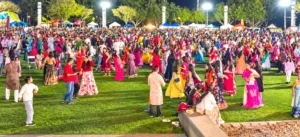
The fifth Greater Springfield Dandiya Night at Robelle Domain Parklands was a beautiful celebration of Indian culture, music, dance and devotion, with more than 4,000 people coming together to enjoy the evening.
But behind those thousands of smiling faces were months of planning, countless conversations, late nights, hard work and, most importantly, a dedicated team of volunteers who gave their time and energy simply because they wanted to do something special for their community.
This Is Our Community Event
Greater Springfield Dandiya Night is not one person’s event.
It belongs to the community.
It is the result of people putting their hands up to help, families giving their time, volunteers taking responsibility, businesses providing support, performers sharing their talent and community organisations coming together with one common purpose.
GSIA President Mukesh Dubey said the event’s growth over the past five years has been incredibly rewarding, but the achievement belongs to the entire team.
“An event of this size does not happen because of one person. It happens because people come together. There are many sleepless nights, countless hours of planning and a lot of work that people never see. But our greatest strength is our team and our volunteers.”
“They are more than volunteers to me — they are family. Everyone contributes in their own way, and together we make this event possible.”
The Power of Teamwork
From the initial planning meetings to the final clean-up, there are hundreds of tasks involved in bringing an event of this scale to life.
Venue coordination, performers, food stalls, community stalls, sponsorships, advertising, stage programs, volunteers, safety, first aid, logistics, entertainment and crowd management all require people working together.
And that is where the true spirit of Dandiya Night shines.
Everyone has a role. Everyone contributes. Everyone matters.
The incredible atmosphere people experienced on the night was the result of a much bigger team working behind the scenes.
Thousands Came Together
As the sun went down, Robelle Domain Parklands came alive with colour, music and celebration.
Thousand of people enjoyed an evening filled with Garba and Dandiya, traditional dress, DJ music, cultural performances, food, children’s activities, shopping stalls and plenty of family entertainment.
People of all ages and backgrounds joined the celebrations, creating a wonderful atmosphere of friendship, happiness and togetherness.
For many families, it was not simply a night of dancing — it was an opportunity to meet friends, make new memories and share Indian culture with the wider community.
A Night of Culture and Devotion
The evening showcased the richness of Indian culture through music, dance and spiritual traditions.
The spectacular Dhol Tasha performance by Shivam Vadhya Pathak was one of the highlights, filling the parklands with powerful beats and incredible energy.
The cultural performances and Diwali-themed presentations added colour and excitement to the evening, while Goddess Durga Pooja and Aarti brought a beautiful spiritual dimension to the celebration.
It was a reminder that culture is not only about entertainment — it is also about faith, tradition, identity and passing our heritage to the next generation. CONTD. ON PG 24 CONTD. FROM PG 22
We Are One
One of the most important messages behind Greater Springfield Dandiya Night is simple:
We Are One.
The event welcomed people from different cultures, backgrounds and communities to celebrate together.
The support from numerous community organisations and multicultural groups demonstrated the strength of collaboration across Greater Springfield and the wider region.
Different communities may have different traditions, but events like this show how easily we can come together through friendship, respect and celebration.
Thank You to Our Supporters
GSIA is deeply grateful for the support received from government representatives, local councillors, MPs, community leaders, organisations, sponsors and well-wishers.
Senator Paul Scarr, Ipswich City Council Mayor Teresa Harding, Deputy Mayor Nicole Jonic and local councillors attended and supported the celebration.
GSIA also acknowledges the support and messages of goodwill from Charis Mullen MP, Shayne Neumann MP, Milton Dick MP, Jess Pugh MP, Cr David Martin, Cr Jacob Madsen and Cr Pye Augustine, along with the continued support of Cr Paul Tully.
The Queensland Police Service once again supported the event, helping create a safe environment for families.
We also sincerely appreciate 1300 Medics volunteers for providing first-aid support throughout the evening.
The messages of support from the Premier of Queensland and Lord Mayor of Brisbane were also greatly appreciated.
Community Organisations Working Together
GSIA was proud to have the support of other community organisations, including FICQ President Dr Preethi Suraj and her team, the Hindu Council of Australia and many other community groups and leaders. Their support represents something bigger than one event. It shows what can happen when community organisations work together rather than separately — we can create something that benefits everyone.
Our Volunteers Are Our Biggest Strength. If there is one group that deserves special recognition, it is our volunteers. They give their time without expecting anything in return. They arrive early, stay late, solve problems, assist families, coordinate activities, support performers, manage stalls and help wherever they are needed. Many of them have their own work, families and responsibilities, yet they still make time for the community.
That is the real spirit of Greater Springfield Dandiya Night. The lights, music, stage and decorations may create the visual magic, but it is the volunteers who create the heart of the event.
Thank You to Our Sponsors. Our sincere thanks also go to all our sponsors and supporting businesses. Their contribution helps make a large community event possible and allows GSIA to continue creating opportunities for families to come together and celebrate.
We are also proud that Dandiya Night provides an opportunity for local businesses, food vendors, clothing and jewellery businesses and other traders to connect with thousands of people. Community events can create both social and economic opportunities, supporting local businesses while bringing people together.
A Family Effort
For Mukesh Dubey and his family, Dandiya Night has become a personal commitment to the community. “Every year my whole family becomes involved. We treat this as our own family event. When you see thousands of people dancing, smiling and enjoying themselves, you forget about the sleepless nights and all the hard work.”
“The happiness on people’s faces makes everything worthwhile.” But Mukesh is quick to emphasise that the success does not belong to him. “This is not my event. This is our community’s event.” “I am fortunate to have a team that stands together like a family. Without our volunteers, sponsors, supporters, performers and the wider community, this event would simply not be possible.”
Five Years. Thousands of People. One Community.
Five years of Greater Springfield Dandiya Night means five years of memories, friendships, teamwork and community spirit. From a small community initiative to an event attracting more than 4,000 people, the journey has only been possible because people believed in the idea of coming together and celebrating together. To every volunteer who gave their time.
To every sponsor who supported us. To every performer who shared their talent. To every organisation that stood beside us. To every government representative and community leader who supported us.And to every single person who came, danced, smiled and celebrated with us —
THANK YOU.
Because at the end of the day, the biggest achievement of Greater Springfield Dandiya Night is not the size of the crowd.
It is the community spirit that brings that crowd together. Culture brings us together. Teamwork makes us stronger. Community makes it possible. Together, We Are One.
Indian Film Festival of Perth Announces Inaugural Edition, Set to Celebrate Indian Cinema in Western Australia from November 12-15
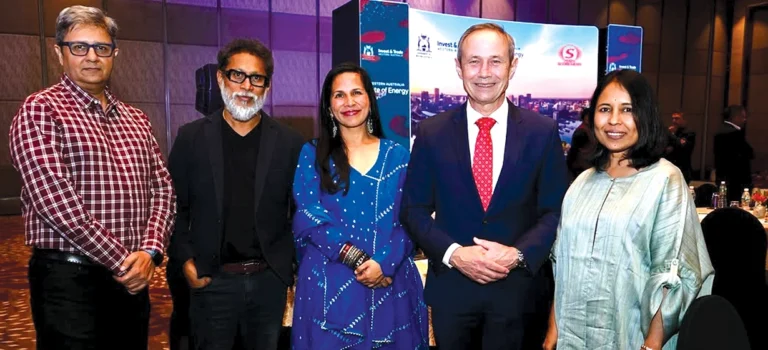
Four-day festival to showcase more than 30 films across Indian and South Asian languages, bringing Indian cinema, filmmakers and audiences together in Perth.
Indian cinema is set to make its mark in Western Australia with the inaugural Indian Film Festival of Perth, taking place across multiple locations in Perth from 12–15 November 2026.
The festival is the latest expansion of the team behind the Indian Film Festival of Melbourne (IFFM) and Indian Film Festival of Sydney, New South Wales (IFFS NSW), bringing the diversity of Indian and South Asian cinema to audiences in Western Australia.
The announcement was made during Western Australian Premier Hon Roger Cook MLA’s visit to India, where he announced the festival during his keynote address, highlighting the growing cultural and creative ties between India and Western Australia.
The inaugural festival will showcase more than 30 films across Indian and South Asian languages and welcome a select group of celebrated Indian filmmakers to Perth.
Announcing the festival, Western Australian Premier, Hon Roger Cook MLA said, “I am pleased to announce the inaugural Indian Festival of Perth, which will take place across multiple locations in Perth from November 12th to November 15th this year.
The festival will showcase more than 30 films across Indian and South Asian languages. And the inaugural festival will welcome a select group of celebrated Indian Filmmakers who will get to witness Western Australian hospitality and visit Perth Film Studio”.
Mitu Bhowmick Lange AM, who is behind both the Indian Film Festival of Melbourne and Indian Film Festival of Sydney, NSW said, “We are incredibly excited to bring Indian cinema to Perth for the very first time. The launch of the Indian Festival of Perth is a natural extension of what we have been building across Melbourne and Sydney, and it is wonderful to now create a platform for audiences in Western Australia to experience the incredible diversity of Indian and South Asian cinema.
Beyond the films, we hope the festival will create meaningful connections between filmmakers, audiences and the wider creative community, and open up new conversations and collaborations between India and Western Australia.”
The launch further strengthens the cultural bridge between India and Australia, with the festival creating a new platform for Indian storytelling in Western Australia and expanding the footprint of Indian cinema across the country.
Greater Springfield Dandiya Night 2026 Five Years of Togetherness, Teamwork and Community Spirit
What began as a community celebration has grown into one of the region’s much-loved multicultural events — but the real success of Greater Springfield Dandiya Night is not measured by the number of people who attend. It is measured by the people who come together to make it happen. The fifth Greater Springfield Dandiya Night at Robelle Domain Parklands was a beautiful celebration of Indian culture, music, dance and devotion, with more than 4,000 people coming together to enjoy the evening.
But behind those thousands of smiling faces were months of planning, countless conversations, late nights, hard work and, most importantly, a dedicated team of volunteers who gave their time and energy simply because they wanted to do something special for their community.
This Is Our Community Event
Greater Springfield Dandiya Night is not one person’s event.
It belongs to the community.
It is the result of people putting their hands up to help, families giving their time, volunteers taking responsibility, businesses providing support, performers sharing their talent and community organisations coming together with one common purpose.
GSIA President Mukesh Dubey said the event’s growth over the past five years has been incredibly rewarding, but the achievement belongs to the entire team.
“An event of this size does not happen because of one person. It happens because people come together. There are many sleepless nights, countless hours of planning and a lot of work that people never see. But our greatest strength is our team and our volunteers.”
“They are more than volunteers to me — they are family. Everyone contributes in their own way, and together we make this event possible.”
The Power of Teamwork
From the initial planning meetings to the final clean-up, there are hundreds of tasks involved in bringing an event of this scale to life.
Venue coordination, performers, food stalls, community stalls, sponsorships, advertising, stage programs, volunteers, safety, first aid, logistics, entertainment and crowd management all require people working together.
And that is where the true spirit of Dandiya Night shines.
Everyone has a role. Everyone contributes. Everyone matters.
The incredible atmosphere people experienced on the night was the result of a much bigger team working behind the scenes.
Thousands Came Together
As the sun went down, Robelle Domain Parklands came alive with colour, music and celebration. Thousand of people enjoyed an evening filled with Garba and Dandiya, traditional dress, DJ music, cultural performances, food, children’s activities, shopping stalls and plenty of family entertainment.
People of all ages and backgrounds joined the celebrations, creating a wonderful atmosphere of friendship, happiness and togetherness.
For many families, it was not simply a night of dancing — it was an opportunity to meet friends, make new memories and share Indian culture with the wider community.
A Night of Culture and Devotion
The evening showcased the richness of Indian culture through music, dance and spiritual traditions. The spectacular Dhol Tasha performance by Shivam Vadhya Pathak was one of the highlights, filling the parklands with powerful beats and incredible energy. The cultural performances and Diwali-themed presentations added colour and excitement to the evening, while Goddess Durga Pooja and Aarti brought a beautiful spiritual dimension to the celebration.
It was a reminder that culture is not only about entertainment — it is also about faith, tradition, identity and passing our heritage to the next generation.
CONTD. ON PG 24
CONTD. FROM PG 22
We Are One
One of the most important messages behind Greater Springfield Dandiya Night is simple:
We Are One. The event welcomed people from different cultures, backgrounds and communities to celebrate together.
The support from numerous community organisations and multicultural groups demonstrated the strength of collaboration across Greater Springfield and the wider region.
Different communities may have different traditions, but events like this show how easily we can come together through friendship, respect and celebration.
Thank You to Our Supporters
GSIA is deeply grateful for the support received from government representatives, local councillors, MPs, community leaders, organisations, sponsors and well-wishers.
Senator Paul Scarr, Ipswich City Council Mayor Teresa Harding, Deputy Mayor Nicole Jonic and local councillors attended and supported the celebration.
GSIA also acknowledges the support and messages of goodwill from Charis Mullen MP, Shayne Neumann MP, Milton Dick MP, Jess Pugh MP, Cr David Martin, Cr Jacob Madsen and Cr Pye Augustine, along with the continued support of Cr Paul Tully.
The Queensland Police Service once again supported the event, helping create a safe environment for families.
We also sincerely appreciate 1300 Medics volunteers for providing first-aid support throughout the evening.
The messages of support from the Premier of Queensland and Lord Mayor of Brisbane were also greatly appreciated.
Community Organisations Working Together
GSIA was proud to have the support of other community organisations, including FICQ President Dr Preethi Suraj and her team, the Hindu Council of Australia and many other community groups and leaders. Their support represents something bigger than one event. It shows what can happen when community organisations work together rather than separately — we can create something that benefits everyone.
Our Volunteers Are Our Biggest Strength. If there is one group that deserves special recognition, it is our volunteers. They give their time without expecting anything in return. They arrive early, stay late, solve problems, assist families, coordinate activities, support performers, manage stalls and help wherever they are needed. Many of them have their own work, families and responsibilities, yet they still make time for the community.
That is the real spirit of Greater Springfield Dandiya Night. The lights, music, stage and decorations may create the visual magic, but it is the volunteers who create the heart of the event.
Thank You to Our Sponsors. Our sincere thanks also go to all our sponsors and supporting businesses. Their contribution helps make a large community event possible and allows GSIA to continue creating opportunities for families to come together and celebrate.
We are also proud that Dandiya Night provides an opportunity for local businesses, food vendors, clothing and jewellery businesses and other traders to connect with thousands of people. Community events can create both social and economic opportunities, supporting local businesses while bringing people together.
A Family Effort
For Mukesh Dubey and his family, Dandiya Night has become a personal commitment to the community. “Every year my whole family becomes involved. We treat this as our own family event. When you see thousands of people dancing, smiling and enjoying themselves, you forget about the sleepless nights and all the hard work.”
“The happiness on people’s faces makes everything worthwhile.” But Mukesh is quick to emphasise that the success does not belong to him. “This is not my event. This is our community’s event.” “I am fortunate to have a team that stands together like a family. Without our volunteers, sponsors, supporters, performers and the wider community, this event would simply not be possible.”
Five Years. Thousands of People. One Community.
Five years of Greater Springfield Dandiya Night means five years of memories, friendships, teamwork and community spirit. From a small community initiative to an event attracting more than 4,000 people, the journey has only been possible because people believed in the idea of coming together and celebrating together. To every volunteer who gave their time. To every sponsor who supported us. To every performer who shared their talent. To every organisation that stood beside us. To every government representative and community leader who supported us.And to every single person who came, danced, smiled and celebrated with us —
THANK YOU.
Because at the end of the day, the biggest achievement of Greater Springfield Dandiya Night is not the size of the crowd.
It is the community spirit that brings that crowd together. Culture brings us together. Teamwork makes us stronger. Community makes it possible. Together, We Are One.
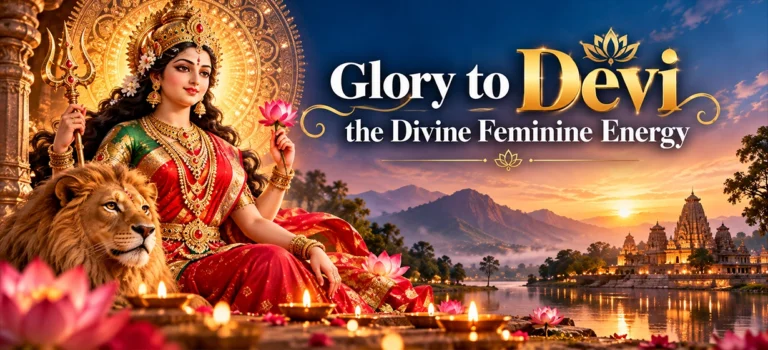
Shrimad Devi Bhagavat Mahapuran and Shree Durga Saptashati are two major scriptures which lay emphasis on the importance of the Devi, the Divine Feminine Energy. The followers of Shakta tradition in Hinduism derive their spiritual inspirations from these books. The Devi Bhagavat presents the goddess in the form of Shakti or energy that creates, sustains and dissolves the universe. Similar thoughts are expressed in the Durga Saptashati. The Durga Saptasati is also known as Devi Mahatmya and Chandi. Being a shorter text than Devi Bhagavat, the Durga Saptasati has wider practical utility for the general Hindu believers. It is an extracted section of Markandeya Puran with additional pieces of praise which help to make it an independent book. Chapters 78 to 90 of the Markandeya Puran which amount to 590 shloks is entitled the Greatness of Devi. Supplementary shloks have been added to bring it to a total of 700 shloks.
The book starts with the Saptashloki Durga. This auspicious text glorifies the Devi who is kind, powerful and generous, and offers refuge to all her devotees. She destroys fears, grants knowledge, health and prosperity, cures diseases, protects from enemies and controls the minds of all creatures.
The Saptashloki is followed by Durga Ashtotarshatam Stotram. It is a collection of 108 names of Durga in verses. These names highlight specific characteristics of the Devi and refer to specific legends. These legends have motivational power and are recounted in various other ancient scriptures.
Subsequently the correct procedure of reciting the Durga Saptashati text is described in the book. To allow the recital of the book to be fully effective and fruitful, certain rituals are to be followed.
Next comes Devyah Kavacham, which eulogises Durga in her numerous forms with varying features. Navadurgas that include Shailputri, Brahmacharini, Chnadraghanta, Kushmanda, Skandmata, Katyayani, Kalratri, Mahagauri and Siddhidatri along with many of her other incarnations are extolled in this section. It is believed that chanting the Kavacham provides divine protection and grants safety from enemies and dangers, whether they are in the form of humans, animals, birds, disease or natural disasters. Hence, devotees who seek protection and safety recite the kavacham text. Navadurgas forms of Durga are the main goddesses worshipped during the Navaratras.
Before the main text starts, other sets of prayers included are Argala Stotram, Kilakam, Vedic Ratrisuktam, Tantrik Ratrisuktam, and Devyatharva Shirsham. Vedic Ratrisuktam is a hymn from the Rigved whereas the Tantrik Ratrisuktam is a prayer sung by Brahma to Bhagavati Nidradevi, the feminine deity of sleep. Devyatharva Shirsham is taken from the Athrvaved and is a prayer offered by gods to Devi.
All of the above-mentioned prayers, mantras and hymns are normally recited before starting the reading of the main text.
The main section of the Durga Saptashati comprises thirteen chapters. Three major legends that demonstrate the greatness of the Devi are narrated in the text. They relate to the destruction of 1) asuras Madhu and Kaitabh, 2) demon Mahishasur, and 3) Shumbh and Nishumbh along with their associates. A summary of the story from the Durga Saptashati is presented below.
Devi Mahamaya – Chapter one relates to the destruction of Madhu and Kaitabh. During the age of an earlier Manu named Svarochish, lived a king named Surath. He was a just king and protected his subjects properly, treating them like his own children. However, he was attacked by powerful enemies and his advisers conspired against him.
The king lost his kingdom and went to a desolate forest. There he saw a hermitage of sage Medha. The sage welcomed him and the king found shelter in his hermitage. The king spent his time roaming around and reminiscing about his previous status of opulence. He often mulled over the potentially appalling condition of his subjects, royal elephants and horses, advisers and family members.
One day the king observed a new exile near the hermitage. He learnt that the new person known as Samadhi was previously a wealthy businessman. His wife, children and relatives had colluded against him, extracted all his riches and banished him from the house. Being rejected by his close family members and relatives, he had retreated to the forest.
He regularly ruminated over his past and worried about the well-being of his family members and relatives, who had expelled him. His mind was deeply engrossed in attachment to them, despite being deprived of wealth and status due to their actions.
Both the king and the businessman were mistreated by their own people, nevertheless they felt affection towards them. They wished to explore the reason that causes one to love those who harmed them. Together, they approached the sage in the hermitage, and the king presented their query to him.
In response to king’s query, the sage Medha stated that all creatures associated with material objects in different ways. In human, this develops into greed with the sense of “mine” that leads to the whirlpool of delusion. The sage further explained that the power of Mahamaya, the goddess of illusion, was the reason for this type of behaviour. Mahamaya, originated from Hari, the lord, when he was immersed in yog and asleep. She confounded the entire universe. Mahamaya forcibly seizes the minds of even those who are learned to thrust them into delusion.
The king further queried about the goddess Mahamaya, including her origin, nature of her work, her power, her temperament and other relevant and related characteristics. In response, the sage stated that she was eternally embodied in everything, however she originated in many different ways. She appears to accomplish the tasks of gods.
Through the legend of Madhu and Kaitabh, the sage illustrates the power of Mahamaya. At the end of a Kalpa, a cosmic aeon, Lord Vishnu was lying asleep on the Sheshnag in the cosmic ocean. Two asuras, known as Madhu and Kaitabh manifested from the wax in Vishu’s ears and prepared to destroy Brahma who was seated on the lotus flower rooted in Vishnu’s navel.
Brahma saw the terrible asuras and noticed that Vishnu was asleep. He sought to awake Yognidra, the sleep deity who resided in Vishnu’s eyes. He praised her with single-minded devotion and chanted a eulogy with intent to awaken Vishnu. Brahma’s prayer to Devi Yoganidra is known as Tantrik Ratrisukta. Following Brahma’s prayer, Yoganidra emerged as Mahamaya from Vishnu’s eyes, nose, arms, heart and chest, and stood aside.
Vishnu awoke and saw the evil-minded Madhu and Kaitabh ready to kill Brahma. Using his arms as weapons, Visnu wrestled with them for an extended period. The asuras were strong and intoxicated but were confounded by Mahamaya. In their confusion, they told Vishnu, “We are pleased with your bravery, seek a boon from us”. Vishnu replied, “If you are satisfied then let you be destroyed by me”.
The asuras looked around and saw water everywhere. They consented to Vishnu’s suggestion with a condition that they should be killed on a dry place. Vishnu agreed to their proposal and placed them on his thighs and sliced their heads off with his Chakra. Thus, the goddess had arisen after being invoked by Brahma to help protect him.
Devi Durga – Chapters 2 to 4 relate to the emergence of a divine female from the union of masses of energy from gods. Sage Medha continues telling the glory of the goddess through the legend of her victory over the demon Mahishasur and his fighters.
In an earlier age, there was an ongoing war between gods and asuras that lasted for hundreds of years. Mahishasur was the leader of asuras and Indra led the deities. Asuras were strong and defeated Indra in the battle. Mahishasur usurped the heavenly kingdom and became ruler of the universe. All the deities headed by Brahma went to the place where Shiv and Vishnu were reposed, and told them about Mahishasur’s misdeeds including how he had seized the positions of deities. The deities requested Shiv and Vishnu find a way to eliminate Mahishasur.
After listening to their stories, both Shiv and Vishnu became filled with anger. At that moment, a great mass of energy arose from the bodies of Vishnu, Shiv, Brahma and other deities, and merged together, forming a blazing mountain. It pervaded the universe and transformed into the body of a woman. The energy of each god formed a specific body part.
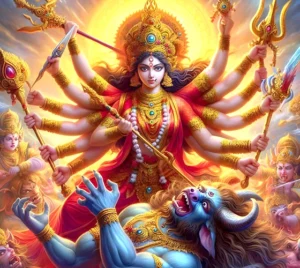
The deities rejoiced upon witnessing the goddess formed from their energy. Each of them bestowed a powerful weapon to her. They also gave her decorative jewels, protective body armours, and a lion as her mount. Infused with divine powers, wearing jewels, holding armours and mounted on a lion, she manifested as a powerful goddess and became famed as Durga.
Honoured by all the gods, the goddess Durga roared and challenged the asuras, causing turmoil among them. Their king Mahishasur sent his commanders to overcome her and also joined the battle himself. They attacked the goddess but she overwhelmed them and initially destroyed a large number of asura soldiers in the battle.
The combat with the Mahishasur’s army continued. In the field, the goddess killed all his commanders, along with their armies and in the end, she conquered Mahishasur. His death delighted all the deities. Gandharvas sang and apsaras danced in honour of the goddess’s victory.
Following Mahishasur’s demise, Indra with all the deities visited the goddess and praised her with a powerful hymn. Pleased with their prayer, the goddess offered them a blessing. The deities asked the goddess to fulfill the wishes of all those who praise her with their hymn and be available to manifest and help them when they need her help. The goddess consented to their request and vanished from the scene.
Devi Kali and Others – Chapters 5 to 10 relate to the stories of asuras, Shumbh and Nishumbh. Intoxicated by their strength, they had appropriated the kingdom of heaven. When all the gods were routed and deprived of their rights, they remembered Jagadamba, the mother of the world, who had promised to help when needed. They went to the Himalayas and praised goddess Vishnumaya with a hymn known as Tantrik Devisuktam.
While the deities were chanting the hymn, goddess Parvati arrived there to bathe in the River Jahnavi. She enquired about the reason for their praying. She realised that they had been defeated by the demons Shumbh and Nishumbh and were seeking her support.
Goddesses Shiva, Ambika, Kaushiki and Kalika emerged from Parvati’s embodied form.
Ambika assumed a supremely radiant and extremely beautiful form. When Shumbh heard about Ambika’s beauty, he became infatuated. Initially, he tried to convince her to become his queen. When she declined, he sent his commanders to bring her forcefully to him.
A fight broke out between demonic forces and the divine Devi. She transformed herself in many female forms and eventually killed demon fighters, including Dhumralochan, Chand, Mund, Raktabeej, Shumbh and Nishumbh.
In the battle, the Devi fought in the form of Ambika, Chandika, Kali, and consecutively emerged in various other images known as Ishana, Katyayani, Maheshwari, Brahmani, Vaishnavi, Aindri, Narshimhi, Shivduti and many others.
In chapter 11, the deities collectively recited hymns in praise of the goddess. She became pleased and agreed to their request to remove any obstacle that they encountered and to destroy their enemies. The effects of reciting the Durga Saptashati are extolled in Chapter12.
In the concluding chapter 13, sage Markandeya narrates that after hearing this story, king Surath and businessman Samadhi bowed down to sage Medha, and went to perform austerities dedicated the Devi. Being pleased with their prayers, Goddess Chandika manifested before them. She granted the king a boon to become a Manu by the name of Savarni in the future epoch. Samadhi’s mind had become detached from worldly affairs and he asked for knowledge so that he might get rid of the notion of me and mine. The goddess granted him his wish.
Following the main text, Vedic and Tantrik Devisuktam, Pradhanic Rahasyam, Vaikritik Rahasyam Murti Rahasyam, Durga Manaspuja and other relevant sections are included in the book. The concept of Mahalakshmi, Mahagauri and Mahasaraswati is also presented.
Durga Sapsahti is especially recited during the Sharad and Chaitra Navaratras. During this period, devout families organise recitals of the text in their homes.
During the Sharad Navaratra, images of Goddess Durga subduing demons are publicly displayed at temples, shops and various public institutions, and public gatherings are organised. A number of hymns from Durga Saptashati are used in regular worship during this time and also throughout the rest of the year.
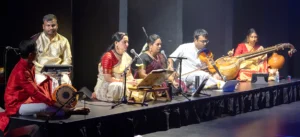
Shivah Saktya Yukto: A Captivating Celebration of Shiva, Shakti and Bharatanatyam
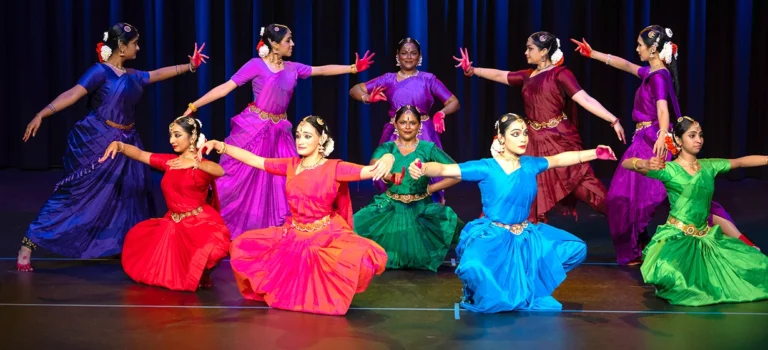
Lalithakalalaya School of Bharatanatyam, under the direction and guidance of its Guru, Smt Padmalakshmi Sriram, recently presented a captivating Margam performance by its senior students. Entitled “Shivah Saktya Yukto – The Ineffable Genesis of Creation,” the production explored the eternal union of Lord Shiva and His consort, Goddess Shakti, through the rich vocabulary of Bharatanatyam.
Smt Padmalakshmi Sriram has established a reputation for her creativity in choreography, thoughtful costume selection, inclusive approach to teaching and disciplined training. These qualities were evident throughout the performance. Her considered selection of music and carefully crafted choreography gave each dancer an opportunity to display their individual skills while contributing to the overall narrative of the production.
A particular highlight was the Varnam, traditionally the most elaborate and demanding item in a Margam. The first section brought to life two stories centred on Lord Shiva, while the second portrayed Lord Natesha performing the cosmic dance. The choreography gave the dancers considerable scope for expressive abhinaya, and several dancers were particularly impressive in their ability to transform from one character into another with remarkable ease and clarity, bringing the stories vividly to life.
The performances by the adult students were also noteworthy. Their presentations, including Pushpanjali and Aigiri Nandhini, demonstrated confidence, agility and grace. Their participation reflected Smt Padmalakshmi’s commitment to nurturing dancers at different stages of their artistic journey and providing each student with opportunities to develop and showcase their abilities.
The other items in the Margam — Ganga Alarippu, Thirukoneshwarar Kauthuvam, Shakti Thandavam, Kalabhairava Ashtakam, Theruvil Varano, Thillana, Dheena Karunakarane Nataraja and Ardhanarishwara Stotram — were presented with equal care and contributed to the richness and variety of the evening.
The visual appeal of the production was enhanced by the vibrant costumes worn by the dancers. The colours complemented the choreography and added to the grace and finesse of the presentation. Particularly refreshing was the costume worn by the most senior batch. It successfully introduced a contemporary touch while retaining the essential elegance and traditional character of the Bharatanatyam costume.
Another commendable aspect of the production was Lalithakalaya School’s decision to engage local artists for the accompanying orchestra. This provided talented musicians within the local community with a valuable platform to perform, gain exposure and further develop their skills. Their contribution added greatly to the quality and atmosphere of the evening.
The orchestra comprised Smt Priyadarshini Swaminathan on Vocals, Shri Ruddra Dorairajan on Mridangam, Shri Ashwin Narayanan on Violin, Kumari Vindhyavasini Sureshchandra on Veena and Shri Sharujan Mahendraraj on rhythm pad. Their collective contribution helped make the performance a memorable musical and artistic experience.
Adding another dimension to the evening was Guru Smt Padmalakshmi Sriram’s nattuvangam, which demonstrated her growing mastery and confidence as a nattuvangam artist. Her rhythmic command provided a strong foundation for the dancers and reflected the depth of her involvement in every aspect of the production.
“Shivah Saktya Yukto” was a celebration of Bharatanatyam, artistic discipline, inclusivity and the wealth of talent within the local community. Congratulations to Lalithakalalaya School of Bharatanatyam, Guru Smt Padmalakshmi Sriram, the dancers, musicians and everyone involved in staging yet another well-organised and culturally enriching programme.
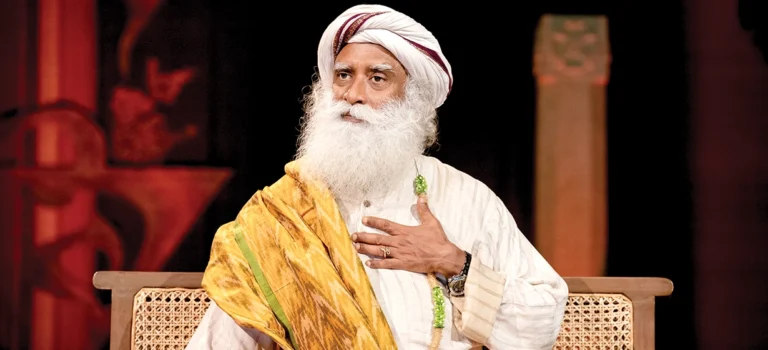
Question: Namaskaram, Sadhguru. During sleep, we are usually unconscious. Is there a way we can stay aware during sleep?
Sadhguru: When you sleep, just sleep. Don’t try to do something else. There is a beautiful story. For many, many years, the Saptarishis, the seven sages, lived with the Adiyogi, doing sadhana, learning, and absolutely bonding with him.
The sharing was so profound that they did not know any other life but him. But one day, he said, “It’s time to go. You have to take this to the world.” He told them to go to faraway places. One to Central Asia, one to North Africa, one to South America, one to Southeast Asia, one to South India, and one to what is today the Indian part of the Himalayas. Only one stayed back with him.
If 15,000 years ago, you asked a man to go to South America, it was as good as asking him to go to another galaxy. The Saptarishis said, “We don’t know where we are going, what kind of people exist there, how they will receive us, and whether they are ready for this or not.
If we are in danger, or if we cannot transmit this as you wish, will you be there for us?” The Adiyogi looked at them incredulously and said, “If you are in trouble, if your life is in danger or your work is in danger, I will sleep.” They got the point. But if I say this to you, you will feel terribly insecure and insulted. “I tell him my difficulties, and he says he sleeps on it!”
To sleep consciously, you should have no sense of body. Only if your identification with the body is completely broken, will you sleep consciously. When we are awake, we are conscious, but our energies are involved and engaged in many things. We have to sit up, we have to speak, we have to do some work, we have to do something else. But if I sleep consciously, my energies are completely consolidated, and I am still conscious – that means I am at my peak performance level. So when Shiva says, “If you are in trouble, I will sleep,” it means, “I will do the best possible thing for you,” because then he is at his best.
Those of you who have been initiated into shoonya meditation may have experienced a few moments here and there of what in yoga is called sushupti – that means being fast asleep but wide awake. The day this state of sushupti lasts for even just two to three seconds, you will not be able to sleep at night. You will be bright and alert.
Only if you are not identified with the body, will sleeping consciously become a possibility. On a certain day, a baby turtle, with great effort, meticulously, slowly, taking 24 hours, climbed up a tree, leapt off the branch, and fell flat. Again, slowly, taking another 24 hours, it crawled up, leapt, fell flat – again and again. After four days, one of the two birds who were sitting in the opposite tree said, “I think it’s time we tell him he is adopted.” So I thought it’s time to tell you, to sleep consciously, striving is needed, but it is not enough.
The most important thing is that you distance yourself from your physical nature.
Ranked amongst the fifty most influential people in India, Sadhguru is a Yogi, mystic, visionary and a New York Times bestselling author. Sadhguru has been conferred the Padma Vibhushan by the Government of India in 2017, the highest annual civilian award, accorded for exceptional and distinguished service.
He is also the founder of the world’s largest people’s movement, Conscious Planet – Save Soil, which has touched over 4 billion people.
Let me get one thing out there before we start. I am not a financial advisor. I and WOW! Advisors don’t have a Financial Services Licence that allows us to tell you what to invest your precious money into.Apparently, as a professional accountant and business advisors we are not good enough or professional enough to even suggest you may wish to consider setting up a self-managed superfund even if I have known you for the last 15 years.
If I do, every federal and state regulator in the country will ensure I am disembowelled, shamed, humiliated, and suffer many ‘bad things.’ Now I know these are the words Trump would use, but I need to be clear here. I would love to make a difference for you, but I don’t love you that much.
But apparently if you’re 20 years old with no experience and no wealth it’s OK to be on Instagram and tell the world you should invest in Cyper.comcoin the latest Crypto currency. According to our regulators that’s perfectly acceptable. Oh by the way…please don’t look up Cyper.comcoin – it does not exist – except in my head.
Or you could sit down and have several boring and grey conversations with a financial advisor whom you may have just met last week. Because they, once they have completed a checklist, know you inside out including what is right for your family. Yeah right.
Anyway, if you do sit down with me, I will probably tell you that you need to invest in something. And we will have a brief discussion in general terms what investments you can invest in.
When it comes to shares, I usually get two responses. One of those responses is absolute fear.
Now Indians are generally risk adverse when it comes to investing in the stock market. That’s mostly because our wealth is new not established. What I mean that is Indian wealth did not come from our ancestors in gold and green notes. They came from hard labour work which we or our parents did. So, losing it is painful. Very painful. So, we do anything we can to make sure we don’t risk it.
Here’s the thing. This fear is usually not based on evidence. It is based on headlines by the media or the share market collapsing and a general lack of education and understanding about how the stock market works.
So, this article is all about shares and why they are not as scary as you think they are.
There’s another thing too. Even if you are a scared like hell about the stock market you are probably already invested heavily in it already. That’s because if you have a Superfund balance it is likely to be invested in shares. And that is because as an investment strategy they tend to be quite good.
There’s has been a lot of financial turmoil in the last 30 years. The Dot-Com Bubble of 2000–2002 which resulted high stock values for companies that were loss making. These crashed rapidly, wiping out trillions of dollars in tech value. That was an ouch period.
Then we had the Global Financial Crisis of 2007–2009. This was when the financial brains (bankers) of our world decided that risky home loans were a good thing.
Until it wasn’t.
And that resulted in banks failing over themselves to collapse like a pack of cards which led to the worst economic downturn since the 1930s. That was not just ouch it was proper scary too.
The European Debt Crisis came about between 2010–2012. Several European countries realised that you cannot keep borrowing money and basically went bankrupt. Who would have thought?
Covid19 came about in 2000 where every trading company stopped trading and the market crashed. It was great for we had clear blue skies but pretty crap for our portfolios as they were a murky grey.
And finally, we have the banking shocks of 2022–2023 where interest rates had to be hiked up because governments and bankers did something stupid. Again.
And because this is the stock market there is probably something that will go wrong soon. So, as you can see this is quite a tricky road to run so it’s not surprising many are totally crap scared of the stock market.
But what would have happened if you invested in $10,000 in 1996 in shares or left it as cash? And I admit in 1996 $10,000 was a decent amount of dough.
Well, if you had put it in a high interest paying deposit savings account it would be worth about $32,000. If you brought Australian shares, then they would be worth about $133,000.
That then is a $100,000 difference. Not bad.
There is always talk about timing when it comes to the stock market. When do you get in and is it the right time is apparently the biggest question you can ask. But is it?
So, let’s assume you are awful at it. Diabolical to such as extent that you are the worst investor in the world when it comes to timing your investment in the stock market.
You invest $10,000 in various Aussie and Global index funds … right before the dot-com Tech crash.
Then the day before the banks started to fail and collapse over themselves for the start of the Global Financial Crisis you dump another $10,000.
And then finally because you are a genius at timing the market so badly you decided to dump a further $10,000 before Covid raised its mad virus head.
So $30K of your hard-earned money at the worst possible time in the last generation.
Apparently, some clever people at Vanguard along with some bearded, crazy haired white coat scientists and a single nerd who knows how to use a computer ran some numbers as to what would have happened to your portfolio. And what they found was amazing.
Because they say that your portfolio would still be worth $117,000. Put in $30,000 at the worst possible time and still walk away with $117,000. Not bad for the worst investor in the world.
And just so you know that is still $85,000 more than if you kept your dough as cash.
Here’s what happens when we invest in the stock market. Everyone notices the crashes. Social media, the news on television and the printed press. It’s all doom and gloom. But no one talks about when the times are good, so we miss them. Concentrate on the good times and when the bad times come just know it is a cycle that will pass.
So next time you are told the stock market is risky, then know that yes, it is – it goes up and down but if you invest wisely and take advise from those that really know, the chances are you will be perfectly fine.
Hitesh Mohanlal & WOW! Advisors are not licenced financial planners and this article is general in nature. You should obtain specific advice from a financial planner before you decide to invest in the stock market.
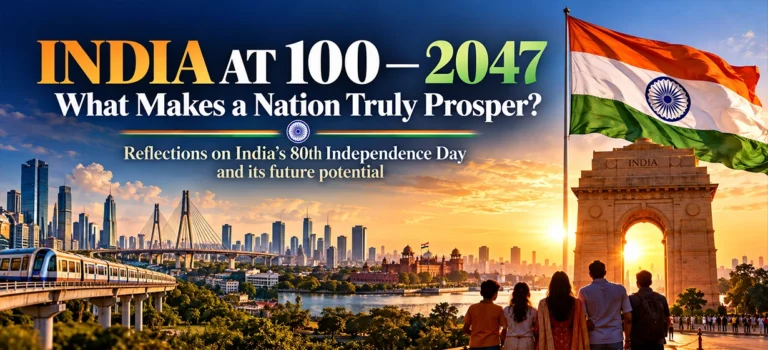
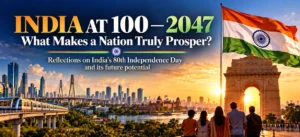
INDIA AT 100 — 2047 What Makes a Nation Truly Prosper? Reflections on India’s 80th Independence Day and its future potential
Contd. from previous edition
identity becomes more important than shared humanity and citizenship.
The deeper question is therefore not simply whether we tolerate people who are different from us.
It is:
Can we genuinely desire their flourishing?
Can people of different faiths defend one another’s dignity? Can communities celebrate each other’s achievements? Can those with greater opportunity help create opportunities for those historically excluded? Can political opponents disagree strongly without treating one another as enemies?
These questions are not directed at one religion, party, caste or community.
They belong to all of us. Unity does not require uniformity. A confident nation can allow deep differences while building around shared commitments to dignity, justice, responsibility and the common good.
The opportunity of the Indian diaspora
The Indian diaspora may also be one of India’s greatest resources for the next generation.
Millions of people of Indian origin now live across the world. In 2024 alone, India received an estimated US$129 billion in remittances, the highest amount received by any country.
That contribution is remarkable.
Yet the diaspora may have something even more valuable to contribute than money.
Indians living in Australia, Singapore, Britain, the United States, Canada, the Gulf and elsewhere have experienced different approaches to workplaces, institutions, public administration, entrepreneurship, civic responsibility and accountability.
Those experiences can become bridges rather than comparisons.
The question should not be, “Why can’t India simply become like another country?”
India’s scale, history and diversity make that too simplistic.
A better question is:
“What have we learned elsewhere that might be useful at home?”
That may mean mentoring a young entrepreneur, investing in productive businesses, transferring technology, supporting education, sharing professional standards, encouraging ethical business practices or creating international networks.
It may also mean modelling something simple but powerful:
success does not require compromising character.
Another ancient teaching captures this principle of stewardship:
“From everyone who has been given much, much will be demanded.” — Luke 12:48 (NIV)
Education is stewardship.
Wealth is stewardship.
Influence is stewardship.
Citizenship is stewardship.
Opportunity is stewardship.
For Indians living abroad, the question might therefore gently shift from “What has India given me?” towards “What have I learned, received or achieved that could now help someone else?”
What can India learn from other nations?
History offers useful comparisons, provided we make them humbly. South Korea endured war, authoritarian rule and deep hardship before becoming a prosperous, democratic and technologically advanced society.
Singapore, though vastly smaller than India, transformed itself through sustained investment in people, infrastructure, trade, public institutions and long-term planning.
Neither country is perfect. Neither offers a template India can simply copy. The useful lesson is not imitation. It is reflection.
Countries that have successfully moved towards high-income status have generally invested consistently in human capability, infrastructure, productive enterprise, global engagement, capable institutions and long-term thinking.
India must create its own path. Yet there may be a deeper principle that applies across nations:
Culture eventually influences economics.
What people believe influences behaviour. Repeated behaviour becomes habit. Shared habits influence culture. Culture shapes institutions. Institutions affect trust, productivity and opportunity. And those forces help determine what the next generation inherits.
Imagine India at 100
Let us imagine India in 2047—not merely richer, but more confident, capable and compassionate.
Imagine a country where every child has a genuine opportunity to develop his or her potential; where women can safely learn, work, create businesses and lead; where entrepreneurs spend more time innovating and less time navigating unnecessary complexity.
Imagine public money being treated as a public trust. Imagine leadership meaning responsibility rather than privilege. Imagine religious identity never diminishing human dignity. Imagine disagreement producing dialogue rather than hatred and success producing generosity rather than arrogance. Imagine Indians across the world contributing not only money, but also knowledge, mentoring, investment, integrity and service.
Political independence came in 1947. Economic liberalisation accelerated in 1991.
India’s digital revolution has opened another extraordinary chapter. Perhaps the next transformation is not only something government must do for us.
Perhaps it is also something we can build together.
That means strengthening honesty rather than normalising corruption, widening opportunity rather than protecting privilege, choosing dialogue over division, responsibility over entitlement and service over status.
No government alone can create such a culture. No political party owns these values.
And no religious community can claim them simply because its sacred writings contain noble teachings.
Values become powerful when people live them.
That brings us back to the ancient words with which we began:
“Godliness makes a nation great, but sin is a disgrace to any people.”
Perhaps the word greatness deserves a richer definition.
Greatness is not only GDP, military strength, skyscrapers, billionaires or technological achievement.
A truly great nation also develops people who use freedom responsibly, treat power as stewardship, protect human dignity, pursue justice and leave something better for those who follow.
India has already demonstrated what Indian intelligence and determination can accomplish.
Its scientists have reached the Moon. Its engineers build global technology. Its doctors serve across continents. Its entrepreneurs create international companies. Its diaspora contributes throughout the world.
The question is no longer whether India has potential.
History has answered that.
The more hopeful question is what may become possible when character grows alongside capability; when wisdom accompanies knowledge; when responsibility accompanies freedom; when service accompanies leadership; when generosity accompanies prosperity; and when truth and human dignity become stronger than fear and division.
If those foundations continue to grow, India’s greatest days may still lie ahead.
As India journeys towards its hundredth year of independence, perhaps history invites every Indian—at home and abroad—to ask two questions:
We gained political freedom in 1947. How can we use that freedom more wisely?
And:
What kind of people must we become for India to become the nation we know it can be?
The answer will not come from one leader, one government, one religion or one generation.
It will emerge from millions of choices, made day after day, by people willing to reflect, learn, contribute and build.
India at 100 begins with us.
Reflect. Learn. Contribute. Build.


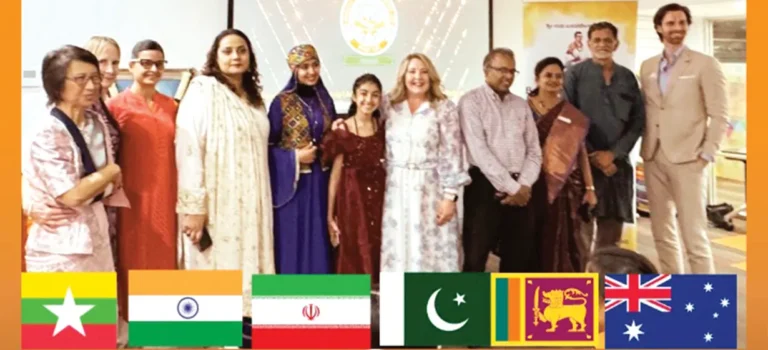
 Brisbane, Australia – 23 May 2025: The vibrant multicultural city of Brisbane witnessed a heartwarming celebration of Basava Jayanthi 2025, hosted by Basava Samiti of Asia Pacific (BSAPAC). The annual event commemorates the birth anniversary of Guru Basava, the 12th-century social reformer and spiritual visionary who pioneered inclusive social practices and ethical living, centuries ahead of his time.
 The program opened by lighting the lamp followed by the key note address was delivered by Mrs Karen Lay-Brew, the Board Member of Energy Queensland, Strategic Advisor to Australian Government. Karen migrated with family at the age of 11 from Mynamar provided an inspiring speech of the hardships of migrants and their journey to success, happiness and peace while navigating through the value system of life. Her speech was inspirational and touched the hearts of young and old.
 Other notable programs included the Australian national anthem via the violin, presentation of the Guru Basava Dashboard Idol – a spiritually uplifting artefact designed for the car, symbolising values of truth, work, and devotion, ideal for daily travel inspiration by the 12 year old Master Hanish Banavar. BSAPAC will promote these dashboard idols that can be used in the cars via their shopping carts.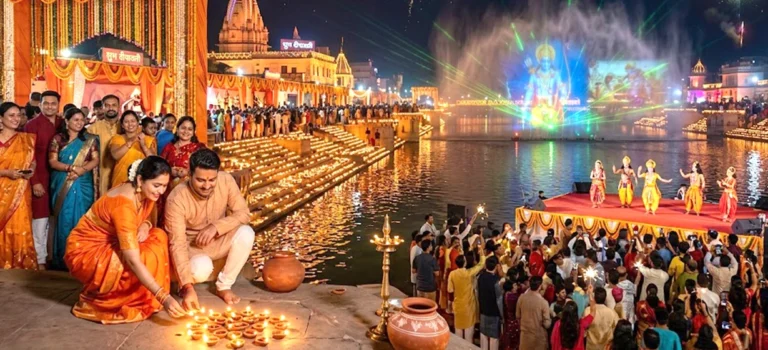
 Happy Diwali to all our readers who have started planning how they will celebrate this local, national and international celebration, which falls on November 8. From the Australian Indian Times family and me, I wish you all a safe and joyful five-day festival, both in the lead-up and throughout the celebrations. Diwali symbolises the spiritual victory of light over darkness, good over evil, and knowledge over ignorance.
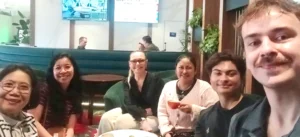 I am grateful to be growing up in such a vibrant and supportive community. Recently, I caught up with a friend and the owner of A–Z Gallery at Sunnybank Shopping Centre. I still remember how he would give me a gift and say hello every time I walked into his store. He has shown me small but impactful acts of kindness since I was three years old. Sitting down with him, seeing his wife and talking with his staff, particularly during the Moon Festival, was an incredible experience. Enjoying a cuppa of organic tea and finding some awesome bargains made it even more memorable. I would like to challenge our readers to perform an act of kindness this month and every month.
 I also had a wonderful time with the Vietnamese senior citizens, President Khue Oanh Do and members. I took part in their Father’s Day badminton challenge and helped hand out knitted beanies and items donated by Mission Possible and Gail Harrow. Gail and I have known each other since we were very young, and seeing her and all her volunteers was another incredible moment. If you would like to volunteer or donate to Gail and her team, reach out to Mission Possible in Logan Central.
 Schools play a huge role, and not just in education. They are increasingly becoming involved in young people’s wellbeing and having to deal with those sorts of issues as well.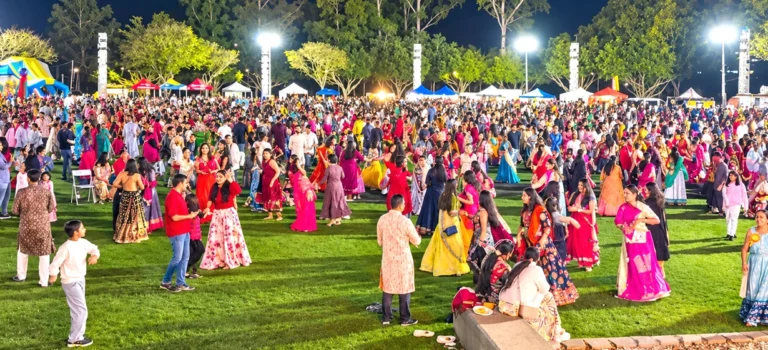
 Four-day festival to showcase more than 30 films across Indian and South Asian languages, bringing Indian cinema, filmmakers and audiences together in Perth.
 Mitu Bhowmick Lange AM, who is behind both the Indian Film Festival of Melbourne and Indian Film Festival of Sydney, NSW said, “We are incredibly excited to bring Indian cinema to Perth for the very first time. The launch of the Indian Festival of Perth is a natural extension of what we have been building across Melbourne and Sydney, and it is wonderful to now create a platform for audiences in Western Australia to experience the incredible diversity of Indian and South Asian cinema.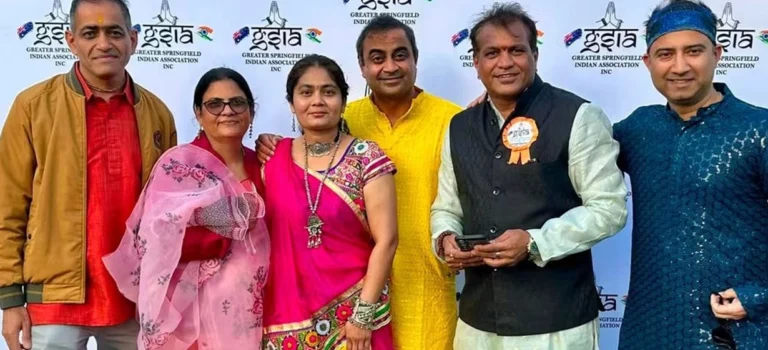
 What began as a community celebration has grown into one of the region’s much-loved multicultural events — but the real success of Greater Springfield Dandiya Night is not measured by the number of people who attend. It is measured by the people who come together to make it happen. The fifth Greater Springfield Dandiya Night at Robelle Domain Parklands was a beautiful celebration of Indian culture, music, dance and devotion, with more than 4,000 people coming together to enjoy the evening.
 The evening showcased the richness of Indian culture through music, dance and spiritual traditions. The spectacular Dhol Tasha performance by Shivam Vadhya Pathak was one of the highlights, filling the parklands with powerful beats and incredible energy. The cultural performances and Diwali-themed presentations added colour and excitement to the evening, while Goddess Durga Pooja and Aarti brought a beautiful spiritual dimension to the celebration.