

Beyond the Blame Game: Protecting
Social Cohesion Amid Australia’s Migration and Housing Debate
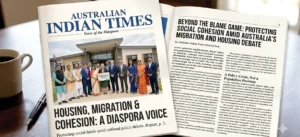
Across suburban neighbourhoods, dinner tables, and parliamentary corridors, one topic continues to dominate national conversation: housing affordability. Rents have surged, homeownership feels increasingly out of reach for younger generations, and infrastructure from public transport to regional healthcare systems faces persistent strain. However, alongside genuine economic anxieties, a concerning trend has taken hold in public discourse: the recurring tendency to turn complex policy failures into an oversimplified scapegoating of migration.
For the Australian Indian community, now standing as the nation’s largest overseas-born demographic and this shift in tone carries profound implications. As political leaders debate immigration caps and headline writers search for easy answers, multicultural advocates, community leaders, and civil rights bodies are issuing a clear warning: politicized migration rhetoric poses a direct threat to Australia’s social cohesion.
A Policy Crisis, not a Population Problem
Housing experts, economists, and welfare organizations have repeatedly emphasized that Australia’s current housing crisis is decades in the making. Factors such as investor tax incentives, planning and zoning bottlenecks, chronic undersupply of social and affordable housing, and shifts in average household sizes have driven rent and property price inflation.
Yet, when political debates heat up, complex structural factors are frequently reduced to a single headcount argument. Australian Human Rights Commission (AHRC) President Hugh de Kretser recently cautioned against treating migrant communities as convenience targets or economic threats during periods of social stress. De Kretser warned that weaponizing migration in political commentary risks weaponizing social division, leaving visible minority groups vulnerable to casual racism and systemic prejudice.
Multicultural peak bodies, including the Federation of Ethnic Communities’ Councils of Australia (FECCA) and Multicultural Australia, have echoed these concerns. They point out that attributing systemic infrastructure deficits to recent arrivals conveniently distracts from long-term planning failures while actively undermining the sense of belonging felt by hundreds of thousands of new Australians.
The Reality of the Indian Diaspora
The framing of migrants as “surplus actors” ignoring economic and social contribution misses the reality of modern Australia. Indian Australians are integral to the nation’s essential services, regional development, and economic growth.
CONTD. ON PG 5
CONTD. FROM PG 4
• Filling Critical Workforce Gaps: From doctors, nurses, and aged-care workers in regional hospitals to software engineers, construction managers, and transport operators, skilled Indian migrants actively keep critical infrastructure running.
• Building Supply: Ironically, addressing Australia’s acute housing shortage requires a larger skilled workforce including trades, engineering, and project management talent, much of which is bolstered through migration pathways.
• Civic and Cultural Richness: Beyond economic metrics, the Indian diaspora contributes vibrant cultural institutions, grassroots volunteer networks, and civic leadership that strengthen social fabric across metropolitan and regional centres.
When public commentary casually frames migration purely as a burden on resources, it erodes the dignity of communities who are actively building Australia’s future.
The Call for Action and Accountable Leadership
Protecting social cohesion cannot be treated as a passive exercise; it demands proactive leadership and institutional courage. Diaspora leaders across Australia are calling for concrete measures to ensure debates remain grounded in policy reality rather than identity politics:
1. Responsible Political Discourse: Political figures across all parties must resist short-term rhetoric that pits Australian-born citizens against new migrants. Long-term population planning must focus on genuine supply solutions, regional infrastructure investment, and intergovernmental coordination.
2. Strengthening Anti-Discrimination Protections: Legal frameworks and anti-discrimination mechanisms must be continuously modernized to address online vilification, workplace bias, and racial harassment.
3. Media Responsibility: News organizations have an obligation to report on demographic and housing data accurately, avoiding sensationalist headlines that fuel anti-migrant sentiment.
4. Active Community Engagement: Community organizations, temples, gurdwaras, and cultural associations are encouraging younger diaspora members to participate actively in civic discourse, local government, and public advocacy to ensure their voices shape national policy.
Preserving Australia’s Multicultural Success
Australia’s identity as a modern, successful multicultural democracy is not an accident, it is the result of deliberate policy, mutual respect, and shared effort. Housing and infrastructure challenges are real and urgent, but blaming the very people who help build, staff, and sustain the nation will not lay a single brick or construct a single hospital bed.
As the Indian diaspora continues to grow and put down deep roots across Australia, standing up against divisive rhetoric is not just about defending migrant rights but it is about preserving the trust, fairness, and mutual respect that underpins Australian society.
