

Final Contours: The India-US Trade Deal
Enters the Home Stretch
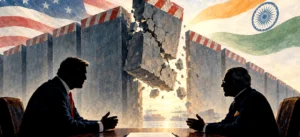
A crumbling tariff wall: India and the United States are closing in on the first phase of a long-awaited trade deal. Illustration: Australian Indian Times
The first phase of a landmark India-United States trade agreement is in its final stages of drafting, according to India’s Commerce and Trade Minister Piyush Goyal, capping a negotiation that has swung between breakthrough and brinkmanship for more than a year.
“It’s going through the final contours, the legal drafting, and we hope to be able to finalise that soon and operationalise that once we get comparable advantage or competitive advantage over our peer countries,” Goyal said in October.
The framework now being converted into legal text was agreed in February, and it marked a dramatic de-escalation. The punitive tariff the United States had imposed on most Indian goods in August 2025, after an earlier round of talks collapsed, was slashed from 50 per cent to 18 per cent.
India’s negotiating position is straightforward: its exporters should face tariffs in the American market no higher than those imposed on competing economies such as Bangladesh, Vietnam and Indonesia, along with preferential market access and greater tariff stability. “We anticipate concluding and signing the trade deal at the earliest possible time,” Trade Secretary Rajesh Agrawal said.
The path has not been smooth. A new American law, the proposed Graham Act, could pave the way for tariffs of up to 100 per cent on Indian goods over India’s continued purchases of Russian crude oil, a lever Washington has not been shy about waving. Neither side has publicly detailed all the reasons for the delays.
Then came the November midterms. Democrats won full control of both chambers of Congress on 3 November, ending Republican unity in Washington and, in the view of trade analysts, changing President Donald Trump’s calculus.
Ajay Srivastava, founder of the Global Trade Research Initiative, believes the election result could accelerate a deal. “I think the bad election results for Mr Trump will nudge him to expedite trade relations with India, and he may be expediting that trade agreement. It may happen sooner than we think,” he said.
“With Trump weakened in the domestic field, he will have only trade to concentrate on and I think he will push for an early India-US trade deal,” Srivastava said, suggesting a conclusion could come within roughly two months, with additional tariff levels of around 17 to 19 per cent still in play as a negotiating range.
The stakes are enormous in both directions. The United States remains India’s single largest export destination, taking nearly a fifth of its goods, and Indian shipments to America were still growing 22 per cent year on year even at the height of the tariff war.
For the diaspora in Australia, the deal matters twice over: for relatives in Indian export industries from textiles to pharmaceuticals, and for the certainty it would restore to the global supply chains on which Indo-Pacific trade depends.
Whether the final signature arrives in weeks or months, one thing is clear: the world’s two largest democracies have decided their commercial relationship is too important to leave broken.
