

Bhagavad Gita Chapters 14 & 15
Bhagavad Gita
Chapter 14
Guna-Traya Vibhag Yog – The Yog of Distinction between the three Qualities
Shree Bhagavan
Krishna said:
1. Again, I shall declare to you the supreme knowledge, which is the best of all knowledge. Having known that all the sages have gone from this world to the highest accomplishment.
2. Resorting to this knowledge and attaining the essence of my nature, they are not born again at the time of creation nor do they tremble at the time of dissolution.
3. The great Brahm is my womb. Within it I place the seed. From that emerges the origin of all beings, O Bharat Arjun.
4. Whatever forms are produced in any womb, O Kaunteya Arjun, the great Brahm is their womb, and I am the seed-giving father.
5. Sattva (goodness), rajas (passion)and tamas (dullness) are the gunas (qualities), born of material nature. O Mahabaho Arjun, they fasten the imperishable dweller of the body in the body.
6. Of these, sattva, being pure, causes illumination and freedom from disease. O Anagh (sinless) Arjun, it binds by attachment to happiness and by attachment to knowledge.
7. Know that rajas is characterised by passion, that arises from craving and attachment. O Kaunteya Arjun, it binds fast the embodied one by attachment to action.
8. Certainly, know that tamas is born of ignorance, which deludes all embodied beings. O Bharat Arjun, it binds fast with negligence, laziness and sleep.
9. Sattva causes attachment to happiness and rajas to action, O Bharat Arjun. But, by obscuring knowledge, tamas causes attachment to negligence.
10. Sattva prevails overpowering rajas and tamas, O Bharat Arjun. Rajas prevails overpowering sattva and tamas, and likewise tamas prevails overpowering sattva and rajas.
11. When the light of knowledge shines forth through all the openings of the body, then one should know that sattva has increased.
12. Greed, exertion, undertaking of actions, restlessness and craving; these spring up when rajas is dominant, O Bharatarshabh Arjun.
13. Darkness, absence of exertion, negligence and delusion arise when tamas reigns, O Kurunandan Arjun.
14. When an embodied being meets its end under the dominance of sattva, then it attains the pure world of those who know the highest.
15. Meeting with dissolution when rajas prevails, it is born among those who are attached to action; and if it dies during the dominance of tamas then it is reborn from the wombs of the deluded.
16. The fruit of a well-done action is said to be sattvic and pure, whilst the fruit of rajas is pain and that of tamas is ignorance.
17. From sattva arises knowledge and certainly greed from rajas. Negligence and delusion arise from tamas and ignorance too.
18. Those established in sattva move upwards and those situated in rajas stay in the midway. Those with tamasic attributes immersed in viler qualities and tendencies slide downwards.
19. When the seer perceives that there is no doer other than the qualities, and also knows that, which is higher than the qualities then he or she attains my being.
20. After transcending these three qualities, which are born of its contact with the body, the embodied being is released from the pain of birth, death and old age and enjoys immortality.
Arjun said:
21. O Lord, by what signs is the person who has transcended these three qualities recognised? What is the conduct of his or her life? How does that person get beyond these three qualities?
Shree Bhagavan Krishna said:
22. O Pandav Arjun, a person who does not abhor illumination born of sattva, exertion born of rajas and delusion born of tamas when they arise, nor crave for them when they cease;
23. Who remains seated as if unconcerned and undisturbed by the qualities, stands firm and does not flicker considering that it is only the qualities that act;
24. Who regards pain and pleasure alike, who dwells in one’s own self, who looks upon a clod, a stone and gold as of equal worth, who remains the same amidst pleasant and unlikable things, who is steadfast and is even-minded in blame and praise of the self;
25. Who holds alike honour and dishonour, who is impartial to friends and foes, who has given up all initiatives for action, that person is said to have transcended the qualities.
26. And one who transcending these qualities serves me with unwavering and exclusive devotion, becomes worthy for absorption into the Brahm.
27. I am the abode of Brahm, the immortal and imperishable, and of eternal laws and of ultimate bliss.
Thus ends the fourteenth chapter, entitled Guna-Traya Vibhag Yog – The Yog of Distinction between the three Qualities containing the discourse between Shree Krishna and Arjun in the Upanishad called the Bhagavad Gita, the science of Brahm, the scripture of Yog.
Bhagavad Gita
Chapter 15
Purushottam Yog – The Yog of the Supreme Spirit
Shree Bhagavan
Krishna said:
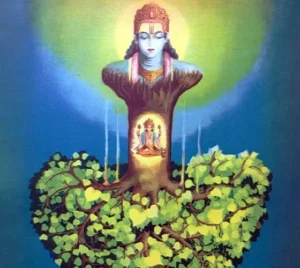
1. It is said that there is an imperishable Ashvatth (peepal tree) that has its roots above and branches below, and its leaves are the Vedic hymns. The one who understands this tree is a knower of the Veds.
Ashvatth symbolises the cosmic process of life. Ashva + stha is also interpreted as a place where a horse stays. The horse denotes the senses.
2. Its branches nourished by the qualities of material nature spread out downwards and upwards with sprouts made of objects of the senses, while its roots in the form of action creating bonds stretch deep down in the world of human.
3. The real form of this tree is not perceived in this world; nor its end, nor its beginning nor its foundation. One can cut this Ashvatth tree with well-grown roots by the strong weapon of detachment;
4. Then that goal from which those who have reached it never return is to be sought, saying ‘I take refuge in the primal spirit from whom the ancient current of the world has streamed forth’.
5. Those, who are free from pride and delusion, who have conquered the evil of attachment, who constantly dwell in the supreme self, who have turned away from desires, who are free from the dualities known as pleasure and pain and are not confused attain to that eternal place.
6. The sun does not illumine that place, nor the moon nor the fire. That place is my supreme abode, from which those who reach it never return.
7. A fraction of my own self becomes an eternal individual soul in the world of living. It attracts to itself from material nature the senses of which the mind is the sixth.
8. When the lord acquires a body and also when he departs from it, he goes taking them along, like the wind blowing fragrances from their sources.
9. The individual soul presiding over hearing, sight, touch, taste and smell, and also over the mind enjoys the objects of senses.
10. The deluded do not perceive him when he accompanied by the qualities of material nature departs or stays or enjoys sense objects, but those who have the eye of knowledge see him.
11. The striving yogis perceive him as established in their self, but the thoughtless ones whose selves are unprepared, though striving, do not see him.
12. The brilliance of the sun that illumines the entire world, and that which shines in the moon and in the fire too; know that brilliance to be mine.
13. Entering the earth, I support all beings with my energy, and becoming the moon, I cause all plants to thrive by nourishing them with the juice of life.
14. Becoming the digestive fire of life in the bodies of living creatures and mingling with the inhaling and exhaling breaths, I digest four kinds of food.
15. Likewise, I am lodged in the heart of all beings. From me come memory, knowledge as well as their loss. I alone indeed am the one who is to be known by means of all the Veds. I am the author of the Vedant and also the knower of the Veds.
16. There are two types of spirits in this world, the perishable and the imperishable. All beings are perishable and the unchanging is called the imperishable.
17. But the highest spirit is another, called the supreme self, who entering into the three worlds as the eternal lord, sustains them.
18. Since, I transcend the perishable and am even higher than the imperishable, I am celebrated as the supreme spirit in the world and in the Veds.
19. Those who, without being steeped in ignorance, perceive me as the supreme spirit, are knowers of all, and worship me unreservedly with their whole being, O Bharat Arjun.
20. Thus, I have revealed to you the most secret doctrine, O Anagh Arjun. By knowing this, one becomes wise and fulfills all his or her duties, O Bharat Arjun.
Thus ends the fifteenth chapter, entitled Purushottam Yog – The Yog of the Supreme Spirit, containing the discourse between Shree Krishna and Arjun in the Upanishad called the Bhagavad Gita, the science of Brahm, the scripture of Yog.
—Awadhesh Sharma
www.hinduguru.com.au
