

Constitution Showdown: Rabuka’s Reform Bid Hangs by a Thread
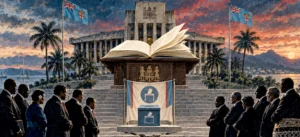
Fiji stands at a consequential moment in its political history, as Prime Minister Sitiveni Rabuka’s plan to amend the country’s 2013 Constitution hangs by a thread in a parliament where his own coalition partners have turned against him. The Constitution (Amendment) Bill 2026 passed its second reading on 2 October. But the decisive third reading, the vote that would send the proposed changes to a national referendum, has been delayed for at least a month after a wave of public backlash, RNZ Pacific reported.
The arithmetic is unforgiving. The bill needs a two-thirds majority, at least 36 votes in a 53-seat parliament, a chamber reduced from 55 members following the passing of two MPs.
The National Federation Party (NFP), whose support was key to Rabuka forming government in December 2022, has withdrawn from the special parliamentary committee leading the review and instructed its members to vote the bill down, arguing the process is being rushed.
SODELPA has gone further, directing its three MPs, all of them Cabinet ministers, to oppose the bill outright. The party wants the 2013 Constitution replaced entirely rather than amended, and the immunity clauses protecting previous coup leaders removed.
Rabuka’s response has been an ultimatum: any minister who votes against the bill will be expelled from Cabinet.
That ultimatum has placed Sashi Kiran, the NFP’s Minister for Women, Children and Social Protection, in an impossible position. “Either way I will lose my job in a month’s time,” she told Fiji Village. “If we vote for the bill the party will expel us and if we vote against the bill the prime minister will let us go.”
Kiran has called for the vote to be treated as a matter of conscience. “Let’s look at what the final bill is when it comes to the parliament again; let’s also look at whether every community’s rights are protected,” she said.
Her question goes to the heart of the matter for Fiji’s Indian community, whose place in the nation has been shaped by every constitution since independence in 1970. Rights protections, land provisions and communal representation are not abstract legal questions; they are the architecture of belonging.
The former prime minister Mahendra Chaudhry, Fiji’s first and only head of government of Indian descent, added his own warning last week, saying the country was “worse off today than we were at independence” and that its political leadership had its priorities wrong.
Rabuka has defended the reform as a duty, telling community consultations the third-reading numbers will determine “whether we keep going or [the constitution reform process] ends there.” He has proposed a referendum on 9 December and suggested it could be held on the same day as the national election, due by law on or before 6 February 2027, to save costs.
Opposition parties, rights groups and community leaders have all criticised the pace, arguing a document meant to bind a nation for generations should not be hurried through a fractured parliament.
For now, Fiji waits. A bill meant to settle the country’s constitutional question has instead exposed how deeply divided its politics remain, and how much is at stake for every community that calls Fiji home.
