Night of Pure Magic: Shreya Ghoshal Captivates Sydney with “The Unstoppable Tour”
By Entertainment Desk
SYDNEY — The iconic and timeless voice of contemporary Indian music, Shreya Ghoshal, left an indelible mark on the Emerald City last weekend, delivering a spellbinding, sold-out performance at the ICC Sydney (TikTok Entertainment Centre) on Saturday, 27 June 2026.
As part of the highly anticipated Australia and New Zealand leg of “The Unstoppable Tour,” the night proved exactly why Ghoshal remains an unmatched force in the global music industry, drawing thousands of enthusiastic fans from across the Indian diaspora and beyond.
An Unforgettable, Immersive Entrance
Breaking the traditional barrier between artist and audience, Shreya Ghoshal surprised the Sydney crowd by making her grand entrance directly through the audience before stepping onto the main stage. The venue erupted into a frenzy of cheers and applause as fans caught a close-up glimpse of the melody queen.
Spanning a spectacular career of over two decades, her setlist was a masterclass in musical versatility. From soulful, classical-infused masterpieces to high-octane Bollywood chartbusters, Ghoshal effortlessly cruised through multiple Indian languages.
Fans were treated to breathtaking live renditions of iconic tracks like:
• Deewani Mastani and Pinga (from Bajirao Mastani)
• Ghar More Pardesiya
• Raabta
• Silsila Ye Chahat Ka
Celebrating Local Talent and “Female Power”
A defining highlight of the Sydney concert was Ghoshal’s commitment to collaborating with local artists. During a high-energy performance of the hit song Nagada Sang Dhol, a talented local Sydney dancer joined her on stage, sending the energy in the arena through the roof.
Reflecting on the magical evening and her broader four-city tour—which also saw a female dhol player join her in Melbourne—Shreya Ghoshal shared her immense gratitude:
“Every city was filled with incredible energy, love, warmth, laughter, and celebration… One of the best parts was the surprises in every city. In Sydney, we had a fabulous dancer perform during Nagada Sang Dhol… There was a lot of female power joining us. Those moments made the performances even more magical. I truly feel that my tribe is growing with every show.”
A Growing Cultural Phenomenon
With over 23,000 fans attending the tour across Auckland, Perth, Sydney, and Melbourne, the massive turnout highlights the sustained, booming demand for large-scale live performances by premium Indian artists in Australia.
For the community gathered in Sydney, the evening was more than just a concert; it was a vibrant celebration of shared heritage, nostalgia, and world-class artistry. As Shreya Ghoshal moves forward with the global leg of her tour, Sydney fans are left with the lingering echoes of a truly unstoppable night.
By Sashi Lal-Sydney
As MIFF 2026 comes to a close, I look back with immense gratitude, pride, and unforgettable memories.
The journey of GIRMIT: The Fields of Sadness to the International Competition Section of the 19th Mumbai International Film Festival was much more than a film screening. It was an emotional journey of sharing the story of the Girmitiyas on one of the world’s most respected documentary film platforms.Watching our film on the big screen, alongside my crew, and engaging with filmmakers, critics, students, and audiences from around the world was a truly humbling experience. The conversations, appreciation, and emotional responses to the film reminded us why these stories must continue to be told.
My sincere thanks to MIFF 2026, NFDC India, the Ministry of Information & Broadcasting, the festival team, fellow filmmakers, delegates, critics, and audiences who made this experience so special.
Most importantly, I wish to thank our producers Rajendra Prasad, Aruna Prasad, Shavleen and Michael Heath. My dedicated crew Arunabha Mukherjee, Umakant Jagtap, Kisaloy Roy, Shamin Kulkarni, and Prakash Palav. our supporters and promoters worldwide; and the global Fiji-Indian community. This film is a reflection of your trust, support, and shared commitment to keeping the story of the Girmitiyas alive for future generations.
These photographs capture moments that we will cherish for a lifetime.
Sunny Bank Ramayan Mandali Supports New Hindu Temple Project with Generous Donation
Members of the Sunny Bank Ramayan Mandali in Brisbane gathered last night to extend their support for the proposed $5 million Hindu temple project at Bracken Ridge, Queensland. During a special presentation, the Mandali proudly donated $10,000 to the Hindu Society of Queensland. The cheque was formally handed over by representatives of the Mandali in the presence of community members and executives of the Hindu Society.
The occasion was marked with warmth, devotion, and a shared vision for strengthening Hindu culture and spiritual life in Queensland.
The donation reflects the Mandali’s ongoing commitment to supporting religious, cultural, and community initiatives that benefit the wider Hindu diaspora in Australia. Members expressed their hope that the new temple will become a significant spiritual and cultural landmark for future generations.
Photographs were taken to commemorate the occasion, capturing the spirit of unity and generosity between the Sunny Bank Ramayan Mandali and the Hindu Society of Queensland.
Historic Shift: India Overtakes England as Australia’s Largest Migrant Demographic
In a monumental milestone that marks a permanent shift in the nation’s multicultural fabric, India has officially overtaken England to become the largest source country for residents born overseas living in Australia.
The historic announcement comes courtesy of the latest demographic update released by the Australian Bureau of Statistics (ABS). The data confirms that the Indian-born population in Australia has surged to nearly 971,000 residents, edging past the UK-born demographic for the first time since European settlement. For a country whose modern migration history was structurally anchored toward Europe for centuries, the numbers represent an extraordinary, era-defining transition.
A Young, Vibrant, and Dynamic Demographic
Beyond the raw numbers, the ABS data reveals a stark and fascinating contrast between Australia’s traditional migrant cohorts and the rapidly expanding Indian diaspora.
While older, traditional European migrant groups are largely reaching retirement age, the Indian-Australian community stands out as an overwhelmingly young, aspirational, and economically active powerhouse. The median age of Indian-born residents in Australia sits at just 36 years, compared to a much older median age among UK-born residents.
This youthful profile means the diaspora is heavily concentrated within the prime working-age bracket, directly feeding vital skills into the Australian economy. From engineering and information technology to healthcare, education, and hospitality, Indian professionals are filling critical labour gaps and fuelling the nation’s post-pandemic productivity.
Education and Suburbs Fuelling the Boom
The growth trajectory has been largely sustained by two main pathways: the thriving international student sector and Australia’s permanent skilled migration program. Tens of thousands of Indian students who arrived over the last decade have successfully transitioned into permanent residency, establishing deep roots across metropolitan Australia.
Geographically, this historic surge is transforming local landscapes. Victoria and New South Wales remain the primary destinations, with western suburbs in Melbourne (such as Tarneit, Wyndham Vale, and Truganina) and Sydney (such as Harris Park and Blacktown) evolving into major cultural, commercial, and political hubs for the community. The rise of these vibrant “Little Indias” reflects a diaspora that is not just growing in size but deeply embedding itself into the local civic identity.
Re-shaping Australia’s Future
Community leaders and sociologists view this shift as a natural evolution of Australia’s geopolitical alignment with the Indo-Pacific. Speaking on the milestone, migration experts emphasize that the Indian diaspora represents a “living bridge” that is completely redefining bilateral relations, trade, and mutual cultural respect between New Delhi and Canberra.
With the population rapidly approaching the one-million mark, the Indian community’s influence on Australian politics, business, cuisine, and sports is undeniable. As India takes the top spot in Australia’s migrant hierarchy, it marks the definitive beginning of a new chapter, one where the subcontinental diaspora is firmly steering the future of modern, multicultural Australia.
BAPS Charities Brisbane Walkathon brings community together
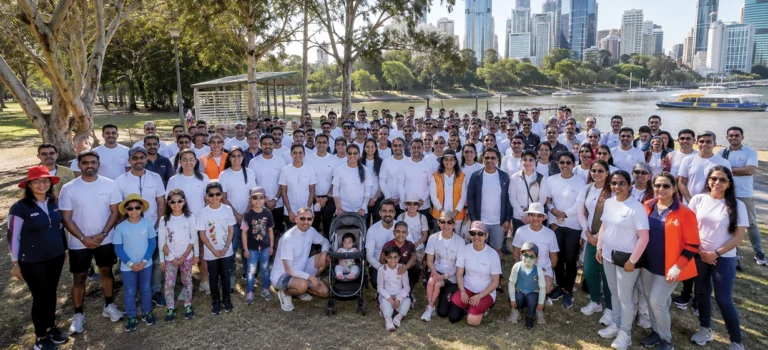
BAPS Charities organised its “In the Joy of Others” Walk and Run at New Farm Park, Brisbane, on Sunday 31 May 2026. Around 210 participants joined the event, including families, children, youth, volunteers and community members.The walkathon started near the New Farm Park Ferry Terminal and followed the scenic pathway along the Brisbane River. Participants enjoyed a peaceful morning walk while supporting the spirit of community service, unity and care for others.
The program included registration, welcome address, guest addresses, announcements, a group photo, the walkathon and light refreshments. Sandy Landers, Brisbane City Councillor, attended as a guest speaker and appreciated the efforts of BAPS Charities and the volunteers for bringing the community together for a meaningful cause.
The event was inspired by the life and message of His Holiness Pramukh Swami Maharaj, who taught, “In the joy of others lies our own.” This message continues to guide BAPS Charities in serving the wider community through compassion, humility and selfless service.
BAPS Charities thanked all participants, volunteers and community members who helped make the walkathon a successful and uplifting event.
In the coming months, BAPS Charities will continue its community service activities, including a blanket drive and hot food drive to support people facing hardship.
The walkathon was a wonderful example of people coming together with one heart and one purpose, to serve others and spread kindness in the community.
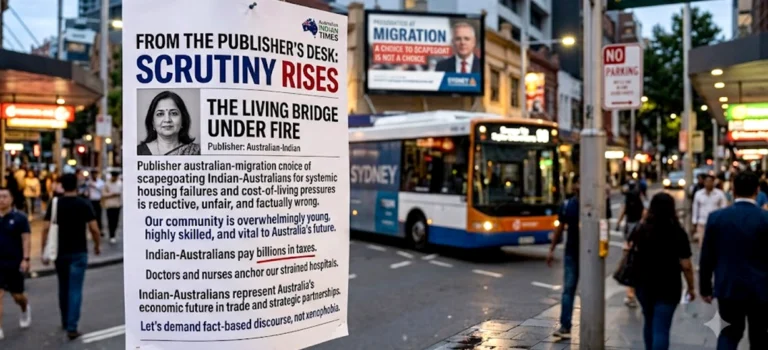
The Living Bridge Under Scrutiny—Why the Indian Diaspora is Vital to Australia’s Future
As Australia marches steadily toward its next federal election, the national conversation has found its familiar, well-worn lightning rod: immigration. Turn on any talkback radio station, scroll through social media, or read the latest political op-eds, and you will find Net Overseas Migration (NOM) figures dissected with aggressive scrutiny. In this hardening public discourse, a troubling shift has occurred. The Australian-Indian community, recently confirmed by the Australian Bureau of Statistics as the nation’s largest overseas-born migrant demographic, the increasingly finds itself unfairly positioned at the centre of complex anxieties surrounding housing shortages, infrastructure bottlenecks, and soaring cost-of-living pressures.
As publishers of the Australian Indian Times, we believe it is time to inject rigorous fact, economic reality, and profound cultural perspective into a debate that risks becoming dangerously reductive. To scapegoat the Indian diaspora for systemic, decades-long domestic policy failures in housing supply and infrastructure is not only intellectually dishonest; it ignores the foundational reality that modern Australia simply cannot function without the skills, taxes, and civic dedication of its Indian-Australian residents.
The Fiscal Engine: Paying Taxes and Building Wealth
A persistent, flawed myth in populist migration debates is that incoming residents place an immediate, uncompensated drain on public resources. The empirical data tells the exact opposite story. The Indian diaspora in Australia is structurally unique: it is overwhelmingly young, highly educated, and economically productive, boasting a median age of just 36.
When a skilled professional or an international student arrives from India, they do not arrive to a blank ledger of public dependency. They enter the workforce immediately during their peak productive years. The Indian-Australian community represents one of the highest tax-paying demographics in the country. From the immediate payroll taxes deducted from their salaries to the Goods and Services Tax (GST) paid on everyday consumption, and the billions of dollars contributed through corporate tax, stamp duty, and visa application fees, this community heavily subsidizes the public infrastructure and social safety nets that all Australians rely upon.
Unlike older, aging demographics that naturally require greater fiscal drawdowns for pensions and healthcare, the youthful Indian diaspora is a net positive fiscal engine. They are actively funding the very roads, schools, and hospitals that critics accuse them of overcrowding.
The Backbone of the Frontline: Medical Skills and Lifesaving Care
Nowhere is Australia’s structural reliance on the Indian diaspora more visible—and more critical—than in our strained healthcare system. Walk into any major metropolitan hospital, rural clinic, or regional health hub across New South Wales, Victoria, or Queensland, and you will find Indian-Australian doctors, specialists, nurses, and allied health professionals anchoring the frontline.
According to healthcare workforce data, thousands of Indian-trained medical graduates and skilled professionals migrate to Australia annually under strict skilled visa pathways. They do not displace local workers; they fill chronic, desperate shortages that local universities cannot meet fast enough. In regional and remote Australia, where the shortage of General Practitioners (GPs) often reaches crisis levels, it is frequently Indian doctors who relocate their lives to ensure rural families have access to primary care. To question the value of this migration path is to question the stability of our healthcare network.
Sustaining the Social Fabric: Aged Care and Child Care
Beyond the high-tech corridors of hospitals and IT hubs, the Indian diaspora performs the vital, emotionally demanding work that keeps Australian society humane and functioning. Our nation is facing a dual demographic challenge: an rapidly aging population requiring intensive support, and working young families requiring affordable, high-quality early childhood education.
In the Aged Care sector, a sector fundamentally shaken by workforce shortages over the last several years, Indian-Australian workers have stepped into the breach. With deep-rooted cultural values that revere elders, Indian professionals and students bring not just labor, but genuine empathy, dignity, and care to vulnerable older Australians in residential facilities and home-care settings.
Similarly, in Child Care and early childhood education, the diaspora forms a significant pillar of the workforce. By providing dependable, professional care for Australia’s youngest generation, Indian childcare workers directly enable hundreds of thousands of Australian parents to return to the workforce, thereby unlocking billions of dollars in broader economic productivity.
Shifting the Bilateral Needle: Trade and Strategic Partnerships
On the geopolitical stage, the Indian diaspora serves as the indispensable “living bridge” that has transformed Australia-India relations from a history of polite neglect to an era of unprecedented strategic intimacy. The economic architecture of modern Australia is deeply tied to India, crystallized by the Economic Cooperation and Trade Agreement (ECTA) and ongoing negotiations for a Comprehensive Economic Cooperation Agreement (CECA).
Indian-Australian entrepreneurs, corporate executives, and trade delegates possess the dual cultural literacy and market insights required to navigate the complexities of the Indian economy. Whether it is securing supply chains for critical minerals, expanding educational partnerships like the historic UNSW Bengaluru campus, or facilitating agricultural exports, the diaspora is the catalyst. As Australia seeks to diversify its sovereign trading partnerships away from historical over-dependencies, the Indian community provides the ultimate competitive advantage.
A Call for Mature Leadership and Social Cohesion
Housing shortages and cost-of-living pressures are deeply painful realities affecting millions of Australians today. They are the consequence of a complex mix of global inflation, historic planning failures, high interest rates, and lagging construction pipelines. They are not caused by the arrival of a skilled Indian nurse, an IT engineer, or an ambitious international student.
When political rhetoric simplifies these systemic issues into a blunt attack on migration numbers, it erodes social cohesion and breeds casual xenophobia. It makes young Indian-Australians, who love this country and call it home, feel vulnerable in the suburbs they have worked so hard to build.
Australia’s greatness has always been its ability to build a highly successful, prosperous multicultural democracy out of orderly, targeted migration. The Indian diaspora does not take from the Australian table; they have baked a larger pie for everyone. As we head into a politically charged election season, let us demand a mature, fact-based discourse from our leaders. Let us celebrate, protect, and stand firmly with a community that gives so much to the peace, health, and prosperity of our shared nation.
Adwin Awadh Meets Prime Minister of Fiji at Historic Flight Inauguration of Fiji Airways
Gold Coast, Australia – In a vibrant celebration of cultural exchange and entrepreneurship, Adwin Awadh, Development Director at Zeon Developments, had the distinct honor of meeting the Prime Minister of Fiji, The Honorable Sitiveni Rabuka during the inauguration of the new Fiji Airways flight connecting Nadi to Gold Coast.As the crowd buzzed with excitement, Adwin stood out not just for his role in development but for his dynamic personality and creative spirit. An MBA graduate from Griffith University, Adwin was born in Suva, Fiji and has called Gold Coast his home for the past 40 years where he has carved a niche for himself in running Medical Businesses and in the competitive world of real estate development.
Zeon Developments, under his leadership, is spearheading four ambitious projects, each valued at $100 million, employing innovative construction methods such as modular and prefabrication in partnership with ARBT prefab & backed by Government Support from the $350million Investment in Infrastructure and Development Fund (IIDF).
“Building communities is not just about structures; it’s about creating spaces where people can thrive,” Adwin shared during his conversation with the Prime Minister. His passion is evident as he discusses the potential of the new flight route to boost tourism and trade between Fiji and Australia & secured an invite from the Prime Minister to discuss potential development opportunities in Fiji.
Adwin’s talents don’t end in the boardroom. Beyond his professional achievements, Adwin is also a celebrated actor, recently winning an International Best Actor Award at ITFFA for his double role in the feature film Langha Phobia.
His diverse talents highlight the importance of creativity in leadership and community building.
“Film has the power to transcend boundaries and inspire change,” he remarked, reflecting on his dedication to storytelling.
As he mingled with other dignitaries, the conversation flowed, covering everything from economic strategies to the importance of cultural connections. Adwin’s vision for the future resonates with many—leveraging tourism to fuel economic growth and fostering partnerships that create lasting impact.
With the new Fiji Airways flight now operational, the future looks promising for both nations. Adwin Awadh’s journey is a testament to the power of collaboration, innovation, and the belief that with the right vision, anything is possible.
As the new flight route opens, it paves the way for greater connections and opportunities between Fiji and Gold Coast. Adwin Awadh’s involvement in this historic event underscores his commitment to fostering collaboration and driving progress in both development and the arts.
For more information about Adwin Awadh and Zeon Developments Investor Opportunities, please contact Adwin on 0415 557 430 or [email protected].
ANCESTORS OF THE SOIL: Landmark “Girmit” Documentary Stirs Deep Emotion in Packed Fiji Screenings
The historical narrative of the Fiji Indian diaspora came full circle as the powerful feature documentary, Girmit: The Fields of Sadness, concluded its emotionally charged community screenings in Nadi and Ba, Fiji. Directed by acclaimed filmmaker Shyam Upadhyay and inspired by the seminal book Tears in Paradise by former Ba Town Council Town Clerk Rajendra Prasad, the 87-minute cinematic masterpiece provides an unflinching look into the brutal realities of the British indentured labour system. Between 1879 and 1916, this system bound more than 60,500 Indian labourers, the Girmitiyas, to harsh plantations across Fiji.
The Sold-Out Shift in Nadi
The documentary’s main screening at Life Cinema in Nadi was a monumental, sold-out community event. Attended by prominent business stakeholders, civil rights advocates, and elderly community members, the atmosphere inside the theatre was thick with collective remembrance. The film systematically deconstructs long-silenced colonial records, substituting them with poignant descendant interviews that highlight the systemic hardships, creative resilience, and deep-seated pain of our shared ancestors.
THE EXPANDING PATHWAY: FROM DOCUMENTARY TO GLOBAL BLOCKBUSTER
• Stage 1: Critical global festival circuit accolades (USA, NZ, Australia, Kerala, Nepal).
• Stage 2: Sold-out community screenings across principal Fijian hubs.
• Stage 3: Official transition into a 2.5-hour international feature film.
• Stage 4: On-site filming slated across primary Indian and Fijian locations.
Following the screening, Director Shyam Upadhyay shared exclusive news that Girmit will soon be adapted into a 2.5-hour international feature film. Backed by substantial global interest, negotiations are currently underway with high-profile Bollywood stars. Principal photography is slated to begin in India late this year, with the secondary, localized filming phase deploying to Fiji after February.
Giving Back: The Free Community Screening in Ba
Recognizing that the town of Ba served as a major historical footprint and a core shooting location for the production crew, the filmmakers expressed their gratitude by hosting a special free screening at the Xavier College Auditorium in Ba. Supported by prominent local institutions like the Vinod Patel Group and Rajendra Prasad Supermarket, the screening allowed rural families, cane-farming descendants, and local students to engage directly with their ancestral history.
For many attendees, seeing their grandparents’ legacy projected on the screen sparked visceral tears, immense pride, and immediate calls for historical preservation. Community elders noted that the documentary serves as a vital pedagogical tool for the younger generation, ensuring that the heavy sacrifices that laid the groundwork for today’s Indo-Fijian and global diaspora are never forgotten.
By charting the historical arc from the sugar fields of the 19th century to the global modern diaspora, the screenings in Nadi and Ba have done more than record history, they have catalysed a vital global conversation on cultural survival and justice.
BSRIA Conference 2026 was organised with the theme “Timeless Teachings from Hindu Gurus.” The event brought together santos, invited speakers, community leaders, families, youth, children, volunteers and devotees for an evening of devotion, learning and reflection.
A total of 28 religious and social organisations and temples participated in the conference, with more than 100 invited guests representing the wider community. The event was attended by an assembly of around 800 people, making it a strong and united gathering of devotion, culture and spiritual learning.
The program highlighted the importance of the Guru in Hindu tradition through the well-known shloka, “Gurur Brahma, Gurur Vishnu, Gurur Devo Maheshwara, Guruh Sakshat Parabrahma.” The conference explained this message in a practical and heartfelt way, connecting ancient wisdom with everyday life.
The evening began with a welcome by the MC, followed by Dhun, Prarthana and Stuti by the BAPS Kirtan Team. A short video then presented the journey of previous BSRI programs from 2022 to 2025 and introduced the 2026 theme. The formal opening took place with Deep Pragatya, where santos, invited guests and community representatives were welcomed on stage.
A special devotional contribution was made by the Namdhari Sikh Society Australia, who sang beautiful bhajans and added a strong feeling of devotion and unity to the evening.
One of the memorable talks was by Swami Shrikarananda, who spoke about faith in the Guru’s agna. He shared a personal story of breaking a box simply because his Guru had instructed him to do so. The story touched the audience and showed the meaning of true trust, surrender and obedience to the Guru.
Nand Kishor Prabhu ji from ISKCON also addressed the gathering, quoting from the Bhagavad Gita and other shastras. He explained that the Guru removes ignorance, gives spiritual knowledge and connects the devotee with God.
A deeply inspiring pravachan was delivered by Pujya Arshpurush Swami Ji from BAPS, who explained the true importance of the Guru in a devotee’s life. He spoke in a simple yet powerful way, showing how the Guru gives direction, removes inner darkness, and helps us live with discipline, devotion and higher values.
His message beautifully connected the theme of the conference with the teachings of Bhagwan Swaminarayan, Gunatitanand Swami, Pramukh Swami Maharaj and Mahant Swami Maharaj. The pravachan left the audience with a clear reminder that when we follow the Guru’s agna and live with faith, our life becomes more peaceful, purposeful and spiritually strong.
The conference was presented through four main themes. Gurur Brahma showed how the Guru creates values, discipline and purpose in life. Gurur Vishnu explained how the Guru nurtures and protects our spiritual journey. Gurur Devo Maheshwara was presented through a panel discussion on how the Guru helps transform our nature by removing bad habits, ego, anger and negative swabhavs. Guruh Sakshat Parabrahma reflected on the Guru as the manifest form of God and the giver of moksha, supported by a video of Pujya Mahant Swami Maharaj, Amrutvani, guest reflections and a keynote message by a BAPS Sadhu.
The BAPS Dance Team also performed “Sarjan Poshan Lay Karnar,” adding colour, energy and devotion to the program.
The event also focused on children and youth education. A video interview with parents highlighted the value of Hinduism and Gita classes. The launch of Shrimad Bhagavad Gita Shlokas Learning Class and Hinduism Class 3 was also announced.
The conference concluded with Arti, vote of thanks, announcements, Dhyey Mantra, Samapan Shlok, a group photo and prasad.
Overall, BSRIA Conference 2026 was a meaningful and well-organised event. Through kirtan, bhajans, speeches, scriptural references, personal stories, panel discussion, videos, dance and educational initiatives, the conference reminded everyone that the Guru’s guidance is timeless and deeply needed in today’s life.
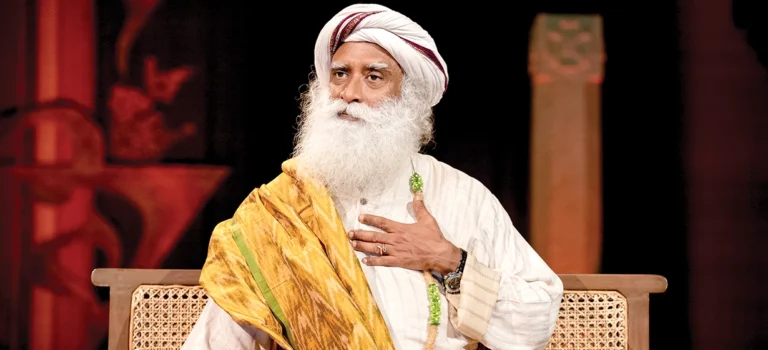
Sadhguru: The whole purpose of yoga is to set up various dimensions in you which are not you. What I mean by “not you” is: whatever you are identified with is what “you” are right now. But to set up a space within you beyond your limited identifications is yoga. Initially, it starts as a tiny speck. If you start clearing space for it, if you unload your crap, this space starts expanding.
A day comes when it occupies everything, and your crap just floats around. If you want, you can pluck and use it, otherwise you are untouched by it. When you become like that, we say you have become truly meditative, you are in samadhi, an equanimous state where this or that doesn’t touch you.
Without an armory of crap, you cannot live in the world. You won’t know any game. You will become like an avadhuta. These days, everyone is taking on the name: “I am avadhuta; you are also avadhuta.” That’s not what I’m talking about. An avadhuta is someone who is in a certain state where they become like infants – they don’t know anything. You have to feed them, you have to make them sit down, stand up. They are simply so ecstatic that they do not know how to handle any other aspect of their life.
Such a person has dropped his mind completely – he is totally free of nonsense. It is a very blissful and wonderful state, but then you need someone to take care of you, otherwise you cannot live like that – you have to take care of him like a baby. For small periods of time, it is good for people to go into those states because it is like sweeping the bottommost floor in your karmic structure.
It is like the karmic structure has 110 floors, and in this state, you are sweeping the bottommost floor, which you don’t get to do in other states – it would take enormous awareness for a person to go that deep and clean himself. But in this kind of state, one can scrape the bottom very easily. He is not doing anything, he does not know anything, but he has no karma, no bondage, so everything is cleaned up for him.
Yogis remain in such states for certain periods of time because it is the quickest way to become free. But at the same time, almost always, avadhutas cannot leave their body as avadhutas. That is one thing that is set up in the human consciousness. You cannot leave the body in that state. When you have to leave the body, you have to come to your awareness. And in those few moments of being out of this state, you can once again create karma.
This karma is springing from the dualities of life. If you transcend all duality, and there is a clear space within you, dualities just function outside of you. If you want, you can play the game, otherwise you are fine the way you are. Then bullshit is not a part of you, but you got a stock. If you want, you can use it, but it’s not you anymore.
Ranked amongst the fifty most influential people in India, Sadhguru is a Yogi, mystic, visionary and a New York Times bestselling author. Sadhguru has been conferred the Padma Vibhushan by the Government of India in 2017, the highest annual civilian award, accorded for exceptional and distinguished service. He is also the founder of the world’s largest people’s movement, Conscious Planet– Save Soil, which has touched over 4 billion people.



 SYDNEY — The iconic and timeless voice of contemporary Indian music, Shreya Ghoshal, left an indelible mark on the Emerald City last weekend, delivering a spellbinding, sold-out performance at the ICC Sydney (TikTok Entertainment Centre) on Saturday, 27 June 2026.
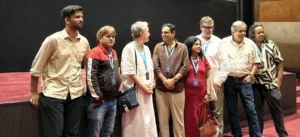 The journey of GIRMIT: The Fields of Sadness to the International Competition Section of the 19th Mumbai International Film Festival was much more than a film screening. It was an emotional journey of sharing the story of the Girmitiyas on one of the world’s most respected documentary film platforms.Watching our film on the big screen, alongside my crew, and engaging with filmmakers, critics, students, and audiences from around the world was a truly humbling experience. The conversations, appreciation, and emotional responses to the film reminded us why these stories must continue to be told.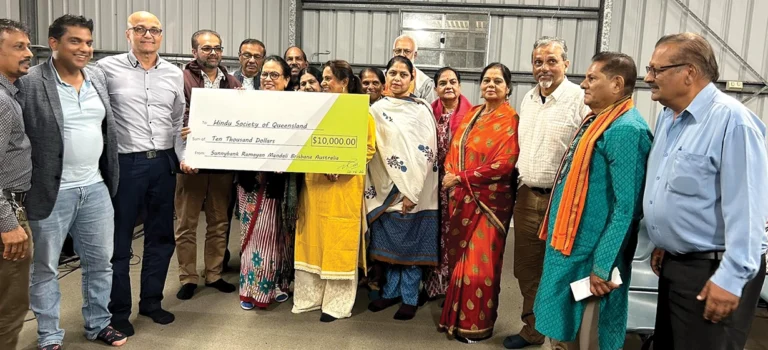








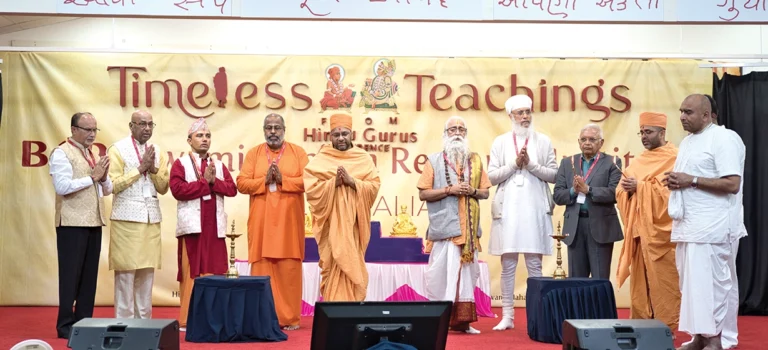
 BSRIA Conference 2026 was organised with the theme “Timeless Teachings from Hindu Gurus.” The event brought together santos, invited speakers, community leaders, families, youth, children, volunteers and devotees for an evening of devotion, learning and reflection.
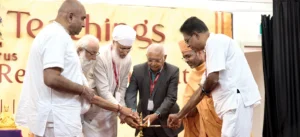 The evening began with a welcome by the MC, followed by Dhun, Prarthana and Stuti by the BAPS Kirtan Team. A short video then presented the journey of previous BSRI programs from 2022 to 2025 and introduced the 2026 theme. The formal opening took place with Deep Pragatya, where santos, invited guests and community representatives were welcomed on stage.
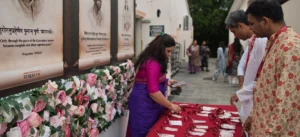 The conference was presented through four main themes. Gurur Brahma showed how the Guru creates values, discipline and purpose in life. Gurur Vishnu explained how the Guru nurtures and protects our spiritual journey. Gurur Devo Maheshwara was presented through a panel discussion on how the Guru helps transform our nature by removing bad habits, ego, anger and negative swabhavs. Guruh Sakshat Parabrahma reflected on the Guru as the manifest form of God and the giver of moksha, supported by a video of Pujya Mahant Swami Maharaj, Amrutvani, guest reflections and a keynote message by a BAPS Sadhu.