By Sandy Deo REMAX Landmark 0400920238 07 3189 6535 2/3 Curban Street Underwood [email protected]
When preparing your home for sale, styling is about much more than simply making your home look beautiful. It’s about presenting your property in a way that allows buyers to instantly connect with the space and imagine themselves living there.
Thoughtful styling has the power to enhance its overall appeal, highlight its best features and, in some cases, completely transform a home appearance.
The way we style our homes for everyday living is very different to styling for sale. And rightly so. When we style our own homes, we style to our personal preference – personal treasures, family photographs and collections that reflect our individual lives. It is these things that make our house feel like home.
But styling for sale is much different. It’s about showing our home at its best, for someone else to see possibility.
The good news is that styling doesn’t have to mean a complete makeover. In many cases, simple changes can have the biggest impact. Decluttering, rearranging furniture, slight decorative editing can help to create a greater sense of space and flow.
Start with the entry, as first impressions matter and it is in this space that the tone is set for the rest of the home. Remove unnecessary clutter and create a welcoming focal point with artwork, a mirror, fresh flowers or greenery to draw the eye and create an inviting atmosphere.
Living, dining and kitchen spaces are where buyers often imagine spending the most time. Keep these areas light, balanced and uncluttered, allowing standout features such as natural light, generous proportions or beautiful finishes to take centre stage. Style with intention, sometimes less is more.
Bathrooms and bedrooms should feel calm, fresh and effortless. Crisp linen, neatly folded towels and a touch of greenery can instantly elevate these spaces, creating a feeling of comfort and understated luxury.
Ultimately, styling isn’t about disguising a home or changing its character. It’s about enhancing what already exists. Thoughtful styling helps draw attention to these features while creating a welcoming atmosphere that leaves a lasting impression.
Coalition secures stronger deal for Australian journalism
The Coalition has secured a stronger deal for Australian news organisations, increasing the contribution required from multinational tech giants and helping protect the future of Australian journalism. The News Media Bargaining Incentive, which passed Parliament today with Coalition support, will require major digital platforms including Meta, Google, TikTok and Microsoft’s LinkedIn to make a fairer contribution for the value they receive from Australian news content.
The Coalition successfully argued that the charge applying to major digital platforms should be increased to 2.75 per cent of their Australian digital advertising revenue, strengthening the incentive for platforms to strike commercial agreements with Australian news businesses.
A strong and sustainable Australian media sector is vital to our democracy. That is particularly true in regional and rural communities, where local journalism plays an essential role in keeping Australians informed and holding decision makers to account.
The Coalition created the world-first News Media Bargaining Code because Australian journalism deserved a fair deal from some of the biggest companies in the world, and we have again acted to protect that principle.
It is deeply regrettable that it took the Albanese Government more than two years to act after Meta walked away in April 2024 from deals struck under the Coalition’s Code.
Rather than move quickly to strengthen the framework, Labor sat on its hands while Australian news organisations lost revenue, journalists lost jobs and local and regional media came under increasing pressure.
Labor’s original proposal was also badly flawed and risked taking Australian news businesses backwards, providing less support than the approximately $250 million reportedly delivered under the Coalition’s original bargaining framework.
The Coalition pushed for a stronger outcome and secured an increased contribution from the digital platforms.
We hope the strengthened scheme will deliver a significant boost to Australian news organisations, support Australian journalists and help protect the local and regional media Australians rely on every day.
The Coalition will continue to stand up for Australian journalism and ensure global technology companies make a fair contribution for the value they receive from Australian news content.
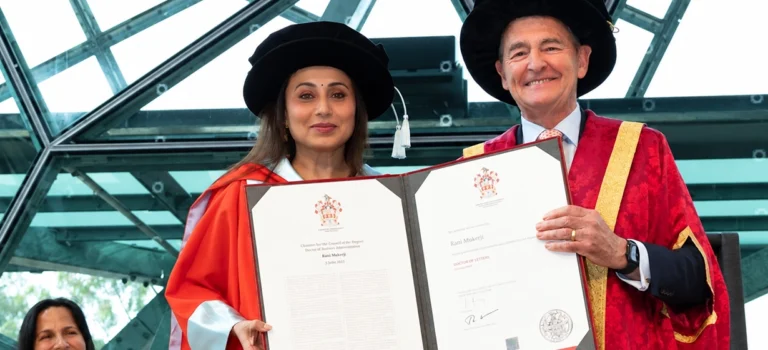
Rani Mukerji awarded Honorary Doctorate by La Trobe University
Melbourne, Australia: Acclaimed Indian actor and humanitarian Rani Mukerji has been awarded an Honorary Doctor of Letters (honoris causa) by La Trobe University, Australia in recognition of her outstanding contribution to Indian cinema, humanitarian work and social advocacy.The honorary doctorate was conferred on 14 August during the 2026 Indian Film Festival of Melbourne (IFFM).
One of the most respected and influential figures in Indian cinema, Rani has enjoyed a career spanning nearly three decades, earning widespread critical acclaim and major honours including a National Film Award and multiple Filmfare Awards.
Rani’s performances in films including Black, No One Killed Jessica, Hichki, the Mardaani
franchise and Mrs Chatterjee vs Norway have helped bring issues including gender-based violence, access to justice, disability inclusion and women’s rights into mainstream public conversation, demonstrating the power of cinema to drive awareness, empathy and positive social change.
Alongside her achievements in film, Rani has maintained a longstanding commitment to humanitarian initiatives supporting women, children and disadvantaged communities across India.
Since 2007, she has supported paediatric and neonatal healthcare initiatives at Holy Family Hospital in Mumbai, including the establishment and ongoing support of specialised intensive care services for critically ill children and newborns. Her philanthropic work has also supported initiatives focused on education, food security and community development.
Rani has additionally supported charitable and advocacy initiatives associated with organisations including Child Rights and You (CRY), the Indian Stroke Association and the Cancer Patients Aid Association.
Rani said she was deeply honoured to receive the recognition.
“Receiving this Honorary Doctorate in Australia from La Trobe University is one of the most emotional and meaningful moments of my career and life. I am deeply humbled by this recognition and accept it with immense gratitude. As an actor, you never begin your journey thinking about honours — you simply hope that the stories you choose and the characters you bring to life will connect with people.
To have that journey acknowledged in this extraordinary way is something I will cherish forever. I have always believed that cinema is one of the most powerful forces for change because stories have the ability to shape hearts, minds and society. Looking back at my career, I feel incredibly grateful that I have had the opportunity to portray women who are strong yet vulnerable, flawed yet inspiring, determined and unapologetically themselves.
These were never just characters to me — they represented countless real women whose voices deserved to be seen, heard and celebrated. If my work has, in any way, helped people view women with greater empathy, respect and equality, then I feel I have truly fulfilled my purpose as an artist.
This honour is also a reminder that art transcends borders. The emotions we share through cinema are universal and I feel privileged that the stories I have been a part of have travelled across cultures and touched audiences around the world.
As an Indian, this moment fills me with immense pride. I come from a country with a rich cinematic heritage and a storytelling tradition that has inspired generations. To be honoured with an honorary doctorate on a global stage is not just a recognition of my individual journey, but also a celebration of Indian cinema and the extraordinary talent it continues to offer the world.”
La Trobe University Chancellor The Hon John Brumby AO said Rani’s contribution reflected the values the University sought to recognise through its highest honours.
“Rani Mukerji is an artist of extraordinary influence whose work has consistently combined creative excellence with meaningful social impact.
“Through some of Indian cinema’s most acclaimed and socially resonant performances, she has helped elevate important conversations about equality, justice, inclusion and the dignity of women and children, demonstrating the unique power of storytelling to shape culture and inspire change.
“Through her artistic achievements and humanitarian contribution, she embodies the values La Trobe seeks to recognise through its honorary degrees: leadership, integrity, social responsibility and service to the public good.”
IFFM Festival Director Mitu Bhowmick Lange said the honour was a proud moment for the festival and the Indian Australian community.
“Rani Mukerji has remained one of the most respected voices in Indian cinema because of the integrity, intelligence and humanity she brings to her work. For nearly three decades, she has captivated audiences through performances that are both powerful and deeply relatable, while continuing to champion stories that encourage empathy, resilience and social awareness.
Her influence extends far beyond the screen, particularly through her longstanding commitment to women, children and community wellbeing.”
La Trobe University has maintained a longstanding association with Indian cinema through its partnership with the Indian Film Festival of Melbourne, previously hosting distinguished Indian film figures including Shah Rukh Khan, Amitabh Bachchan, Aamir Khan, Vidya Balan and Rajkumar Hirani.
The honour reflects the growing cultural and educational ties between Australia and India and recognises the role of cinema in fostering understanding, connection and dialogue across cultures.
Saving tax probably won’t make you rich. But none of that matters because there is one thing that unites Australians (and Indians) more than cricket, complaining about the weather and arguing over property prices: We Just Hate Paying the Damn Thing.
Tax laws have changed again. Apparently, Parliament decided you should suffer as a business owner. So, naturally Parliament has been sitting around a table drinking tea and concocting fresh ways to make running a business feel like attempting to reverse-park a V12 Lamborghini in a telephone box.
So, pour yourself a hot mug of coffee (still completely non-deductible, because of course it is) and let’s inspect the latest legislative disasters.
So, grab your coffee (still sadly not deductible unless you’re buying it for the office) and let’s dive into what changed this month.
The $20,000 Instant Asset Write-Off (Is Now Permanent)
In a rare, terrifying moment of sanity the Government has done something worthwhile. As promised in the budget, it has introduced legislation to make the $20,000 instant asset write-off permanent. Yes, permanently. I’ll give you a moment to recover from the shock.
If Parliament actually manages to pass it, it starts from 1 July 2026:
• You can write off eligible depreciating assets up to $20,000 instantly (instead of the laughable $1,000 limit they keep trying to drag us back to).
• The general small business pool threshold will also sit permanently at $20,000.
• They’ve also suspended the infamous ‘lock-out rule’ until 30 June 2027. (For those who don’t spend their weekends reading tax acts, this is the rule that banishes your business to the tax wasteland for five years if you dare opt out of simplified depreciation).
What does this mean to you? It means if you need a brand-new, power-packed piece of machinery for your business—say, an absurdly large hydraulic press or a heavy-duty trailer—you don’t have to spread the deduction over the next four decades. You buy it, you write it off, and you tell the ATO to jog on.
Loss Carry Back Returns
Remember when the world turned upside down and then back to front in 2020? The Government let companies carry back losses to get actual cash refunds on tax they’d paid in better times? Well, it’s back.
Legislation has been introduced to re-boot the ‘loss carry back’ scheme from 1 July 2026. If your company hit a bit of a snag and made a tax loss, you don’t just have to sit there staring at it like a broken-down supercar on the side of the Bruce Highway. You can carry that loss backwards and offset it against profits you paid tax on in the previous two income years.
The result? The ATO—a machine designed purely to suck money out of your bank account—might actually have to send some of it back. It’s like demanding a refund from a thief. Marvellous.
ATO Warning: Don’t Claim Your Dining Room
The ATO has launched a full-scale assault on business owners and employees claiming “occupancy expenses” (rent, mortgage interest, rates) because they occasionally answer an email while sitting in their underpants at the kitchen bench.
If you want to claim mortgage interest or rent on your home, the ATO says your space must be an actual, unassailable ‘place of business’. To prove this without getting dragged into an audit room and tortured, you must satisfy four strict rules:
• It must be clearly identifiable as a place of business (a desk covered in coffee mugs and tax bills in your bedroom don’t cut it).
• It cannot be readily capable of private or domestic use (if you can fold up your laptop and eat a microwave curry on the same surface, you lose).
• It is used exclusively or almost exclusively for business.
• It is used regularly for client or customer visits (unless your clients enjoy tripping over your dog on the way to the kettle, good luck).
If you are an employee, you also must prove your employer was so outrageously stingy they didn’t provide you with an alternative workplace at all. If you meet these brutal hurdles, you can claim a fraction of your expenses based on floor area and time. But be warned: the tax office is watching, and they have no sense of humor so don’t expect them to laugh at your hilarious excuse.
Property Manager Reports: A Minefield Of Errors
If you own investment property, you probably receive a nice, neat end-of-year summary from your property manager and hand it straight to your accountant. The ATO has publicly warned that these reports are frequently littered with mistakes. Apparently, they are about as accurate as undertaking surgery whilst being tickled.
The tax man’s hitlist of common property report errors includes:
• Capital expenses disguised as repairs: Fixing a tap is a repair; replacing a rotten balcony before a tenant falls off it is capital. You can’t deduct capital costs all at once.
• Grouped lump sums: Managers dumping $5,000 into a line item called “Maintenance” without explaining whether it was for a lightbulb or a new roof.
• Timing mismatches: Mixing up when expenses were actually incurred versus when the property manager got around to paying them.
• Private slip-ups: Smuggling personal expenses—like the owner’s weekend stay at the property—onto the ledger.
Don’t assume your property manager is a tax expert. They aren’t. Your accountant must inspect these reports with a fine-tooth comb before the ATO does.
Scammers Impersonating The ATO (and Doing a Worryingly Good Job)
As if the official ATO wasn’t scary enough, fake ones are now sending out phishing emails designed to steal your myGov credentials.
The latest scam email claims you have a “scheduled phone appointment with the ATO” and tells you to open an attached file to confirm or reschedule. That attachment leads to a fake myGov login page that looks utterly genuine—until it drains your passwords and personal security codes.
Remember The ATO Golden Rules — The ATO will NEVER:
• Email you an attachment containing a link to a myGov login page.
• Force you to access ATO services via unsolicited email links.
• Send you to a login page outside official .gov.au websites.
• Ask for your myGov password, username, or SMS codes via email.
If you receive one of these, do not click it. Do not open the attachment. Delete it, or call us immediately.
Final Coffee Sip (Because Lawyers Lack A Sense Of Humour)
This article contains general thoughts and observations only. It does not replace proper, tailored professional advice. Before you make any monumental financial decisions—or attempt to explain your unconventional tax strategies to the ATO—talk to tax agent first. It is infinitely cheaper than paying penalties.
Please, under no circumstances, attempt to:
• Sell your factory floor to buy physical gold;
• Declare your home dining room a sovereign international trade zone;
• Pay your staff in vintage wine; or
• Tell an ATO auditor that “this Coffee Update said it was fine.”
—Hitesh Mohanlal
Why the Indian Diaspora is Not to Blame for Australia’s Housing Crisis
By Jitendra Deo Chief Executive Officer JD Group Australia
The Australian housing crisis is the barbecue stopper of the decade. Renters are queuing around the block for mouldy apartments, first-home buyers are being perpetually locked out of the market, and political pressure is boiling over. In the desperate search for a quick fix, a familiar and highly convenient target has emerged: immigration, and by extension, Australia’s rapidly growing Indian diaspora.
It is a seductive narrative for those seeking simple answers to complex problems. More people arriving means fewer houses available, right? It sounds like simple math. But this reductionist logic is not just intellectually lazy; it is a dangerous misdirection. The Australian housing crisis was not packed in the suitcases of recent arrivals from Bengaluru, Punjab, or Gujarat. It is a homegrown disaster, brewed over three decades of systemic policy failure, tax distortion, and political cowardice.
To understand the true roots of this crisis, we must look away from the arrival gates of Sydney and Melbourne airports and instead examine the nation’s tax code and planning laws. For over twenty years, structural incentives have transformed the humble Australian home from a fundamental human right into a speculative financial asset.
The real architects of the crisis are policies like negative gearing and the capital gains tax discount. These mechanisms heavily incentivized multiple-property ownership for domestic investors, artificially inflating demand and locking a generation of young people out of homeownership. While investors were handed tax breaks to hoard existing properties, governments at all levels simultaneously walked away from their responsibility to build social and affordable housing. We stopped treating housing as infrastructure and started treating it as a stock portfolio.
Add to this the chronic bottlenecks in construction, restrictive local zoning laws that empower “NIMBY” (Not In My Back Yard) councils to block medium-density urban infill, and the monopolistic practices of land banking by major developers. Successive governments have watched this supply-demand imbalance widen since the late 1990s. Blaming a skilled IT professional or a nursing student arriving in 2024 for a structural deficit that began a generation ago is completely absurd.
The reality is that the Indian diaspora, now Australia’s largest overseas-born demographic, is walking into the exact same crisis as everyone else. We are the renters paying exorbitant weekly rates. We are the young families saving desperately for a deposit while the goalposts continuously shift.
More importantly, migrants are an integral part of the solution. The Australian economy relies on targeted migration to offset an aging population and fill critical skills shortages. Migrants are overrepresented in the very industries essential to building our way out of this deficit, from civil engineering and architecture to logistics and essential trades. Halting migration to “fix housing” would be akin to cutting off a leg to lose weight. It would trigger a recession, stall major infrastructure projects, and collapse the higher education sector, all without laying a single new brick for affordable housing.
Why, then, is the diaspora being blamed? Because scapegoating the “other” is politically expedient. It demands nothing of our leaders. It requires no courageous tax reforms, no bruising battles with wealthy local councils over housing density, and no massive public investments in social infrastructure. Pointing the finger at migrants allows policymakers to shrug off decades of their own neglect and channel the very real economic anxiety of the public toward a visible minority.
As a community, we must push back against this narrative firmly and factually. The Indian-Australian community is not a burden on the housing market; we are active, tax-paying contributors to the Australian economy and society. We must join forces with all Australians locked out of the housing market to demand genuine reform. We need equitable tax policies that favour first-home buyers over seasoned investors, streamlined zoning laws that allow for sensible urban growth, and a massive revitalization of public housing.
The housing crisis is a national emergency that requires a national, policy-driven solution. Blaming the newest arrivals will not build a single home, but it will fracture the multicultural fabric that makes modern Australia so successful. It is time for our leaders to stop looking for scapegoats and start doing the hard work of structural reform.
No HIV Vaccine Yet—But There Are Many Ways to Prevent HIV
HIV affects people from many cultures and communities in Australia. Some people who were born overseas may find it difficult to access health information and services because of language and cultural barriers, cost, or unfamiliarity with Australia’s health system.
There is currently no vaccine for HIV. However, there are several highly effective ways to prevent HIV. You can choose the method—or combination of methods—that works best for you. HIV can be passed on through certain body fluids, including blood, semen, vaginal fluids and anal fluids. It can be prevented in the following ways.
Use condoms
Condoms help prevent HIV and many other sexually transmissible infections (STIs). They can also prevent pregnancy.
Condoms come in different sizes. Make sure you know what size fits you. Check the expiry date and make sure the packet is not damaged before use. Store condoms in a cool, dry place.
Use a new condom every time you have sex. Do not use two condoms at the same time because friction may cause them to break. Use a water-based lubricant with condoms.
You can buy condoms from pharmacies, supermarkets and online. You can also order free condoms from https://eccq.com.au/health/love-health/ or https://www.qc.org.au/wrapped-n-ready
Take PrEP before possible exposure to HIV
Pre-exposure prophylaxis, or PrEP, is medicine taken by an HIV-negative person before possible exposure to HIV. When taken correctly, PrEP is highly effective at preventing HIV.
PrEP does not prevent other STIs or pregnancy.
PrEP can be taken daily or, for some people, only around the time they have sex (on-demand PrEP). On-demand PrEP is not suitable for everyone. A doctor or authorised nurse practitioner can help you choose the safest option.
Some people have mild side effects when they start PrEP, such as nausea or headaches. Kidney problems are rare, and regular health checks help make sure PrEP remains safe for you.
Learn more at https://www.healthdirect.gov.au/Pre-exposure-prophylaxis-PrEP
Take PEP after possible exposure to HIV
Post-exposure prophylaxis, or PEP, is medicine that may prevent HIV after a possible exposure. You may need PEP if, for example:
• a condom broke or was not used during sex
• you shared injecting equipment
• you experienced sexual assault
• you had contact with blood that may contain HIV. PEP must be started within 72 hours of the possible exposure. The sooner you start, the better. PEP must be taken for 28 days.
You can ask for PEP at a sexual health clinic, a hospital emergency department, a Medicare Urgent Care Clinic or from a specially trained family doctor (a list can be found at https://ashm.org.au/prescriber-programs/find-a-prescriber/find-a-hiv-prep-prescriber/ ). Visit www.getpep.info to find a PEP service near you, or call 13 HEALTH on 13 43 25 84, 24 hours a day, 7 days a week.
PEP does not prevent other STIs or pregnancy. Some people experience temporary side effects such as nausea, headache, diarrhoea or vomiting.
HIV treatment prevents sexual transmission: U=U
HIV treatment is highly effective. A person living with HIV who takes their treatment as prescribed can reduce the amount of HIV in their blood to a level called “undetectable”, meaning that current tests cannot detect HIV in their blood.
When a person maintains an undetectable viral load, they cannot pass HIV to another person through sex. This is called Undetectable = Untransmittable, or U=U.
U=U protects sexual partners and helps people living with HIV stay healthy. Regular viral-load tests are important.
Use sterile injecting equipment
HIV can be passed on by sharing needles, syringes or other injecting equipment. Always use new, sterile equipment and do not share it with another person.
Needle and syringe programs (NSPs) provide sterile equipment, information and confidential support.
If you travel overseas for medical or dental treatment or cosmetic procedures, make sure that sterile medical equipment is used to prevent HIV transmission as some countries may not have the same strict infection-control and blood safety measures.
If you need an interpreter, you can ask the health service to arrange one for you.
Stay safe and protect yourself from HIV!
Our bilingual community health workers can provide information and support in your language.
For more information, contact: Email: [email protected] Information in different languages is available at: www.eccq.com.au/bbv
New Leadership and Strategic Expansion for the Centre for Australia-India Relations
A Defining Chapter in the Bilateral Relationship
The Australia-India bilateral partnership is experiencing unprecedented momentum. As the Comprehensive Strategic Partnership (CSP) deepens across economic, strategic, and cultural spheres, the Australian Government has taken a major stride in reinforcing the institutional bridge between the two nations.
Foreign Minister Senator Penny Wong has officially announced new high-profile appointments and reappointments to the Advisory Board of the Centre for Australia-India Relations (CAIR). The move brings a wave of elite expertise spanning green technology, hyperscale infrastructure, advanced manufacturing, and academic research into the core body driving Australia’s engagement with India.
The announcement arrives at a transformative epoch. With the India-born population now officially representing the single largest overseas-born demographic in Australia, the diaspora’s economic and civic influence has never been more pronounced. CAIR’s refreshed mandate signals a clear objective: translating diplomatic goodwill into tangible commercial, technological, and community outcomes.
The following distinguished Leaders are newly appointed members to the CAIR Advisory Board reflect the evolving priorities of the bilateral relationship, focusing heavily on critical technologies, advanced manufacturing, and sustainable innovation.
1. Professor Veena Sahajwalla AO
A world-renowned scientist, inventor, and Director of the Centre for Sustainable Materials Research and Technology (SMaRT) at the University of New South Wales (UNSW), Professor Sahajwalla is globally celebrated as the pioneer of “Green Steel”. A recipient of the prestigious Pravasi Bharatiya Samman Award, her appointment embeds cutting-edge recycling science, waste transformation, and circular economy research into CAIR’s core strategic focus at a time when both nations are aligning on clean energy transitions.
2. Robin Khuda
As the Founder and Chief Executive Officer of AirTrunk which is a hyperscale data centre giant across the Asia-Pacific, Robin Khuda brings unmatched commercial acumen in digital infrastructure, cloud computing, and technology investment. His presence on the board reinforces Australia’s ambition to tap into India’s booming digital economy and artificial intelligence ecosystem.
3. Faz Pollard
Director of Western Australia-based advanced manufacturing firms Adarsh Australia and Afaridan Plastics, Faz Pollard brings deep operational experience in engineering, product development, and cross-border commercial engagement. His expertise will be vital as Australia seeks to integrate its supply chains with India’s rapidly growing manufacturing base.
In addition to these new appointments, the Minister confirmed the reappointment of four incumbent board members who have been central to shaping CAIR’s early successes:
• Amrit Gill, CEO of Theatre Network Australia;
• Catriona Jackson, former CEO of Universities Australia and higher education policy specialist;
• Mitu Bhowmick Lange AM, Founder of Mind-Blowing Films and premier cultural distributor; and
• Amit Singh, Managing Partner of Mandala Partners and former Senior Economic Advisor to the Prime Minister.
Under the continued leadership of Advisory Board Chair Swati Dave, alongside board members Dr. Helen Nugent AC, Steve Waugh AO, and DFAT Secretary Jan Adams AO PSM, the board represents one of the most formidable collections of strategic intellect in Australian public policy today.
CAIR’s Strategic Pillars: Bridging Policy, Business, and Diaspora
Established as a flagship platform by Prime Minister Anthony Albanese, CAIR serves as a national nexus designed to scale up Australia’s capability to engage with India. Operating under the Department of Foreign Affairs and Trade (DFAT), the Centre’s agenda centers around key strategic priorities:
1. Promoting Policy Dialogue & Indo-Pacific Security: Elevating strategic alignment between New Delhi and Canberra amid complex geopolitical shifts in the Indo-Pacific.
2. Building India Business Literacy: Assisting Australian businesses in navigating India’s vast market realities, leveraging frameworks like the Economic Cooperation and Trade Agreement (ECTA) and the broader Roadmap for Economic Engagement.
3. Deepening Education, Tech & Cultural Connections: Expanding research collaborations, clean technology partnerships, and artistic exchanges.
4. Harnessing the Diaspora as a National Asset: Actively integrating Indian-Australian leaders into formal bilateral trade, investment, and policy discussions.
Through its signature Maitri (Friendship) Programs—which include Maitri Grants, Scholarships, and Fellowships—the Centre is pouring millions into cross-cultural theatre, joint academic research, and innovative clean-tech ventures.
The Diaspora: From Demographic Shift to National Asset
For the Indian diaspora in Australia, CAIR’s expanding mandate is more than a policy exercise—it is institutional validation of their contribution to modern Australia.
“The strengthening of institutional links between the two countries reflects the increasingly vital role of the diaspora,” noted foreign affairs analysts following the announcement. Indian-Australians are no longer viewed simply through the lens of migration statistics, but as economic multipliers, cultural ambassadors, and key drivers of innovation.
With diplomatic footprints expanding—marked by Australia’s mission in Bengaluru and India’s consulate in Brisbane—and high-level exchanges occurring regularly between ministers, the architecture connecting the two democracies has never been stronger.
As CAIR embarks on this next phase of strategic growth under its refreshed board, the message for the readers of Australian Indian Times is clear: the Australia-India partnership is no longer just about potential—it is about execution, leadership, and a shared vision for the Indo-Pacific.
First two productions on sale for 2027 Adelaide Festival
With previous Festival productions Go Down Moses (2016) and Mozart’s Requiem (2020) wowing audiences, Romeo Castellucci’s breathtaking production of Béla Bartók’s operatic masterpiece, Bluebeard’s Castle, transcends a naturalistic setting with a spectacular water-filled stage lit by flames.Castellucci places the audience in the viewpoint of Judith, newlywed to Duke Bluebeard and driven to open the seven forbidden locked doors of their castle. Each new chamber in turn brings an eruption of fire that illuminates both Bluebeard’s secrets and the unfolding layers of Judith’s psyche.
Lauded for its poetic brilliance after premiering at Salzburg Festival in 2022, this production illuminates why Bluebeard’s Castle is a 20th century operatic cornerstone; from the awe of its orchestration to the power of its vocal writing.
Barrie Kosky continues his career-long association with Adelaide Festival following a string of spectacular operas including Saul (2017), The Magic Flute (2019), The Golden Cockerel (2022) and The Threepenny Opera (2024).
K. is his theatrical reimagining of Franz Kafka’s famous novel The Trial, a whirlwind of theatre, dance, song and vaudeville delivered by the extraordinary actors of the Berliner Ensemble and a live band.
“Someone must have been telling lies about Josef K, he knew he had done nothing wrong but, one morning he was arrested”…so begins The Trial; a comic yet terrifying tale of Josef K’s blind tumble through totalitarian bureaucracy and an absurd, labyrinthine system of laws that are nearly impossible to navigate.
Fuelled by Kafka’s exploration of Yiddish theatre and his own Jewishness, Kosky’s chaotically inventive spectacle features German star Kathrin Wehlisch in the title role. Wehlisch’s masterclass in comedy and vaudeville will be the talk of the festival.
Adelaide Festival Artistic Director Matthew Lutton OAM said: “Our early release brings together two Adelaide Festival favourites – Romeo Castellucci and Barrie Kosky – directors whose work is wildly imaginative and impossible to forget. Just remember the spectacle of Kosky’s Saul and Castellucci’s Requiem. Now they return with two productions that promise to be equally unmissable.
Bluebeard’s Castle is one of the great 20th century operas, and Castellucci’s elemental production unleashes the full power of what visionary opera can be. Kosky transforms The Trial into an all-singing, all-dancing feverish collision of terror and comedy that only he could conjure, and I’m particularly thrilled that this will be Barrie’s first theatre work in Australia since 2010’s The Tell-Tale Heart. These are audacious, spectacular events: rare, exhilarating, and unlike anything audiences will experience anywhere else in Australia.”
Minister for Arts Kyam Maher MLC said: “These two extraordinary productions from two world-class directors are setting the stage for a truly exciting Adelaide Festival in 2027. Bringing Barrie Kosky’s K., a wild reimagining of Franz Kafka’s The Trial alongside the Australian premiere of Romeo Castellucci’s Bluebeard’s Castle to Adelaide speaks to the strength of our state as a global arts and cultural hub, supported by the State Labor Government’s investment in the arts.
Adelaide Festival has a proud history of bringing some of the world’s most acclaimed artists to South Australia, giving audiences the opportunity to experience ambitious work without travelling overseas. Bluebeard’s Castle is the latest international drawcard to land in Adelaide, following Pulp, Little Amal and the opera Innocence, and offers audiences across Australia and the Asia-Pacific the chance to experience a landmark 20th-century opera right here in South Australia.
I look forward to another successful Adelaide Festival in 2027 and welcoming audiences from near and far.”
Bluebeard’s Castle will be performed at the Festival Theatre from 26 February – 2 March 2027.
K. will be performed at Her Majesty’s Theatre from 4 – 7 March 2027.
Adelaide Festival will launch its full program on Tuesday 27 October and the Festival will run from 26 February – 14 March 2027.
NEW STUDY FINDS ACCESSIBILITY BARRIERS ACROSS EVERYDAY LIFE ARE IMPACTING THE WELLBEING OF AUTISTIC AUSTRALIANS
A new national study by Aspect has found accessibility barriers across healthcare, employment, public transport, retail, education and community activities are having a significant impact on the wellbeing of Autistic Australians. Between 64% and 82% of Autistic adults reported difficulties accessing or using services in every area examined, with more than half saying those experiences had a moderate or large impact on their wellbeing.
The Autistic Community Experiences of Services and Supports in Australia study surveyed 246 participants, including 149 Autistic adults and 97 parents and carers, to better understand how accessible everyday Australia is for Autistic people. Participants reported barriers across an average of more than three areas of everyday life, highlighting the potentially cumulative effect repeated accessibility challenges can have on participation and wellbeing.
Lead researcher Dr Chris Edwards from Aspect’s Research Centre for Autism Practice (ARCAP) said the findings challenge the way access is often understood.
“The issue isn’t simply whether a service exists,” said Dr Edwards. “A doctor’s clinic, workplace, train station or supermarket may all be available, but that doesn’t necessarily mean they’re accessible for Autistic people.
And it’s the repeated barriers across everyday life that can have a real impact on people’s wellbeing, confidence and participation.
“The research also found accessibility challenges often extended well beyond the moment itself. Participants described spending hours researching suitable services, preparing for appointments, advocating for adjustments and needing time afterwards to recover from everyday experiences others might take for granted.”
Retail emerged as the most challenging setting, with 82% of Autistic adults reporting difficulties in this environment, followed by employment (81%), community activities (72%), education and training, (71%), employment support services (71%), public transport (70%) and healthcare (64%). Participants described challenges ranging from overwhelming sensory environments and inflexible systems to communication barriers and limited autism understanding.
Participants described spending hours, days and sometimes months searching for healthcare providers who could accommodate their needs, while others said routine medical appointments could leave them needing several days to recover.
For many, the cumulative effect of these experiences meant participating less in everyday life. As one parent explained: “My kids have a very simple life, where much of their time is spent at home or school. They would have an enriched life experience, and we could get out more often if accessibility was improved.”
Another participant described cutting back on other activities to save enough energy for essential everyday tasks, “I’ve withdrawn from a lot of things to focus on leaving enough sensory energy for essential tasks.”
Dr Edwards said improving accessibility does not always require major infrastructure or expensive changes.
“Accessibility is about designing everyday environments that people can actually use,” he said. “Clear communication, predictable processes, quieter environments and greater understanding of autism can all make a significant difference.”
The researchers say accessibility should become a routine consideration wherever Australians learn, work, travel, shop, participate in community life and receive healthcare. Rather than expecting Autistic people to continually adapt to environments designed or the majority, the study argues organisations and communities should take greater responsibility for making everyday life accessible for everyone.
The findings come as Australia implements the National Autism Strategy and highlight how reducing the “access burden” experienced by many Autistic people and families could improve participation and wellbeing.
WAMCI 2026 Multicultural Festival Celebrates Cultural Diversity
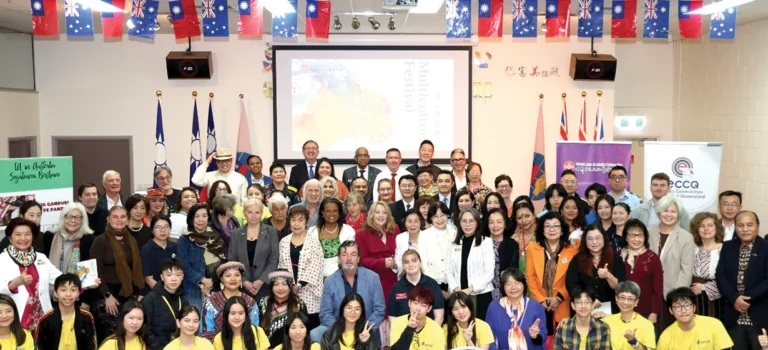
Brisbane, 22 August 2026 — The 2026 WAMCI Multicultural Festival – Cultural Exchange Opening Ceremony was successfully held on Saturday at the Queensland Taiwan Centre, bringing together government representatives, community leaders, cultural organisations, artists, performers and community members.
Hosted by World Arts & Multi-Culture Inc. (WAMCI), the event celebrated Queensland’s multicultural community through cultural performances, art, cultural displays and community presentations.
The program featured an energetic FASCA BNE drumming performance, a Colombian harp solo, cultural presentations from the Philippines, Fiji and Taiwan, and a special performance by ATIA the Taiwanese Indigenous dance group. A major highlight was the opening of the “STORIES” Art Exhibition, featuring four artists representing Australia, Taiwan, Japan and Brazil — Jeanette Stok, Amy Chen, Yoshi Hughes and Maria da Silva. The artists shared their creative stories through their artworks and artist talks.Guests also enjoyed cultural displays representing Japan, Bangladesh, ECCQ, Ukraine, Poland, Taiwan and Romania, providing an opportunity to learn more about the traditions and cultures of participating communities.
WAMCI President Susan Yang said the Cultural Exchange demonstrated the importance of bringing people together to share cultures, stories and experiences, while building friendships and stronger multicultural communities.
WAMCI sincerely thanks all government representatives, community leaders, participating organisations, artists, performers, volunteers, sponsors and guests for their support in making the event a success.
The Cultural Exchange was part of the 2026 WAMCI Multicultural Festival, celebrating Queensland’s cultural diversity and community connections.












 HIV affects people from many cultures and communities in Australia. Some people who were born overseas may find it difficult to access health information and services because of language and cultural barriers, cost, or unfamiliarity with Australia’s health system.
 Post-exposure prophylaxis, or PEP, is medicine that may prevent HIV after a possible exposure. You may need PEP if, for example:





 Brisbane, 22 August 2026 — The 2026 WAMCI Multicultural Festival – Cultural Exchange Opening Ceremony was successfully held on Saturday at the Queensland Taiwan Centre, bringing together government representatives, community leaders, cultural organisations, artists, performers and community members.
 WAMCI sincerely thanks all government representatives, community leaders, participating organisations, artists, performers, volunteers, sponsors and guests for their support in making the event a success.