

The Vedas: The Eternal Echo of Cosmic Wisdom
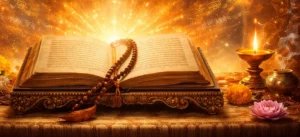 The Vedas represent the oldest layer of Sanskrit literature and the oldest scriptures of Hinduism. Derived from the root word Vid (to know), “Veda” literally translates to “Knowledge.” They are not considered the compositions of human authors but are categorized as Shruti—that which is “heard” or revealed. According to tradition, ancient sages (Rishis) perceived these eternal truths in states of deep meditation and articulated them into the hymns we study today.
To understand the Vedas is to explore the blueprint of a civilization that sought to harmonize the internal spirit with the external universe.
The Fourfold Structure of Vedic Literature
The Vedic corpus is divided into four primary texts, each serving a distinct liturgical and philosophical purpose.
1. Rig Veda: The Book of Mantra
The Rig Veda is the foundation of all Vedic knowledge, consisting of 1,028 hymns (Suktas) organized into ten books (Mandalas). These hymns are primarily addressed to deities representing natural forces, such as Agni (Fire), Indra (Thunder/Rain), and Surya (Sun). It explores the relationship between humanity and the divine through the lens of gratitude and cosmic order.
2. Sama Veda: The Book of Song
The Sama Veda is the “Veda of Chants.” While much of its text is drawn from the Rig Veda, it is rearranged specifically for musical rendering during rituals. It underscores the importance of vibration and sound (Nada) as a vehicle for spiritual elevation.
3. Yajur Veda: The Book of Ritual
The Yajur Veda serves as a guidebook for priests. It contains the prose mantras and instructions necessary for performing the Yajnas (sacred rituals). It is divided into two parts: the Shukla (White) and Krishna (Black) Yajur Veda, focusing on the mechanical and symbolic aspects of sacrifice.
4. Atharva Veda: The Book of Spell and Science
Often distinct from the first three, the Atharva Veda deals with the practicalities of daily life. It includes prayers for healing, protection against disease, and ethical conduct. It bridges the gap between high philosophy and the immediate needs of a functioning society.
The Evolution of Vedic Knowledge
Each of the four Vedas is further subdivided into four layers, representing a progression from external ritual to internal realization:
1. Samhitas: The core collection of hymns and mantras.
2. Brahmanas: Explanatory texts detailing the “how-to” of rituals.
3. Aranyakas: “Forest books” that begin to shift focus from ritual to meditation.
4. Upanishads: The concluding portions (Vedanta) that explore the nature of the soul (Atman) and the ultimate reality (Brahman).
Core Teachings and Philosophical Pillars
The teachings of the Vedas are vast, but they are anchored by several “Mahavakyas” (Great Sayings) and fundamental concepts that continue to influence global philosophy.
1. The Cosmic Order
The concept of cosmic order is perhaps the most vital Vedic contribution to ethics. It suggests that the universe operates on an inherent, rhythmic order. The seasons, the movement of stars, and the cycles of life are all governed by cosmic order. Human morality (Dharma) is seen as the act of living in alignment with this cosmic rhythm. When we act selfishly or destructively, we disrupt cosmic order; when we act with integrity, we sustain it.
2. Vasudhaiva Kutumbakam: The World is One Family
A recurring theme in Vedic thought is the radical unity of existence. The Vedas teach that the same spark of consciousness resides in all beings. This isn’t just a social sentiment but a metaphysical claim: because we all share a common source, the suffering of one is the suffering of all. This teaching serves as the foundation for non-violence (Ahimsa) and compassion.
3. The Quest for Truth (Satya)
The Rig Veda famously proclaims: “Ekam Sat Vipra Bahudha Vadanti”—Truth is One, but the wise call it by many names. This teaching fosters a unique sense of pluralism. It suggests that different religions, philosophies, and paths are simply different languages describing the same ultimate reality.
4. The Purusharthas: The Four Goals of Life
The Vedas provide a balanced framework for a fulfilling human life, suggesting that four objectives must be pursued:
• Dharma: Righteousness and duty.
• Artha: Material prosperity and security (necessary for a stable life).
• Kama: Aesthetic and emotional pleasure.
• Moksha: Spiritual liberation and freedom from the cycle of rebirth.
The Concept of Yajna: Sacrifice as Service
In the Vedic period, the Yajna (fire ritual) was the central act of worship. However, the teachings make it clear that the physical fire is a symbol for the internal fire of transformation.
The core philosophy of Yajna is Idam Na Mama (“This is not mine”). By offering clarified butter or grains into the fire, the practitioner practices detachment from material possessions. In a modern context, Vedic teachings interpret Yajna as Seva—selfless service. Any action performed for the benefit of the community or the environment, without ego, is considered a Vedic sacrifice.
Relevance in the Modern Era
Despite being millennia, old, Vedic teachings offer profound solutions to contemporary challenges:
• Environmental Stewardship: The Vedas deify nature. By viewing rivers as mothers and forests as sacred, Vedic thought promotes a sustainable relationship with the Earth, contrasting with the exploitative view of nature as a mere “resource.”
• Mental Well-being: The Vedic emphasis on meditation and breath work (further developed in Yoga) provides tools for managing the stresses of the modern digital age.
• Social Cohesion: The principle of Atman—that the same divinity is in everyone—is a powerful antidote to discrimination and social division.
Conclusion
The Vedas are not merely dusty relics of a bygone era; they are a living “manual for humanity.” They do not demand blind faith but rather invite inquiry (Jigyasa). By teaching us to see the divine in the mundane and the infinite in the finite, the Vedas encourage a life of purpose, balance, and profound connection.
As the ancient prayer from the Brihadaranyaka Upanishad beautifully summarizes:
Lead us from the unreal to the Real. Lead us from darkness to Light. Lead us from death to Immortality.
