

Bridging the Quantum Divide: India and Rigetti Computing Strike Landmark $8.4 Million Deal
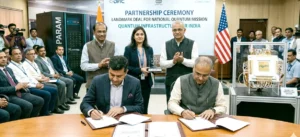
In a move that signals India’s growing dominance in the frontier of emerging technologies, the Centre for Development of Advanced Computing (C-DAC) has officially inked an $8.4 million contract with Rigetti Computing. This milestone partnership marks a definitive leap forward for India’s National Quantum Mission, positioning the nation as a formidable player in the global race for quantum supremacy.
The Power of Hybrid Computing
The deal focuses on the delivery of a state-of-the-art quantum processing system that will be integrated into India’s existing high-performance computing (HPC) infrastructure. Unlike traditional computers that process bits as 0s or 1s, quantum computers use qubits, allowing them to perform complex calculations at speeds currently unimaginable.
By partnering with Rigetti, an American pioneer in the field, C-DAC aims to create a “hybrid” environment. This will allow Indian researchers to utilize quantum power for specific, high-complexity tasks—such as molecular modelling for drug discovery or climate pattern simulation—while relying on traditional supercomputers for data management.
A Strategic Asset for the National Quantum Mission
Launched with an ambitious vision, India’s National Quantum Mission (NQM) seeks to build a robust ecosystem for quantum technology within the decade. The acquisition of Rigetti’s hardware is more than just a purchase; it is a strategic infrastructure play.
The system will be hosted at one of C-DAC’s premier facilities, providing Indian startups, academic institutions, and government labs with “on-soil” access to quantum hardware. This reduces reliance on cloud-based quantum services hosted abroad, ensuring data sovereignty and fostering a homegrown community of quantum developers.
Why This Matters for the Australian Indian Tech Corridor
For the Indian diaspora in Australia—particularly those in the burgeoning tech hubs of Sydney, Melbourne, and Brisbane—this news is a significant indicator of India’s changing economic profile. Australia and India already share a “Critical and Strategic Minerals” partnership; the expansion into quantum technology adds another layer to this bilateral synergy.
Australia itself is a leader in quantum research, with institutions like the University of New South Wales (UNSW) and companies like Silicon Quantum Computing leading the charge. As India scales its hardware capabilities through deals like the one with Rigetti, the opportunities for cross-border collaboration in quantum software development, cybersecurity, and financial cryptography are set to explode.
Future Horizons
The $8.4 million investment is widely seen as the first of many steps. As the world moves toward the “Quantum Era,” India’s proactive approach ensures it will not be a mere consumer of technology, but a co-creator.
For the readers of the Australian Indian Times, this deal represents a proud moment in India’s scientific journey. It showcases a nation that is no longer just the “back office of the world,” but a laboratory for the future. As C-DAC begins the integration process, the global tech community will be watching closely to see how India leverages this new power to solve some of the world’s most pressing challenges.
