

Secretary Rubio’s Meeting with Indian External Affairs Minister Jaishankar

Secretary Rubio’s Meeting with Indian External Affairs Minister Jaishankar

In a powerful address to the Rajya Sabha this week, Prime Minister Narendra Modi declared that India’s youth are the nation’s “greatest valuable asset,” positioning the younger generation as the primary drivers behind India’s transition to a developed nation by 2047.
Replying to the Motion of Thanks on the President’s Address, the Prime Minister highlighted a unique global alignment: while many of the world’s leading economies are facing the challenges of an aging population, India is becoming increasingly youthful. This “demographic dividend,” he argued, is a “second blessing of strength” that has turned the eyes of the world toward the Indian subcontinent.

A New Global Era for Youth
The Prime Minister emphasized that recent historic milestones, including the “Mother of all Deals” trade agreement with the European Union and significant pacts with the United States, were designed with the youth in mind.
“India’s youth will be the biggest beneficiaries of these trade agreements,” PM Modi stated, noting that the world now sees India as a “trusted partner” and a vital talent pool.
He further detailed how the mantra of “Reform, Perform, Transform” has put the country on a “Reform Express,” opening doors in sectors once dominated by the state. Today, over 1,000 defence startups are led by young Indians creating everything from AI-powered cameras to advanced robotics.

Resonating with the Diaspora
For the Indian diaspora in Australia, these words carry significant weight. Community leaders in Australia, such as Jitendra Deo, CEO of JD Media and a prominent voice for the Australian Indian Diaspora have long championed the preservation of heritage alongside modern achievement. Much like the PM’s call for the youth to “free themselves from a colonial mindset,” the Australian Indian diaspora continues to foster a balance of Indian values and contemporary success.

Empowering the Next Generation
The Prime Minister’s speech was not just a reflection on economic figures but a call to action. He urged the youth to:
• Innovate Boldly: Utilize platforms like Startup India and the MUDRA scheme, which has already provided Rs 30 lakh crore in collateral-free loans.
• Maintain Standards: Focus on “uncompromising quality” to ensure the sustainability of global opportunities.
• Celebrate Heritage: Draw inspiration from figures like Swami Vivekananda to engage with the modern world using original Indian ideas.
As India moves toward becoming the world’s third-largest economy, the message remains clear: the second quarter of the 21st century belongs to the dreams and determination of the Indian youth, whether they are in the streets of Delhi or the suburbs of Melbourne.

Governor-General hosts Women in Sport & Business Leadership Celebration ahead of AFC Women’s Asian Cup Australia 2026™

Governor-General hosts Women in Sport & Business Leadership Celebration ahead of AFC Women’s Asian Cup Australia 2026™

The Governor-General of the Commonwealth of Australia, Her Excellency Sam Mostyn, today hosted a Women in Sport & Business Leadership Celebration at Admiralty House marking one month to go until the kick-off of the AFC Women’s Asian Cup Australia 2026™ and recognising the tournament as a defining moment for women’s sport in Australia and across Asia.
The high-level gathering convened senior government leaders and C-suite women from across sport and business, uniting influential voices in a moment of shared leadership to celebrate the women shaping the future of sport and acknowledge the collective responsibility to continue driving progress, on and off the field.
Joining the Governor-General were Sarah Walsh, Chief Operating Officer of the AFC Women’s Asian Cup Australia 2026™ Local Organising Committee, Heather Garriock, Interim Chief Executive Officer of Football Australia, alongside an impressive cohort of senior women leaders from across the sporting, corporate and public sectors.
The celebration also featured the AFC Women’s Asian Cup Trophy, appearing on the second leg of its Trophy Road Trip, arriving from Scarborough Beach in Western Australia, where the tour was launched. The trophy served as a powerful symbol of excellence, aspiration and achievement, reinforcing the tournament’s position as the pinnacle of women’s football in Asia. The trophy will travel to iconic locations across the country, heading north to Queensland, then back to New South Wales before returning to Western Australia ahead of the spectacular Opening Ceremony featuring Audrey Nuna, KPop Demon Hunters star, and blockbuster opening match between the Matildas and the Philippines on 1 March at Perth Stadium.
The AFC Women’s Asian Cup Australia 2026™ will bring together Asia’s 12 best teams, with matches hosted in Perth, Sydney and the Gold Coast from 1-21 March.

The Great Generational Squeeze: Debt, Interest, and the Vanishing Australian Dream

The Great Generational Squeeze: Debt, Interest, and the Vanishing Australian Dream

Debt, Interest, and the Vanishing Australian DreamThe Australian dream of homeownership, once a rite of passage as certain as the rising sun, is increasingly looking like a mirage for the nation’s youth. As we move deeper into 2026, a “perfect storm” of economic pressures has converged to create the most challenging housing market in modern history. At the centre of this storm are three relentless forces: soaring interest rates, a chronic undersupply of dwellings, and a mountain of national debt that threatens to bury the financial future of those currently entering the workforce.

The Debt Ceiling and the “Trillion Dollar” Shadow
For years, economists and politicians have debated the sustainability of Australia’s fiscal trajectory. However, few voices carry as much historical weight as former Treasurer Peter Costello. As the architect of Australia’s modern era of budget surpluses, Costello’s recent warnings have taken on a prophetic tone. He has been vocal about the federal government’s failure to restrain spending, noting that the country is hurtling toward a trillion-dollar debt—a figure that was once unthinkable.
“Saving money is the hard part of politics. Spending it is easy,” Costello recently remarked, reflecting on the “foolhardy schemes” that have seen the nation’s balance sheet deteriorate. His critique is pointed: by failing to balance the budget today, the current generation of leaders is effectively “favouring current voters over future voters.”
The concern is simple yet devastating as the national debt climbs toward that trillion-dollar mark, the cost of servicing that debt rises. This diverts billions of dollars away from infrastructure, education, and housing initiatives, leaving the younger generation to foot the bill through higher taxes and reduced services. For a twenty-something trying to save for a deposit, the knowledge that their future tax dollars are already earmarked to pay off today’s deficits adds a layer of systemic injustice to their personal financial struggle.

The Interest Rate Noose
While the long-term debt levels cast a shadow over the future, the immediate pain for young Australians is being felt at the bank. After a decade of record-low interest rates that artificially inflated property prices, the “easy money” era has ended with a vengeance.
The Reserve Bank of Australia’s (RBA) series of rate hikes—aimed at taming stubborn inflation—has fundamentally altered the math of homeownership. In 2026, a typical new mortgage now consumes approximately 54% of a household’s disposable income. This is not just a “tightening of the belt”; it is a “mortgage noose” that leaves little room for groceries, healthcare, or the Ayurvedic routines many Australians rely on to maintain their well-being in high-stress environments.
The irony is cruel: while interest rates have risen to curb spending, property prices have remained stubbornly high due to a chronic shortage of supply. In cities like Brisbane and Perth, prices are expected to jump by as much as 10% to 13% this year alone. For the young professional, the goalposts aren’t just moving; they are being sprinting away at a pace that outstrips almost any salary growth.

The Great Divide: Boomers vs. Gen Z
The generational divide has never been more visible. In the 1990s, while interest rates were high, the median house price was roughly five times the average annual income. Today, that ratio has exploded to nearly 14 times.
A young Australian today needs more than eight years of disciplined saving just to scrape together a 20% deposit—up from six years only two decades ago. For many, this has turned the “Bank of Mum and Dad” from a luxury into a necessity. Those without access to family equity find themselves “locked out” of the market, trapped in a rental cycle where rising rents (up nearly 50% over the last decade in some capitals) make saving for a deposit a mathematical impossibility.

How Can the Younger Generation Afford to Buy?
Despite the grim headlines, the dream isn’t entirely dead, but it has certainly evolved. For those determined to break into the market in 2026, the strategy has shifted from “waiting for a crash” to “pivoting with the punches.”
• Sacrificing Preferences: The “starter home” is no longer a three-bedroom house in a leafy suburb. Many Gen Z buyers are looking at “reinvesting”—buying a more affordable apartment in an outer suburb or regional area while continuing to rent where they work.
• Alternative Ownership Structures: Co-buying with friends or siblings is no longer a niche trend. Platforms specializing in co-ownership agreements are helping young people pool their borrowing power to combat high prices.
• Government Schemes: Programs like the First Home Guarantee (allowing a 5% deposit without Lenders Mortgage Insurance) and state-based stamp duty exemptions remain vital lifelines, though they are often criticized for adding further upward pressure on prices.
• The “Splurge” Audit: While the “avocado toast” trope is tired and unfair, financial advisors in 2026 emphasize the “subscription trap.” In an era of high inflation, trimming digital subscriptions and utilizing “splurge accounts” to strictly cap discretionary spending is the new baseline for those serious about a deposit.

A Call for Structural Reform
Individual discipline, however, cannot solve a systemic crisis. Peter Costello’s warnings about the national debt highlight a broader truth: the current economic model is borrowing from the future to pay for the present.
To truly restore housing affordability, experts argue that the focus must shift from “demand-side” handouts to “supply-side” solutions. This includes planning reforms to increase density, replacing stamp duty with a broad-based land tax to improve market mobility, and addressing the tax concessions like negative gearing that favour established investors over first-time buyers.

The Path Forward
As we look toward the remainder of 2026, the message is clear. Australia is at a crossroads. We can continue to accumulate debt and ignore the housing supply crisis, or we can heed the warnings of fiscal conservatives like Costello and demand a balanced approach that protects the next generation.
For the young Australian, the path to a front door key is steeper and rockier than it was for their parents. It requires a mix of extreme financial discipline, creative ownership strategies, and a healthy dose of political advocacy. The “Great Australian Dream” may be under life support, but it is too central to our national identity to let it slip away into a sea of debt and high interest.

“Seema” Premieres on the Gold Coast: A Powerful Film Addressing Domestic Violence

“Seema” Premieres on the Gold Coast: A Powerful Film Addressing Domestic Violence

Home of the Arts (HOTA) on the Gold Coast played host to the premiere of “Seema” on November 1st, marking a significant moment for Australian cinema and a powerful statement against domestic violence. The event drew a distinguished crowd, including film industry professionals and representatives from a prominent Indian network, underscoring the film’s international appeal and relevance.

“Seema” features a compelling cast, led by Bollywood American actress Reena Shah, known for her previous work with Manisha Koirala, and Australian actor Morrison James. Directed by Sabrina Khan, an international human rights lawyer and recipient of the 2025 NSW Human Rights Medal and a Qld Community Service Award, the film promises a nuanced exploration of a sensitive subject. The premiere was particularly well-attended by artists from the Indian community, highlighting the film’s cultural resonance.

Reena Shah shared insights into her portrayal of Seema, a character trapped in a cycle of domestic violence: “It was essential for me to embody the internal psychology of someone trapped in a cycle of domestic violence in a way that felt truthful, layered, and immediately recognizable. I relied on subtle physical choices: the way Seema holds her body, how her breath changes, how her eyes avoid or search for connection, and the small, instinctive movements of someone constantly assessing danger. I wanted the audience to feel her story.”

Shah also emphasized the importance of collaboration: “Our director Sabrina Khan and I spent time aligning on the emotional arc of Seema’s journey. With the actor Morrison James playing George, communication and consent were essential. The crew also made key decisions that strengthened the impact: keeping sets closed for vulnerable scenes, adjusting lighting to mirror Seema’s internal world, and allowing space between takes to reset.”

Morrison James reflected on his preparation for the role: “I read quite a few various articles and interviews on the subject from both the victims and perpetrators. I also accessed and watched some documentaries.” He also spoke about the emotional challenges on set: “I would have to say when my screen wife (Reena) became emotionally affected as the story progressed. We both spent genuine time together getting to know each other as real people and chatting about any possible boundaries each other may have had on set while we were filming.”

Director Sabrina Khan on Bringing “Seema” to Life mentioned that “my work as an international human rights lawyer has provided me with a deep understanding of the complexities and nuances of domestic violence. I wanted to ensure that “Seema” was not just a film, but a platform for raising awareness and promoting empathy. We worked closely with advocacy groups and survivors to ensure the story was told authentically and respectfully.

Every scene was crafted with the intention of honouring the experiences of those who have lived through similar situations. I hope “Seema” will spark conversations and encourage people to recognize the signs of abuse, offer support to those affected, and challenge the societal norms that perpetuate violence. Ultimately, I prayerfully hope the film empowers survivors to seek help and find their path to healing.”

In a remarkable tribute to the film’s powerful message, the USA has officially named November 1st “Seema” Day, dedicated to standing in solidarity with individuals trapped in abusive relationships and unable to leave. This recognition underscores the film’s potential to make a lasting impact on the fight against domestic violence.

The Guilt of Having It All How Millennial Indian Women in Australia Are Redefining Success, Family, and Self-Worth

The Guilt of Having It All
How Millennial Indian Women in Australia Are Redefining Success, Family, and Self-Worth

Australia’s data shows 17% of women have experienced partner violence since age 15, and one in three migrant women report domestic or family abuse. Among South Asian communities, studies show up to 32% of women have encountered or witnessed dowry-related coercion or financial control.

By Rinchaal Patel
Mindset and Relationship Coach (YOLO Academy)

They are the women who did everything right. They studied hard, migrated to Australia in the early 2000s, built careers, created families, and checked every box that once defined success. Yet, beneath the surface of their carefully balanced lives — run by color-coded calendars and endless to-do lists — many carry a quiet, persistent weight: the guilt of having it all.

It is the unspoken inheritance of a generation raised between duty and desire, expectation and independence. For millennial Indian women living in Australia, guilt isn’t just an emotion — it’s a constant undercurrent shaping how they love, parent, and belong.

The Dual Life of the Modern Indian Woman

These women are the product of post-liberalization India – raised by parents who dreamed of stability, and societies that demanded perfection. They were told to pursue success, but with humility. Ambition, but with restraint. Independence, but never at the expense of family.

When they arrived in Australia, those lessons travelled with them. They became professionals by day, caregivers by evening, emotional anchors by default. And while they gained financial freedom, many found themselves emotionally indebted — to families back home, partners beside them, and children before them.

“We call it achievement, but often it’s just exhaustion disguised as success,” says a psychologist who works closely with South Asian women.
“They’re constantly toggling between gratitude and guilt — for the life they’ve built and the life they left behind.”

For millennial Indian women, guilt shows up in subtle ways. It is the pang of missing a call from aging parents in India. The hesitation before posting a vacation photo that might seem “too indulgent.” The uneasy silence after being called “lucky”.

It is also the guilt of being a working mother — wanting to be fully present at work and at home, knowing that doing both often means being absent somewhere. That quickly converts to guilt and keeps them in a constant state of inner conflict.

As one mother shared, “No one told us that freedom would feel this heavy. I love what I have built here, but sometimes I feel like I am constantly apologizing- to my kids, to my parents, to my partner and even to myself.”

“As soon as I find some sort of calm within myself, something will happen and the goal post would feel farther than my reach. I am constantly chasing that goal post that would allow me to enjoy things guilt free” says another working mother.

Shifting Sibling Bonds and the Changing Family Web

In many families, migration redefined sibling dynamics. The physical distance turned shared childhood memories into intermittent phone calls and WhatsApp groups. Over time, roles evolved — the one abroad became the “responsible one,” the problem solver, the emotional bridge between aging parents and extended family.

What used to be a relationship of equality became one of quiet expectation. This shift, though often unspoken, adds another layer to the emotional load many Indian women in Australia carry.

“When you are the daughter who left, you often become the emotional caretaker for everyone who stayed.”
It is not resentment — it is responsibility, wrapped in love and guilt.

The Hidden Strain in Modern Marriages

While many millennial Indian couples thrive, the emotional terrain beneath their relationships can be complex. These are unions built on modern ideals but shaped by traditional pressures – the expectation to “having it all” and “doing it all” without complaint.
Australia’s data shows 17% of women have experienced partner violence since age 15, and one in three migrant women report domestic or family abuse. Among South Asian communities, studies show up to 32% of women have encountered or witnessed dowry-related coercion or financial control.

For others, the strain is more invisible- the emotional loneliness of being high-functioning but unsupported, successful yet unseen and sometimes unappreciated.
Many women quietly internalize this imbalance, convinced that struggle is the price of stability. They crave connection that goes beyond coordination.

“We long for our partners to truly see us – to talk beyond schedules and to-do lists, to share their dreams and fears, and to listen when we do the same.” says a millennial woman.

It is a simple need, but one often lost in the blur of responsibilities and unspoken expectations. When emotional intimacy is replaced by logistics, even love can begin to feel like another task to manage.

Motherhood and the Perfection Paradox

Parenting intensifies the internal divide. Many Indian-Australian mothers live in two worlds at once – raising children in a world built on shared roles, while still shaped by the hierarchies they once knew.”

They want to give their children freedom, but fear they’ll lose connection to heritage. They want to model ambition, but dread being judged for working late. Each decision -school choice, holiday plan, extracurricular activity, carries the invisible weight of comparison.
“We compare without meaning to. It is how guilt travels – from mothers to daughters, disguised as care.”

The Unseen Cost of Success

Statistically, Indian women in Australia are among the most educated and professionally accomplished migrant groups. Yet, many still measure their worth by how well they maintain relationships, not how far they have come.

The guilt of “having it all” manifests as over-functioning: the woman who manages every detail, smoothens every conflict, remembers every birthday. She is praised for her strength — and punished by her exhaustion.

Toward a New Definition of Having It All

But change is underway. Across Australia, Indian women’s circles, professional networks, and cultural platforms are reframing guilt not as weakness but as evidence of deep emotional intelligence.

The modern Indian woman is learning that balance is not about doing everything; it is about doing what matters most. She is learning that saying no to others can sometimes be the most powerful yes to herself. And she is beginning to see guilt not as a burden- but as a reminder of her capacity to care deeply while still claiming space for her own joy.

A New Feminine Wisdom

Perhaps this generation’s legacy won’t be the myth of having it all – but the wisdom to redefine what “all” really means.
It is not about perfection, but presence.
Not about sacrifice, but self-awareness.
Not about being everything to everyone, but being true to oneself first.
For today’s woman, freedom isn’t measured in balance but in belonging – in owning her choices, her flaws, and the evolving story of who she is.

God Is My 24/7 Protection – A Living Testimony

God Is My 24/7 Protection – A Living Testimony

When you pass through the waters, I will be with you;
and when you pass through the rivers, they will not sweep over you.
When you walk through the fire, you will not be burned;
the flames will not set you ablaze.”
— Isaiah 43:2

I do not believe in God’s protection as a theory. My life is a living, breathing testimony.
I believe because I have walked through my own floods, fires, and dangerous dens — and witnessed His unseen hand shelter me every time.
The Holy Scriptures paint His power clearly:
The Red Sea split open.
The River Jordan stood still.
Fire spared the three faithful Hebrew men.
Hungry lions bowed before Daniel.
A deadly snake could not kill Paul.
But what convinces me most is not only what God did then —
it is what He continues to do now, in our generation and in our troubled world.
In my debut book, FINDING YOUR SUNRISE, I recount many life stories. One such moment was the night the road tried to take my life.

The Night the Road Tried to Take My Life

One late night, driving home exhausted, my eyes grew heavy. Suddenly, I felt my car drift due to wet road conditions. Within seconds, it spun out of control and slid across to the opposite side of the road.

I cried out, closing my eyes, “O God, save me…”
Miraculously, my car came to a complete stop — perfectly aligned on the opposite side of the road. I stepped out trembling, stunned to discover I was unharmed and the car was undamaged.
That night I realised:
My God does not sleep, even when I do.

When Fear Knocked at My Door

Another day came when the medical report in my hand felt heavier than the world. The doctors spoke in careful tones, preparing me for the worst. Fear knocked loudly at the door of my heart.

Yet deep within, something stronger arose — a quiet, unshakable peace.
I prayed, “Lord, give me faith to believe in Your power to heal and save.”
I began to question the rigidity of traditional beliefs and surrendered my fears and worries to a God whose ways and Word I did not yet fully understand.

Yet a gentle calmness began to wash over me.
What was expected to worsen reversed itself. Healing came where logic said it shouldn’t. I knew then — this was no coincidence. This was the same God who walked with Daniel in the lions’ den, still guarding His children today.


Because I have walked through many dangers and witnessed God’s protection.
Because I have faced fear and found peace that surpasses all human understanding.
Because I have seen chaos and evil powers bow to His authority.
God’s protection is not limited to ancient stories.

It is a living promise for those who call on His name and walk in His Word.
I believe He is my shield in storms.
My refuge in uncertainty.
My guardian in the night.
My strength in every invisible battle.
The floods may rise.
The fires may roar.
The lions may growl.
But my God still declares:
“I will be with you.”
And that is why I believe —
not just with words,
but with my life —
that God is my 24/7 protection in every danger of life.

A Gentle Invitation

Are you walking through challenges in health, finance, or relationships? Your true help is found in humbling your heart and seeking God’s grace. His grace alone has the power to break every chain, silence every curse, and restore what seems lost.
I encourage you to meditate on God’s truth.
Let His love and light transform your world from chaos to peace.

Why Open-Eye Raja yoga Meditation Fits the Modern Busy Life

Why Open-Eye Raja yoga Meditation Fits the Modern Busy Life

In a world where time is scarce and stress abundant, the search for peace often feels like a luxury. Yet, what if inner calm didn’t require silence, seclusion, or closed eyes? What if peace could be experienced right here—while in traffic, in meetings, or making dinner?
Welcome to Open-Eye Raja yoga Meditation-a practice rooted in ancient wisdom yet perfectly suited to today’s fast-paced life.

Meditation With Eyes Open?

Across cultures, yogis and sages are often depicted with eyes softly half-open – not withdrawn from the world, nor consumed by it. This subtle gaze represents a deeper truth: balance. In the practice of Raja yoga, this is more than posture. It’s a powerful reminder that peace isn’t found by escaping life – but by engaging with it, differently.
Closed-eye meditation offers deep rest and introspection. But Raja yoga introduces a complementary path: meditation with the eyes open-remaining soul-conscious while fully present in the world.

The Power of Soul-Awareness

In our daily lives, we may see-but are we truly aware? Thoughts drift to the past or race toward the future. Open-eye meditation anchors us in the now. It gently reminds the soul:
“Stay awake. Stay aware. Remember who you are.” This shift in awareness transforms everyday moments. You are no longer just reacting-you’re responding with clarity, patience, and love.

Drishti: Silent Energy Through the Eyes

In Raja yoga, the eyes are seen as more than sense organs. They are instruments of energy. Through your Drishti-your spiritual gaze-you radiate vibrations. When your thoughts are peaceful, so is your presence. When your heart is pure, your glance becomes a blessing.
This silent energy influences families, workplaces, and relationships. Without a word, your calmness uplifts others. Your awareness becomes your service.

Peace You Can Practice All Day

Busy schedule? No time to meditate for hours? That’s okay. Raja yoga isn’t about duration—it’s about awareness. You can practice it:
While working I am a peaceful soul. While speaking: Let my words uplift. While waiting: The Divine is with me.
These gentle thoughts become anchors of peace. Gradually, they shape how you feel, think, and interact. Meditation becomes a way of living, not just a spiritual task.

Real-Life Impact

At Work: In a tense meeting, someone interrupts. You pause, breathe, and respond with calm. Your energy diffuses the tension. At Home: Your child makes a mistake. Instead of reacting, you remember: They are a soul, learning their path. Your gaze comforts, not criticizes. In Solitude: Even alone, you silently affirm I am light. I am loved. I am under divine care. This inner remembrance recharges the soul.

How to Start

Sit comfortably—at home, at your desk, or outdoors. Let your eyes remain softly open, without focusing on anything in particular. Gently think I am a soul, a being of peace. The Supreme is a point of divine light. His light fills me with strength and love.
Practice this for a few minutes each morning, then return to this awareness throughout the day in short moments of pause.

Raja yoga Meditation offers something rare: peace that moves with you. It invites us to live with deeper awareness-where each interaction becomes sacred, each thought a choice, and each gaze a blessing.

In a noisy world, it teaches us to see with silence. To act without reaction. To be present-and peaceful-right now.

Brahma Kumaris Shailer Park provide free Raja Yoga Meditation, Positive Thinking and Anger Management Courses. Please contact us on 0414685144 or [email protected] for further information. https://brahmakumaris.org.au and find out the events happening close to your location.
OM SHANTHI

CHRISTMAS 2025 – GOD WITH US

CHRISTMAS 2025 – GOD WITH US

By Pastor Suresh Dass Joseph
[email protected]

Dear reader, it is our joy to bring to you the word of God. As we celebrate Christmas, we remember the birth of our Lord and Saviour Jesus Christ. After Mary, His mother, was engaged to Joseph, before they came together, she was found to be with child of the Holy Spirit. Then Joseph her husband, being a just man, and not wanting to make her a public example, was minded to put her away secretly.

An angel appeared to Joseph and said, “Joseph, son of David, do not be afraid to take to you Mary, your wife, for that which is conceived in her is of the Holy Spirit. And she will bring forth a Son, and you shall call His name Jesus.” This was done that it might be fulfilled what God had already said through the prophet, “Behold the virgin shall be with child and bear a Son and they shall call His name Immanuel.” Which is translated, “God with us.”

God was announcing, “I am no longer a distant God, a faraway God, a remote God, I am with you, always, fully, personally, permanently.” Many years before the birth of Jesus, during the reign of King Ahaz, fear dominated the nation as enemy armies threatened Jerusalem. At, this time of trouble and suffering, God spoke a promise of His presence for His people. This presence was fulfilled through Jesus. He is not just God around us, or God above us, but God with us.

Right from the beginning, God’s presence was always His plan. God was present with the first man on earth, Adam. God’s presence was with the children of Israel in the form of a pillar of cloud and fire as they journeyed towards their promised land.

As we come together to celebrate Christmas, we are reminded that God is with us in our weaknesses, when we feel tired, exhausted, and burdened. He is not a God who is uncaring; He understands. He is with us in our journey of financial distress, emotional pain, and spiritual drought. He is our very present help in times of fear and attacks.

One time, a father was trying to get his fearful son to go to sleep. He said, “God is with you, son,” but the child replies, “I know that, but I want someone with skin on.” Jesus is God with skin on. He is the invisible expression of the visible God. Jesus touched people, forgave their sins, fed them, and healed them.

This Christmas, let me remind you that if you are hurting, Immanuel is with you. If you are afraid, He is with you; if you feel forgotten, He is still with you.
God bless you and have a wonderful Christmas with your families and friends.
Ps Suresh Dass Joseph

श्रद्धेय पंडित दीनदयाल उपाध्याय जी की 110 वीं जयंती के सुअवसर पर आयोजित अंतर्राष्ट्रीय सम्मेलन २१ – २२ नवंबर २०२५ विज्ञान भवन, नई दिल्ली।

श्रद्धेय पंडित दीनदयाल उपाध्याय जी की 110 वीं जयंती के सुअवसर पर आयोजित अंतर्राष्ट्रीय सम्मेलन २१ – २२ नवंबर २०२५ विज्ञान भवन, नई दिल्ली।

राष्ट्रीयता व मानवता के प्रतीक : पंडित दीनदयाल उपाध्याय के स्वर अंतरराष्ट्रीय सम्मेलन में गूंज उठे।
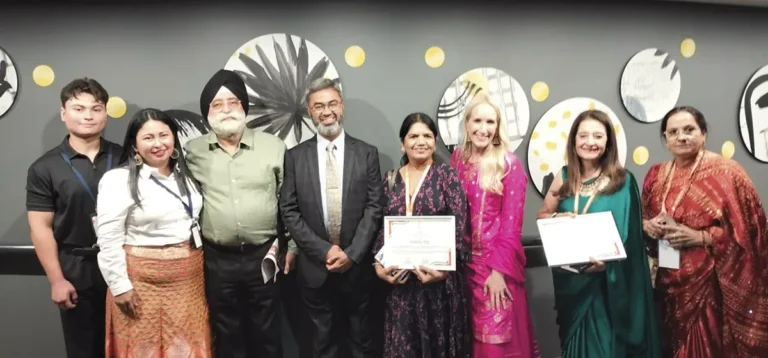
लेखिका मधु खन्ना को नई दिल्ली विज्ञान भवन में विश्व हिंदी परिषद के तत्वाधान में आयोजित अंतरराष्ट्रीय सम्मेलन में “विश्व हिंदी सेवा सम्मान” से सम्मानित किया गया।

नई दिल्ली में विश्व हिंदी परिषद के तत्वावधान में राष्ट्रीयता और मानवता के प्रतीक पंडित दीनदयाल उपाध्याय पर केंद्रित यह अंतरराष्ट्रीय सम्मेलन २१ एवं २२ नवंबर २०२५ को विज्ञान भवन में आयोजित हुआ। देश विदेश से अनेक प्रबुद्ध जन की उपस्थिति रही।

इस अवसर पर हिंदी में अतुलनीय योगदान के लिये श्री कवीन्द्र गुप्ता जी माननीय उपराज्यपाल लद्दाख व विश्व हिंदी परिषद के राष्ट्रीय अध्यक्ष पद्मश्री एवं पद्मभूषण आचार्य यार्लगड्डा लक्ष्मी प्रसाद (पूर्व राज्य सभा सांसद एवं पूर्व उपाध्यक्ष संसदीय राजभाषा समिति, भारत सरकार) द्वारा “विश्व हिंदी सेवा सम्मान” प्रतीक चिह्न व अंगवस्त्र से सम्मानित किया।
आदरणीय श्री अजय मिश्र टेनी माननीय निवर्तमान केंद्रीय गृह राज्य मंत्री व परिषद के महासचिव प्रख्यात स्तंभकार एवं लेखक डॉ विपिन कुमार जी की गौरवमय उपस्थिति रही।

श्री ग्रेबु टेकले राजदूत इथियोपिया और सुश्री सुनैना मोहन, सूरीनाम दूतावास ,
के सी त्यागी पूर्व राज्य सभा सदस्य व वरिष्ठ नेता जद (यू) ,

प्रो सच्चिदानंद मिश्र जी, सदस्य सचिव, भारतीय दार्शनिक अनुसंधान परिषद,
डॉ वी एस चौहान जी, अध्यक्ष, प्रकाश ग्रुप ऑफ़ हॉस्पिटल्स एंड इंस्टीटूशन, नोएडा
प्रो हेमचंद्र जैन, प्राचार्य, दीनदयाल उपाध्याय महाविद्यालय, दिल्ली।
डॉ महेशचंद्र शर्मा अध्यक्ष, एकात्म मानवदर्शन अनुसंधान एवं विकास प्रतिष्ठान, नई दिल्ली
प्रो पूरनचंद टंडन, सेवानिवृत प्रोफ़ेसर, दिल्ली विश्व विद्यालय, दिल्ली
डॉ शिवशक्ति नाथ बख्शी
संपादक, ‘कमल संदेश’
श्री बलदेव पुरुषार्थ

सयुंक्त सचिव, आर्थिक कार्य विभाग, वित्त मंत्रालय
प्रो संध्या गर्ग,
डॉ रेवा शर्मा
श्रीमती धर्मशीला गुप्ता जी, माननीय सांसद, राज्य सभा
प्रो रामनारायण पटेल, सम्मेलन सयोंजक,
डॉ शंकुंतला सरपुरिया, राष्ट्रीय समन्वयक
श्री देवी प्रसाद मिश्र, राष्ट्रीय उपाध्यक्ष, विश्व हिंदी परिषद, नई दिल्ली
महामंडलेश्वर श्री शांतिगिरी जी महाराज
श्रीमती कमलेश जांगड़े जी माननीय लोकसभा सांसद, जांजगीर चांपा, छत्तीसगढ़

श्री संदीप मारवाह जी
अध्यक्ष एवं चांसलर, एएएफटी यूनिवर्सिटी आफ़ मीडिया एंड आर्ट्स
श्री सुरेश चौहान
अध्यक्ष व प्रधान संपादक, सुदर्शन न्यूज़
डॉ ऋतु शर्मा ननंन पांडेय जी नीदरलैंड
डॉ विवेकमणि त्रिपाठी जी – चीन
सुश्री वंदना खुराना – लंदन
डॉ दुर्गा सिंहा ‘उदार’ अमेरिका
डॉ पूर्णिमा शर्मा – जापान
डॉ मृदुल कीर्ति – ऑस्ट्रेलिया
डॉ मधु खन्ना – ऑस्ट्रेलिया
डॉ कादम्बरी शंकर – अमेरिका

सभी सत्रो में होना तो संभव ना था किंतु महान अनुभवी वक्ता से, उन के दृष्टिकोण को समझा। विभिन्न सत्रो में ज्ञान का आदान प्रदान, आलेख व आनंदमय कविसम्मेलन का आयोजन किया गया।
माननीय श्री अजय मिश्र टेनी जी ने अपने वक्तव्य में कहा – वसुधैव कुटुम्बकुम – समता व समरसता – एक दूसरे की उन्नति में सहयोग – निश्चय ही वसुधैव कुटुम्बकम की भावना से हमारा कल्याण होगा । उन्होंने कहा भाषा केवल संवाद के लिये नहीं अपितु वैश्विक रूप से फैलनी चाहिए। भारत की संस्कृति का सम्पूर्ण विश्व को दर्शन कराना है।

माननीय डॉ बिपिन ने अपने विचार प्रकट करते हुए कहा – “तन, मन, भावना से एक हो तभी व्यक्ति राष्ट्र के लिये बेहतर काम कर सकता है।

प्रवासी भारतीय तन, मन, भावना से जहाँ भी रहे वह अपनी भाषा के लिये, देश के लिये समर्पित है।
अनेक महानुभावों के वक्तव्यों से कुछ ना कुछ सीखने को मिला।
फ़िल्म परदर्शन – नालंदा विश्वविद्यालय : एक झलक – बहुत सुंदर प्रस्तुति रही। श्री मालखान सिंह वि श्री मनीष खन्ना प्रसिद्ध अभिनेता मुंबई। अंत में सोने पर सुहागा

कवि सम्मेलन में देश भर से आये राज्यो से कवियों के मुख से मधुर काव्य पाठ सुनने को मिला।
हो सकता है सभी ज्ञानी जन के नाम उल्लेख करना कठिन है किंतु उन के सुने समृद्ध विचार सदा स्मरणीय रहेंगे। इस आयोजन में विदेश सहित भारत देश के सभी राज्यों के प्रतिनिधियों की बहुमूल्य उपस्थिति रही। इस में छतीसगढ़ के 15 से अधिक साहित्यकारों की महत्वपूर्ण भूमिका रही। मन को छूने की बात है कि कोई कहाँ से भी आया हो मन से वह भारतीय है व साहित्य सेवा में समर्पित है।

यह आयोजन एक अनूठा भव्य अंतरराष्ट्रीय सम्मेलन रहा जहाँ विश्व भर के साहित्यकार, लेखक, कवि सभी ने इस महायज्ञ में आ कर अपने सच्चे मन से हिंदी भाषा के प्रति प्रेम जताया व आहुति दी। जहाँ राष्ट्रीयता और मानवता के प्रतीक पंडित दीनदयाल उपाध्याय की विचारधारा पर प्रकाश डाला गया। पंडित दीनदयाल की जीवन शैली युवा पीढ़ी के लिये एक उदाहरण है।

“समाज का विकास अंतिम व्यक्ति के उत्थान से ही मापा जाना चाहिए“
“राजनीति केवल सत्ता प्राप्ति का साधन नहीं बल्कि समाजसेवा का माध्यम है”
“संवेदनशीलता और नैतिकता के बिना विकास केवल विनाश का रास्ता है”

यह केवल दो दिन के समारोह तक सीमित नहीं अपितु ज्ञान की अविरल धारा है जिस ने देश विदेश के प्रबुद्ध जन को माला में मनको की भाँति विश्व भर के हिन्दी प्रेमियों को एकता में गूँथ दिया।
—मधु खन्ना।

Hindu Society of Qld Marks a Historic Milestone with Bhoomi Pooja

Hindu Society of Qld Marks a Historic Milestone with Bhoomi Pooja

The Hindu Society of Qld celebrated a historic moment with the auspicious Bhoomi Pooja ceremony, marking the beginning of construction for its new cultural and spiritual centre in Brisbane. The event, held on 11th October 2025, brought together members of the Indian community in a vibrant display of faith and tradition.

The Bhoomi Pooja, a sacred ritual performed before laying the foundation of a new building, symbolizes respect for the Mother Earth and seeks blessings for a successful and prosperous venture. Pundit Harihar Adhikari ji from Delhi officiated the ceremony, with assistance from Pundit Bharat Solanki ji, adding meaningful spiritual value to the event.

The event drew a large gathering of community members, young and old, all participating in the celebrations with devotion and enthusiasm

Anit Ram, President of HSQ, shared his excitement: “This is a momentous day for our community. Our vision has always been to create a space that not only fosters spiritual growth but also preserves and promotes our rich cultural heritage. The Bhoomi Pooja marks the first step towards that dream becoming a reality.”

HSQ’s new centre promises to be a landmark in Brisbane, providing a spiritual home for Hindus while serving as a hub for cultural education, community events, and charitable initiatives.