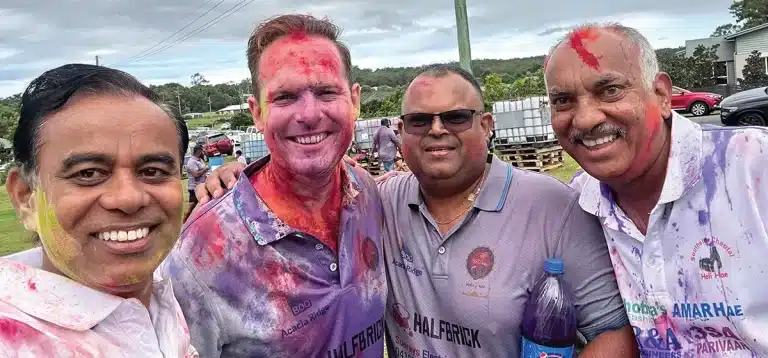
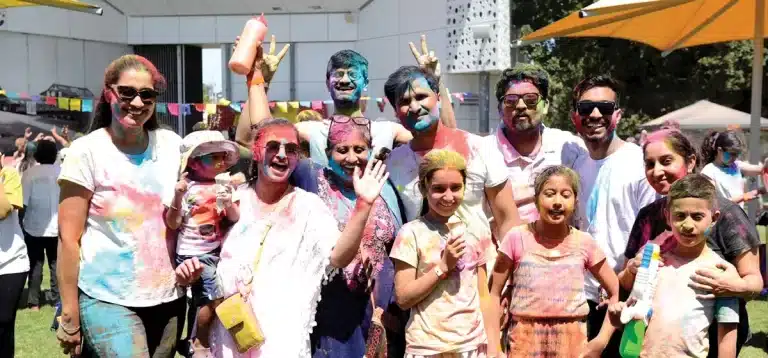
The ICGC Indian community of Gold Coast celebrated their 5th annual Gold Coast Colour Festival Holi on March 2 at Broadwater Parklands. More than 3 thousand people attended and nonstop performances from around various multicultural community groups. The vivid colours and festive atmosphere brought Indians and wider community together, creating a memorable community event with traditions & Joy. Holi symbolizes a fresh start to new season & encouraging people to welcome spring with enthusiasm.
There was foam pit, 45 metres inflatable obstacle course, food trucks and many other free activities.
Thank you, all Dignitaries, who joined in the celebration
E.g.: Sam O Connor MP
Angie bell MP
Mark Buthon MP
Cr. Hermann Vorster
Gold Coast Police representative
And many other community leaders.
Big Thanks to the sponsors and supporting partners include TMC Organisation, Dosa Hut Gold Coast, Big Belly and others.
Many thanks to Volunteer and ICGC executive committee.
Patron: Pushpinder Oberoi
President: Manish Saini
Vice president and Treasurer: Venkat Rao
Secretary: Senthil
PRO: Ree Ali
Councillor: Dinesh Balsara
Joint Secretary: Seema Sharma
Joint Treasurer: Sadhana
Community development: Naren Chavda
Student ambassador: Devika, Dhruv and Mohit
Volunteers: Rahul and Bheem.
Best travel destinations, journeys and experiences in 2024
By Rama Gaind
Book review: Lonely Planet’s Best in Travel 2024 Published by Lonely Planet, $27.99
Lonely Planet’s Best in Travel 2024 returns to its best-selling print format as well as online and across social channels.
When an English-born Australian publishing entrepreneur, businessman and travel writer, Tony Wheeler co-founded the Lonely Planet guidebook company with his wife, Maureen, in 1973, they had a shared vision to fulfil travel dreams.
They also comprehended “… unique experiences, people and perspectives awaited around every corner.”
Five decades later, Lonely Planet’s Best in Travel 2024 builds on this legacy of inspiring future journeys, near and far, with 50 destinations, journeys and encounters. Let this beautifully illustrated edition set the holiday agenda for the year to come!
It is Lonely Planet’s 19th publication of the annual collection, featuring highlights of must-visit destinations around the world, including the top 10 countries.
South Australia’s Kangaroo Island sits in the number two regional position as it proudly showcases its distinct local produce, abundant wildlife, natural experiences and some of the nation’s most pristine beaches. After a resilient recovery from the devastating 2020 bushfires, this much-lauded island has re-emerged as a premier ecotourism hotspot in Australia.
According to Lonely Planet’s senior director of trade sales and marketing Chris Zeiher, Kangaroo Island provides a quintessential Australian travel experience.
“It’s blessed with amazing beaches, offers delicious food, wine, and spirits experiences, and delivers on the drama when it comes to outdoor adventures.”
“It’s been much lauded of late, but 2024 is the year that Kangaroo Island will be set to capitalise on all of the accolades. Best illustrated by the reopening of the prestigious Southern Ocean Lodge and the launch of a stunning new visitors’ centre at the entrance of Flinders Chase National Park. Get there before the rest of the world works it out — 2024 is the year to pop KI on your travel list.”
While all the selections place emphasis on experiences celebrating community and diversity, there’s also a specific catalogue of top sustainable travel and best-value destinations to show how you can journey well in a world of rising costs.
Travel experts have ranked these lists for topicality, uniqueness and a ‘wow’ factor. Leading the 2024 class are the untamed open lands of Mongolia, bike-touring on the Trans Dinarica Cycling Route across the western Balkans and diving into one of Africa’s most dynamic cities. Finishing the headline acts are Nairobi in Kenya, a maintainable travel guide to Spain and a budget-friendly adventure in the USA’s Midwest. More suggestions follow from Donegal in Ireland’s windswept northwest to the spectacular deserts of Algeria. Then there’s Kangaroo Island’s raw native nature and jungle-framed beaches on St Lucia.
These picks seek to both inspire and follow the instincts of the post-pandemic traveller, with a nod to countries indelibly associated with the Lonely Planet story; revisiting India, Thailand and Kenya. Also included are choices like Nicaragua, Benin and Uzbekistan that have rarely, if ever, been in the series.
Lonely Planet’s Best in Travel 2024 also delivers a new take on popular destinations such as Japan, Tuscany, Italy and Mexico, and unearths some lesser-known gems like Uzbekistan, Ikaria, Greece and Izmir, Turkey.
‘Slow Travel’ is celebrated by highlighting the Camino Portuguese hiking trail and the continued rise of night trains in Europe. Featured in the Top 10 Best Value category, the Southern Lakes and Central Otago regions of New Zealand (including the towns of Queenstown and Wanaka) beckons travellers to embrace a leisurely pace, reduce their environmental impact, enjoy new cycling routes, rich local culture and wonderful cuisine and wines.
Appreciate the fresh takes, with specifics, on popular themes. Enjoy hiking and rediscovering old favourites. Then consider the Portuguese Camino de Santiago, and the trail system throughout Wales. Thrilling renaissance of night trains in Europe remains a fine way to combine sleeping with an unforgettable passage that’s very much on-trend among the climate-conscious.
Lonely Planet’s Best in Travel 2024 reflects on how travel is a privilege not enjoyed by everyone in the world in the same way. According to Tom Hall, for the lucky ones 2024 is a year of huge, thrilling possibility.
The final word before hitting the road is: “… All you’ve got to do is decide to go and the hardest part is over. So go.”
Compassion, culture and citizenship: A different international experience
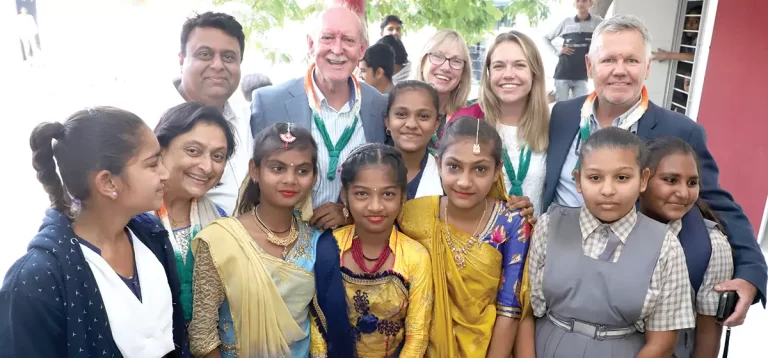
LifeGA trip participants with school childrenLife Global Australia
Some international trips are for romance, for relaxation or for adventure. Others are for business, for family or for nostalgia. One international trip to India is for compassion, for culture and, most importantly for its travelers, for global citizenship.
Life Global Australia launched its first philanthropic trip to India in 2023. The itinerary included visiting the beneficiaries of the charity’s three programmes, in education, health and women’s independence, but also involved learning more about the culture and history of the state of Gujarat. The effect on the volunteer board members and donors who participated was so strong the trip was reprised in 2024.
Donors Lee and Mary Thompson
“It was an emotionally profound experience,” said LifeGA’s Director Rachel Thompson. “The trip was filled with unforgettable moments.”
Chair of the LifeGA Advisory Board, Geoff Anson, went in 2023 to see with his own eyes the people and their needs.
“I went back in 2024 because we successfully raised funds and I wanted to meet the people we were actually helping.”
The donors and volunteer directors who have participated in LifeGA’s tours in Gujarat have all wanted to understand more about the effect their contributions are having. The 2023 trip began with a visit to Mulchand Village school and a labourers’ school near Rajkot. Dr McGowan’s father donated the money to build the Mulchand Village school in memory of his wife. The schools were important destinations as one of the first realisations Founding Director Dr Dipti McGowan had was that education is the key to independence. If students can stay at school, both students and the community can develop.
Geoff & Rajkot students
“My mother was born in a remote rural village and lived a very simple life with her family. She was a girl in a remote area of the world where gender equity was, and continues to be, unheard of. She had to stop her education at primary level to help in the home. My mother ensured my education was uninterrupted. This has empowered me to lead a successful, confident and independent life.”
For donors Mary and Lee Thompson, the visit to Mulchand Village school was a highlight. 2023 was the fifth anniversary of its opening, and the first year of graduation.
LifeGA Welcome ceremony
“The whole village came out to welcome us with music and dancing and great joy. The smiles on the children’s faces were unforgettable.”
In both 2023 and 2024, the Life Blood Centre in Rajkot provided another opportunity to see the outcome of LifeGA’s funding. The centre, established in 1981 by LifeGA’s partner charity, Project Life, is internationally recognised for its world class equipment and commitment to providing scientifically validated processes. By 2024, LifeGA donors had enabled 100 units of blood to go free of cost to needy recipients, and funded 500 screening tests for Thalassemia, a crippling hereditary blood disorder. Dr McGowan found meeting the Thalassemia patients very moving, while Geoff Anson was impressed by their resilience.
LifeGA directors Dr Dipti McGowan and Rachel Thompson
“Their struggle, their humility, their thankfulness, were all impactful.”
The impact of meeting those for whom the charity was founded clearly resonated with all trip participants. For Rachel Thompson, the visit to remote schools showcased the dedication of teachers and the eagerness of children to learn, despite challenges, while hearing the beneficiaries’ stories of resilience and hope, despite facing significant challenges, was the most important part of the trip.
“They reminded me of why we do what we do here at LifeGA. It reinforced the importance of our collective efforts and the real change that can be achieved through compassion and support.”
Dr McGowan was struck by the courage of trainees in the Women’s Empowerment Programme. Participants in this programme are usually from impoverished remote areas, or are widows struggling to support their families. They receive vocational training as well as studying budgeting, banking, finance, gender equality and self-defense.
“Many of the women were travelling further than they had ever gone before and into a city which they had never seen before,” Dr McGowan said. “That would have taken great courage.”
“These women’s lives were transformed by having the opportunity to learn a skill that could support them and their families,” Mary Thompson said. “They were so happy and grateful, but also overcome with emotion as they told their stories. It was very humbling for us and so incredible to see how such a small thing on our part could make such a huge difference to their lives.”
One of Dr McGowan’s aims for the annual trip is a very pragmatic one. As LifeGA’s Director and Chairperson, she is committed to ensuring every donation to the charity is used as intended. Dr McGowan meets with the executive of in-country partner, Project Life, viewing their records and meeting the beneficiaries.
“LifeGA’s aim is to make meaningful change by donating money where the money is not eaten up by administration fees,” Dr McGowan said. Donations to LifeGA in Australia are passed on with no administration costs to the partner charity, which in turn has been vetted to have lower than 5% administration costs. “Each trip we also see where the need is for future donations.”
LifeGA’s trips, however, are more ambitious than simple tours of programmes and sites. The aim is to provide an enriching, holistic experience in which the culture of the region shines. Warm welcomes, local festivals and traditional foods are all integral.
“The food was amazing! The people were delightful! The sights were magical!” Dr McGowan said.
“It was wonderful to travel with people who could speak the language,” Lee Thompson said. “There was a real connection with the people there. We were able to weave in some sightseeing and learn more about the history of the province and of India.”
In 2023 and 2024, the diverse itineraries included the Hindu pilgrimage sites of Somnath temple and the ancient city of Dwarka, Mahatma Gandhi’s birthplace of Porbandar, a Gandhi ashram, the wildlife sanctuary of Gir National Park, Rann Utsav the internationally renowned tent city in the White Desert, and the vibrant city of Ahmedabad, home to the world’s largest cricket stadium. It is no wonder Geoff Anson found his journeys exciting and memorable.
“The energy of Indian cities is just incredible. The order within chaos is only seen in a few places on earth.”
Each of the participants in LifeGA’s tours is acutely aware of their global citizenship. Underpinning their trips to India is dedication to making a lasting impact. Donors and volunteers alike are driven by the conviction that positive change is not just possible, but essential.
“I was particularly motivated by the needs of remote India as it is far away and often forgotten. In remote areas like that, if funds do not arrive, people die. It’s as simple as that,” Geoff Anson said. “I like giving back to important causes where the need is great.”
Rachel Thompson believes in the power of meaningful impact. “Contributing resources and time is a way for me to make a lasting difference.”
For many, a journey from Australia to India would be a once-only experience. But for those profoundly affected by the stories of beneficiaries – the change from poverty to independence, from despair to hope – the chance to return again and again is alluring.
“I am already looking forward to our next trip to India, knowing that each journey brings new perspectives, experiences, and opportunities to make a positive impact,” Rachel Thompson said.
“The journey makes what we do real,” Dr McGowan said. “It has inspired and motivated me to keep donating my money, time and effort to LifeGA’s vision and mission.” (www.lifeglobal.org.au)
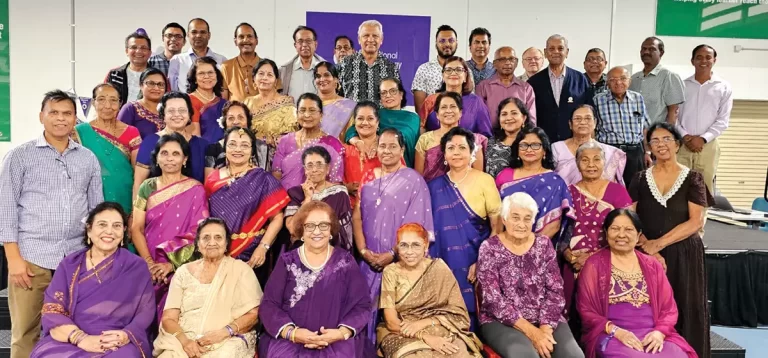
The International Women’s Week finale was celebrated on 24th March at Runcorn State School with great enthusiasm by the Indian Senior Citizens Association. Ekta Women’s Group ladies came together with tremendous enthusiasm. The theme for this year was,
‘Count Her In; Invest in Women, Accelerate Progress’.
True to the theme, the ladies put on a fantastic show of togetherness, unity, and passion, Showcasing some amazing talents with inspirational talks, poems, folk song and dance. Chief guest Councillor Kim Marx stood amongst the vibrant purple saris, enjoying every moment of it. The event ended with Holi songs and dance followed by a lovely lunch.
Sant Nirankari Mission Australia Leads Campaign to Keep Australian Beaches Clean
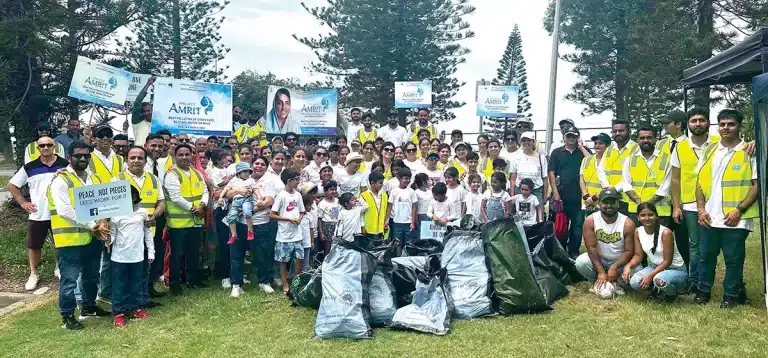
On 3rd March 2024, The Sant Nirankari Mission Australia (SNMA) proudly joined the Clean Up Australia campaign to advocate for the preservation and cleanliness of water bodies by organising beach clean-up events across Australia.
On this day, close to 1000 volunteers from the SNMA simultaneously gathered at the beaches across seven different cities to help contribute to keeping our beautiful country clean: 1. Adelaide – Semaphore Beach
2. Brisbane – Redcliffe Beach
3. Canberra – Lake Burley
4. Melbourne – Aspendale Beach
5. Perth – Hillarys Beach
6. Sydney – Manly Beach
7. Tasmania – Bluff Beach
The Sant Nirankari Mission is a Global spiritual and social welfare movement advocating the importance of unity amongst all humankind. The catalyst for SNMA’s participation in this beautiful event is the teachings of Satguru Mata Sudiksha Ji Maharaj, the Spiritual Head of the Sant Nirankari Mission. Satguru Mata Sudiksha Ji has often said in her discourses, ‘ While maintaining the cleanliness of surroundings, it is equally essential to maintain the cleanliness of the Mind.’
A Global Initiative
This initiative by SNM Australia is part of a Global initiative by the Sant Nirankari Mission known as Project Amrit, which is an inspiring move towards global environmental stewardship. The term ‘Amrit’, a Hindi term, symbolizes that water is an elixir for living beings.
Inspired by the slogan ‘Swachh Jal, Swachh Man’ (Clean Water, Clean Mind), Project Amrit’s initial launch saw more than 1.1 million volunteers participate in waterway cleaning programs across 1500 locations in India. Similar waterway conservation campaigns have also been organised in 70 countries all over the globe.
The activities under Project Amrit are complemented by the Sant Nirankari Mission’s ongoing commitment to social welfare, including blood donation drives, tree planting, and environmental awareness programs. Each of these welfare programs encourages volunteers to manifest the ‘Think Global, Act Local’ principle.
Her Holiness to Undertake a Spiritual Tour Across Australia and New Zealand
This drive for social service stems from the guidance of Her Holiness Satguru Mata Sudiksha Ji Maharaj. Mata Sudiksha Ji has devoted her life to encouraging all humans to lead a life full of spirituality, love, and service to humanity.
Her Holiness Satguru Mata Sudiksha Ji Maharaj, along with her spouse, Nirankari Rajpita Ramit Ji, will embark on a Spiritual Tour across Australia and New Zealand throughout April 2024. During her tour, Her Holiness will visit seven cities and share the message of ‘Know One, Be One’.
Details of Her Holiness tour can be found at https://www.nirankari.org/news/salvationtour_202404aunz/.
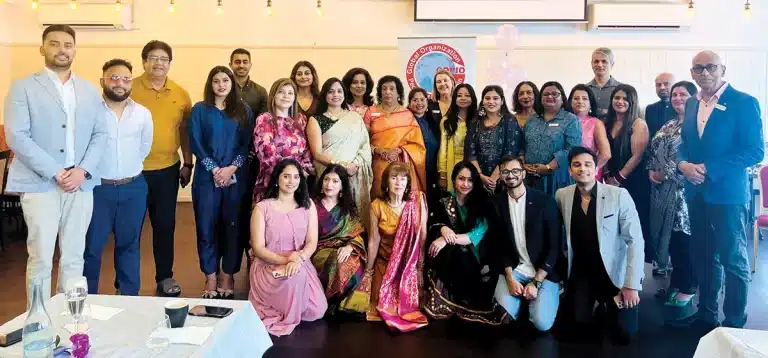
GOPIO Queensland Inc hosted a remarkable Women’s Day event on March 17th, 2024, at Indian Brothers, Annerley, bringing together individuals from diverse backgrounds to celebrate the strength, resilience, and beauty of women worldwide. Prominent businesswomen, community leaders, and advocates of women’s empowerment graced the event as speakers, sharing their experiences and strategies for success. Among the esteemed speakers were Lisa Ward, CEO of ECCQ (Ethnic Communities Council of Queensland), Pravinita Singh Pillay, Principal Lawyer of Cornerstone Law Offices, and Suman Dua, Founder of Nationwide Migration and Visa Services.
The event also featured a special Q&A session by Umesh Chandra OAM, Executive Vice President of GOPIO International and Founder President of GOPIO Queensland, providing valuable insights into women’s empowerment. Attendees enjoyed a delightful 3-course lunch accompanied by Champagne, adding a touch of elegance to the celebration. The MC for the function was Mrs. Usha Chandra, Vice President of GOPIO, who ensured the smooth flow of the event.
“We are immensely grateful to our dedicated committee members for their hard work and commitment. Their contributions have been invaluable in making this event a success.”
The event was organized in less than two weeks by the new committee, demonstrating their efficiency and dedication to the cause. The committee members who played vital roles in organizing the event include: • President: Arpit Singh • 1st Vice President: Usha Chandra • 2nd Vice President: Nileshni Balgovind • Joint Secretary: Irene Bayldon • Treasurer: Rohani Prasad • Asst. Treasurer: Rishi Bhardwaj • Public Relations Officer: Sidharth Malhotra • Business Council Chair: Yousuf Ali Khan • Youth Council Chair: Kanish Chhabra
The event not only celebrated women’s achievements but also served a philanthropic purpose. Raffle prizes were sold to raise funds for GOPIO Queensland’s initiatives supporting women in need. Attendees enjoyed a memorable time together, highlighted by an amazing dance and singing performance to honor the achievements of women.
“This inaugural Women’s Day event was a testament to the incredible achievements of women in our community,” continued the organizer. “It also marked the first event for GOPIO Queensland under our new executive committee, dedicated to promoting empowerment and collaboration.”
GOPIO Queensland extends its heartfelt gratitude to all attendees for their support and invites everyone to join future events aimed at fostering inclusivity and equity.
Joan Clark of Clontarf, Queensland celebrated her 100th birthday on Saturday, the 23rd of March at her Son Robert (Bob) and Daughter in law Anila’s house where she lives. She celebrated the milestone with her Grand Children, Great Grand Children and other Family Members.
Joan was born on the 23rd of Marc, 1924. Her parents, Samuel Hardy and Alice Hardy lived in Highgate Hill, Brisbane then. She was the 3rd child from the family of 6. She is the only one still alive.
Joan married Eric Clark in 1950 and lived in Royal Terrace. They had 3 children who are Robert, Lynda and Desliegh, the youngest whom they lost at the age of 53. She lost her Husband in April 2014. Joan has 10 grandchildren and 15 great grandchildren.
Joan loves to watch all sports, especially her Broncos team playing on the Television and listening to the wireless. She also has a great sense of humour.
Congratulations from the Brisbane Indian Times community!
Mr GANGA PRASAD Veteran Masters Athlete of Redbank, Queensland still winning medals at competitions. Recently he competed in 2024 Queensland State Masters Annual Athletics Championships in March 2024 and won 10 Medals – 4 Golds, 2 Silvers and 4 Bronze medals. His events were Shot Put, Discus, Javelin, Weight Throw, Hammer Throw, Long Jump, Triple Jump, High Jump, Weight Pentathlon and Open Pentathlon. All his winnings made Ganga the highest medals winner in the Championships.
CONGRATULATIONS to Ganga from Brisbane Indian Times.
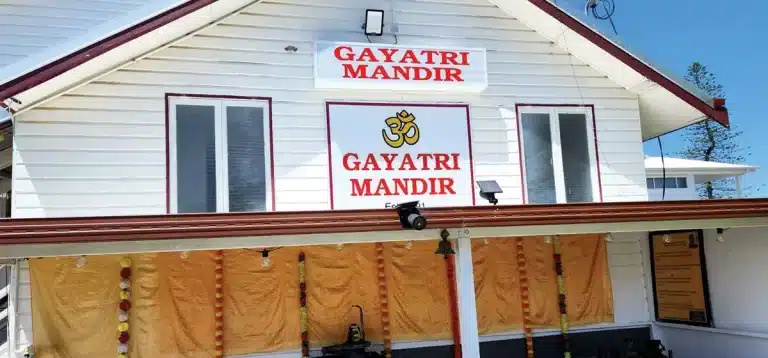
Community Contributed for New Illuminated Sign – Gayatri Mandir, Boondall
Prem Chand approached few businessmen and obtained funds to manufacture the “Gayatri Mandir” illuminated sign and install on the Site.
The kind donors of this project were: • Dr Dip Chand; • Retired Suresh Motibhai; • Bhaskara Nand (Bobby Builder); • Businessman Suresh Sharma; • Retired Yashwant Lal; • Retired Prem Chand; • Businessman Anand Kumar; • Valhalla Accounting Salesh; • Businessman Ashok Kumar; and • Businessman Sunny Sachin Charan.
The sign will be a Dusk to Dawn /daylight timer switch that will:
Turn ON – When Night gets dark; and
Turn OFF- When Morning daylight arrives.
Power was installed free of charge by a true devoted Hindu, Mr Niraj Kumar of Strathpine.
Prem Chand has contributed a lot to the Brisbane Indian Times since its inception and served as Secretary for 7 years, Vice President for 4 years and President for 2 years Hindu Society of Queensland Inc.
Prem Chand was the first Voluntary Community Service Winner award given by Brisbane Indian Times for his recognition to the Community at large.
A humble man’s journey from the construction site to the Mayoral Chambers of a major Australia City
Mayor Jon Raven
Inaugural speech by Mayor Jon Raven at the swearing in ceremony
Mayor Jon Raven, along with 12 Councillors of the City of Logan, took their Declaration of Office in a ceremony held at the Logan Entertainment Centre on Friday, April 5th, 2024, amidst the presence of family and friends. Representing the longstanding friendship with the Deo family, Shanjeshni Deo, Managing Editor of the Brisbane Indian Times, was graciously invited to the event.
In his inaugural address as Mayor, Jon Raven expressed his fervent commitment to changing the city’s reputation over the next four years, aiming to attract investments, create jobs, and foster opportunities for the residents of Logan. Logan City stands out as one of the youngest, most diverse, and rapidly expanding cities in both the state and the nation. Notably, JD Media, the parent company of the Brisbane Indian Times, recently relocated its headquarters to Logan City.
Mayor Jon Raven with Jitendra and Shanjeshni Deo during holi celebrations
For several years, Mayor Raven has actively participated as a chief guest or speaker at community events hosted by the Deo Family Foundation, renowned for its benevolent and philanthropic endeavours. He is recognized for his familiarity with the diverse generations of the Australian Indian Diaspora, whether originating from India or other nations worldwide, who now call Logan City their home or are closely associated with its citizens.
Mayor Raven’s roots in Logan City run deep, with over twelve years of residency, currently residing in Waterford West. Previously, he and his family owned and operated a business in the Civil Engineering sector, a venture he decided to sell in 2017 to fully devote his energies to serving as a Councillor.
Mayor Jon Raven with Shanjeshni Deo and Ravneel Deo
His dedication and hard work as a Logan City Councillor were quickly acknowledged, with unprecedented achievements such as serving as Chairperson and Deputy Chairperson of crucial Municipal Committees during his first term. Those early years as Councillor of Division 5 has provided invaluable learning experiences in various aspects of municipal governance, including corporate and finance planning, public interest infrastructure, community services, environmental sustainability, and economic development.
It came as no surprise when Mayor Raven was elevated to Deputy Mayor in the last two years before unanimously being elected as Mayor by the citizens of Logan City for the next four years. Mayor Raven is known for his inclusive approach, actively engaging in cultural celebrations and solemn observances within the Queensland Indian Diaspora community, often donning Indian attire with majesty and grace.
Despite his affiliation with a major political party, Mayor Raven has never claimed endorsement or financial support from it. He firmly believes in the independence of the Logan City Council, free from direct political influence.
As a Logan City-based business, the Brisbane Indian Times, with its directors being close friends of Mayor Raven, extends its warm wishes for his success. Mayor Raven’s commitment to faithfully serving all citizens of Logan City is deeply appreciated, as he passionately asserts himself as the Mayor and friend of every resident of this great city.














 Joan Clark of Clontarf, Queensland celebrated her 100th birthday on Saturday, the 23rd of March at her Son Robert (Bob) and Daughter in law Anila’s house where she lives. She celebrated the milestone with her Grand Children, Great Grand Children and other Family Members.
 Mr GANGA PRASAD Veteran Masters Athlete of Redbank, Queensland still winning medals at competitions. Recently he competed in 2024 Queensland State Masters Annual Athletics Championships in March 2024 and won 10 Medals – 4 Golds, 2 Silvers and 4 Bronze medals. His events were Shot Put, Discus, Javelin, Weight Throw, Hammer Throw, Long Jump, Triple Jump, High Jump, Weight Pentathlon and Open Pentathlon. All his winnings made Ganga the highest medals winner in the Championships.