

The “Big Khela” Shifts East: PM Modi Sets the Tone for Bengal’s Electoral Battleground
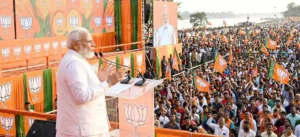 As the heat intensifies across the Indian subcontinent, both meteorologically and politically, Prime Minister Narendra Modi has brought a high-decibel campaign to the heart of West Bengal. Addressing massive rallies in the districts of Burdwan and Murshidabad this week, the Prime Minister launched a blistering critique of the ruling Trinamool Congress (TMC), signalling a strategic shift in the BJP’s quest to capture the eastern stronghold.
From “Khela Hobe” to “Big Khela”
For years, the TMC’s slogan “Khela Hobe” (The game is on) has served as a defiant battle cry for Chief Minister Mamata Banerjee. However, speaking to a sea of saffron-clad supporters, PM Modi sought to reclaim the narrative. Dismissing the slogan as a symbol of “misrule and intimidation,” the Prime Minister promised the electorate a different kind of “khela”—a “Big Khela” (Major Change) cantered on development and the dismantling of alleged corruption syndicates.
“The time for the old game of fear is over,” Modi declared. “The people of Bengal are now ready for the ‘Big Khela’ of progress, where the youth get jobs, the poor get houses, and the culture of Bengal is restored to its rightful glory.”
The choice of Murshidabad and Burdwan as rally sites is no coincidence. These districts represent critical demographics where the BJP is looking to make significant inroads, particularly by highlighting issues of governance and central scheme implementation that the party claims have been blocked by the state government.
The UCC and the National Narrative
A cornerstone of the Prime Minister’s address was the reiteration of the BJP’s commitment to the Uniform Civil Code (UCC). While the UCC is a national policy plank, its mention in West Bengal—a state with a complex and diverse demographic fabric—is a clear indication that the BJP intends to make legal uniformity a central pillar of its ideological pitch.
Modi argued that the UCC is not about targeting any specific community but about ensuring “one nation, one law” for the empowerment of all citizens, particularly women. By bringing the UCC to the forefront in Bengal, the Prime Minister is challenging the TMC on its own turf, forcing a debate on secularism versus “appeasement politics,” a recurring theme in the BJP’s regional strategy.
Guarding Against the “Digital Front”
In a nod to the evolving nature of modern warfare and elections, the Prime Minister issued a stern warning regarding the rise of AI-generated disinformation. With deepfakes and manipulated media becoming increasingly prevalent in global elections, Modi urged voters in Bengal to be “vigilant digital citizens.”
“Technology is a tool for progress, but some are using it to spread lies and create social fractures,” he warned. He specifically highlighted the risk of “AI-generated voices and videos” designed to mislead voters in the final days before polling. This technological caution resonates deeply with the Indian diaspora in Australia, who often see the ripple effects of such disinformation across social media platforms like WhatsApp and Facebook.
Implications for the Diaspora
For the Indian Australian community, particularly the vibrant Bengali diaspora in cities like Brisbane and Sydney, the developments in West Bengal are more than just distant headlines. Many maintain deep family and business ties to the region and view the state’s stability as paramount.
The Prime Minister’s focus on the “Big Khela” of development mirrors the aspirations of many NRIs who wish to see West Bengal emerge as an industrial powerhouse akin to India’s western and southern states. Furthermore, the discussion around the UCC and digital integrity reflects broader global trends in governance that are frequently debated within the community forums across Australia.
A State at a Crossroads
As West Bengal moves closer to the polls, the Prime Minister’s visit has undeniably energized the BJP cadre. By blending local grievances with national legislative goals like the UCC and modern concerns like AI ethics, the Prime Minister is attempting to bridge the gap between regional identity and national aspiration.
The “Big Khela” has indeed begun. Whether this promised “change” resonates enough to upend the entrenched political machinery of the TMC remains the most watched story in Indian politics today. For the readers of the Australian Indian Times, the outcome will define not just the future of West Bengal, but the momentum of the national political landscape heading into the latter half of 2026.
